David Lean

  • The Passionate Friends (1949)

    The Passionate Friends (1949)

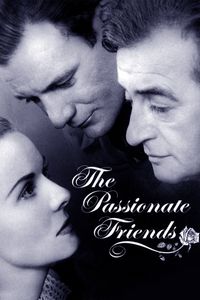
    (On Cable TV, March 2021) It sometimes boggles my mind that David Lean, the acknowledged master of the British epic film who eventually became synonymous with expansive, widescreen adventures largely shot on location and tackling ambitious topics (Lawrence of Arabia, The Bridge on the River Kwai, Doctor Zhivago, etc.), had his start on much smaller, far more intimate romances — Including a simple tale of an affair in 1945’s Brief Encounter, and a love-triangle special with The Passionate Friends. The story of a woman who rekindles an old affair through happenstance despite being married to a banker (admittedly a dull one), it’s the kind of stiff-upper-lip British romance that helps perpetuate all sorts of national stereotypes. It’s almost insufferably dull whenever the adulterous lovers are involved in their insufferable should-we-or-shouldn’t-we, but our interest rises sharply whenever her banker husband becomes involved — and decides that he won’t tolerate any hanky-panky. Still, The Passionate Friends is about as far away from epic filmmaking as you can be, with most of the action taking place in quiet rooms and smouldering restraint. It’s not bad, but it does feel longer than its 95 minutes. The last act somewhat redeems the considerable investment you have to make at the onset, but it feels a bit too much like a chore for little payoff.
  • Blithe Spirit (1945)

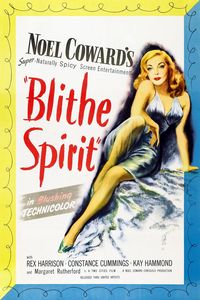
    Blithe Spirit (1945)

    (On Cable TV, February 2021) Surprisingly enough, the 1940s offer a substantial list of supernatural romantic comedies. Beyond the obvious picks of the Topper series, The Ghost and Mrs. Muir and I Married a Witch, here’s Blithe Spirit to show what happens when a séance brings back a man’s first wife from the dead and he has to explain her presence to his second wife. The pedigree of the film is impeccable: Directed by David Lean before he became an epic filmmaker, scripted from a play by producer Noël Coward and featuring a young Rex Harrison in the lead role, the film also showcases British filmmaking at the close of WW2 with decent colour cinematography and Academy Award-winning special effects. You can see the basic elements of an American 1930s screwball comedy filtered through wartime British sensibilities, and the combination does have its pleasant quirks. Good biting dialogue compensates for the somewhat ordinary direction, although one suspects that the requirements of the special effects may have had an impact on limiting camera movements when a ghost shows up on-screen. The film does suffer from a bit of a slow start, as it puts together its fantastical elements for an audience less used to supernatural devices, but the film becomes sharply more interesting once the undead make their appearance, and it builds to an impressively dark (but remarkably funny) ending. Those who like a specific, somewhat stereotypical strain of British comedy will appreciate the result even more — in its closing moments, Blithe Spirit anticipates the arrival of the Ealing Studios films such as The Ladykillers and Kind Hearts and Coronets in mixing dark topics and humour. It’s a fun watch even today, which is what happens when still-credible special effects are bolstered by great dialogue.

  • Oliver Twist (1948)

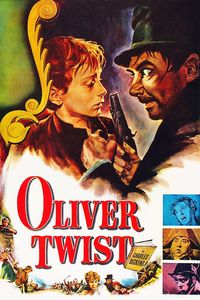
    Oliver Twist (1948)

    (On Cable TV, August 2020) There’s something to the faithfulness of David Lean’s adaptation of Oliver Twist that simply makes it feel generic to me. I’m using “generic” in a somewhat unusual sense here – I have seen so many Classic Hollywood adaptations of classic English Literature novels by now that I almost know what to expect before the film even starts playing, and that was Oliver Twist from beginning to end. There are the historical sets, the black-and-white cinematography, the well-mannered theatrical acting from the actors and the loose adaptations in order to make it more of a movie than a book. The only thing that stands out from this Oliver Twist is Alec Guinness’s hideous anti-Semitic makeup as Fagin, a design decision from Lean that has been criticized even since the pre-production of the film and is likely to be criticized forever. Otherwise (and I’ll admit that it’s a big “otherwise”), the film itself feels like an EngLit class brought to motion. Great if you’re illustrating the classics, not so great if, like me, you’ve overdosed on them.

  • In Which We Serve (1942)

    In Which We Serve (1942)

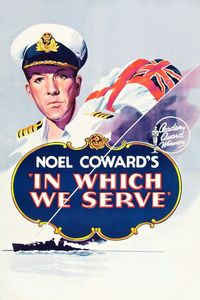
    (On Cable TV, May 2020) If ever you’re tired of American WW2 propaganda movies, why not try a British WW2 propaganda movie? In Which We Serve has the distinction of being largely shaped by well-known playwright Noel Coward, his fingerprints being present on the entire film considering that he served as writer, co-director (handing the baton to David Lean in his first feature film credit as such), producer, star (as the captain of the ship it follows), and co-composer. Whew. The plot here is didactic in its intention to follow the life of a ship from the initial riveting to a gripping battle sequence that eventually leads to the sinking of the ship. The episodic plot alternates between life aboard the ship and home life for the characters. Thanks to playwright Coward being in control, the dialogue is much better than usual for a war film. While clearly propagandist in the British still-upper-lip style, In Which We Serve is generally interesting and has a great shipboard atmosphere. (Your assignment: compare and contrast with American WW2 propaganda films.)

  • Oliver Twist (1948)

    Oliver Twist (1948)

    (On Cable TV, March 2019) I have now seen three adaptations of Charles Dickens’ classic Oliver Twist in a single year, and that is about two more than strictly necessary. That being said, this 1948 take from director David Lean is about as close to a canonical one as it gets. It’s exceptionally well directed, lavishly produced with very good black-and-white cinematography with deep use of shadows to give an extra-gloomy atmosphere. As usual for the story, this is a tale of misery piled upon misery, with the very detailed set giving a still-credible portrayal of life in gloomy low-class London. Characters die a lot, sometimes not very gracefully. The one aspect in the work I’m really not fond of, however, is the hideously racist Jewish stereotyping that Alec Guinness gives to his interpretation of Fagin—a monumentally wrong note in an otherwise strong literary adaptation. Do not, under any circumstance, prefer the atrocious Oliver! musical adaptation to this version. Sometimes, literary classics deserve the classic filmmaking adaptation treatment.

  • A Passage to India (1984)

    A Passage to India (1984)

    (On Cable TV, February 2019) I’m on a quest to see all the movies nominated for the Academy Award for Best Picture, and unfortunately this means that I have to make my way through movies such as A Passage to India. Considering that’s it’s a long movie (2h44m!) that feels even longer due to its slow narrative pacing, you may want to book a holiday before you embark on seeing the movie. It’s long. It’s so unbelievably long. It’s David Lean-class long, which makes sense considering that he wrote, produced and directed it. The production design is sumptuous, evoking the atmosphere of 1920 India … but it’s long. If you do manage to dig into the material (or if this is your kind of thing), there’s a lot to like in the film’s depiction of British Raj India, racism and class distinction against a visually refined backdrop. But the marathon-like pacing of a rather simple story makes it a sometimes-punishing viewing. Lean’s approach here is interesting in that he draws back from the wide-scale vistas of his previous epic films to deliver a well-visualized smaller story … but he could have gone further in being more efficient, bringing the length of the film to one more appropriate for the story being told. This being said, A Passage to India is the kind of atmospheric film where I suspect that many factors (including mood and personal preference) will influence an overall assessment.

  • Brief Encounter (1945)

    Brief Encounter (1945)

    (On Cable TV, June 2018) Watching classic movies from a list of pre-approved classics is usually one happy discovery after another—after all, those are the movies that have lasted throughout the ages, so they come with a presumption of quality. After a while, you start to wonder if all movies of the time were just as good, or if you’re getting a skewed idea of the period through its best representatives. But then you’re brought back to earth by a film such as Brief Encounter, which feels dull, overlong, anticlimactic and even useless. But our perspective is not that of the time, of course: Back in 1945, Brief Encounter and its tale of unconsummated adulterous passion was seen as a return to normalcy after the wartime years, as a refreshing example of realism, as a courageous take on many British presumptions. It’s subtle, unfulfilling and stoic—and it betrays a ton accumulated and assumed social restrictions. That does not make for exhilarating cinema. But it did bring director David Lean to the forefront of his contemporaries, and earned Brief Encounter an overwhelming number of favourable notices. Don’t ask me what I think, though: I barely stayed awake throughout the film, and would not jump at the chance of seeing it again.

  • Doctor Zhivago (1965)

    Doctor Zhivago (1965)

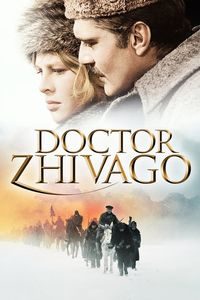
    (On Cable TV, June 2018) I have little patience for anything these days, so getting me to sit down for three-and-a-half-hours to watch a Russian novel turned into an epic movie, even a David Lean movie, is asking too much. It took me four days to get through Doctor Zhivago, and I kept going only because the film is of some historical interest. Even then, the journey was gruelling. It’s not that the film is 193 minutes long—it’s that even for that amount of time, not a lot actually happens. It is a generational romance set against the backdrop of early-twentieth-century Russia, and yet it feels uncomfortably small, with a handful of characters bouncing against each other even in a country as large as Russia. To be fair, Omar Sharif is fantastic as the titular Zhivago, and Julie Christie isn’t bad as the lead female character. This being said, the show is stolen by smaller roles: Rod Steiger is delightfully evil as a well-connected politician, while Tom Courtenay has a great arc as the initially meek Pasha. Still, much of Doctor Zhivago unfolds slowly, with characters having intimate conversations while the country goes up in flames somewhere in the background. For an epic, it feels curiously small-scale and focused on melodramatic plot threads. Reading about the film, its troubled production and the historical context of the original novel is more interesting than the film itself—as I was wondering how a Russian film could be produced by a big Hollywood studio in the middle of the Cold War, the film doesn’t exactly act as pro-Soviet propaganda … and adapting the novel was seen as a big gesture against the USSR given that it had banned the book. Still, the result is an often-exasperating experience as nothing happens for a very long time. The film’s high points (such as the moments immediately preceding its intermission) aren’t, quite enough to make up for the rest, including an even more punishing framing device that adds even more minutes to an already bloated result. But at last it’s done: I have watched Doctor Zhivago and don’t have to watch it ever again in order to say that I did.

  • Great Expectations (1947)

    Great Expectations (1947)

    (On Cable TV, May 2018) Some films connect and others don’t, and the 1947 version of Great Expectations mostly doesn’t despite a few good qualities. I suspect that I would have been far more impressed by this take if I had both read and loved the original Dickens novel, or had I not seen the 1998 version transplanting the story to contemporary Florida and New York. As it is, this faithful Victorian-era version of Great Expectations is both a retread of a story I knew, with just enough to keep it interesting but not enough to make it anything memorable. The highlight of the movie, aside from David Lean’s competent direction and occasional set pieces, is John Mills’s performance as adult Pip, moving through the years and becoming ever more hardened by the events of his life.   Otherwise, it’s a good movie that has aged into a bit of an average viewing experience. The Victorian details can be intriguing, and there’s no denying the effectiveness of Dickens’ plotting. But there isn’t much here to be enthusiastic about, although I’ll allow for the possibility that another look at Great Expectations, at a different time, may produce a more enthusiastic reaction—after all, my issues here are about impact, not quality of execution.

  • Lawrence of Arabia (1962)

    Lawrence of Arabia (1962)

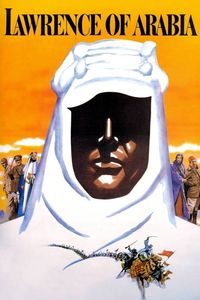
    (Second viewing, On Cable TV, November 2017) I first watched Lawrence of Arabia in university, taking advantage of the selection of classic movies at the library. I recall being impressed at the scope of the movie, its cinematography and the train attack sequence. A re-watch twenty-five years later is amazing for different reasons: while the epic scope and cinematography remain astonishing (although, seriously, did this film need to be more than three hours?), I’m more interested by the complexities of the lead character as played by Peter O’Toole. T.E. Lawrence’s dramatic arc plays out in multiple dimensions, first transforming him from an underestimated drone to a full-fledged desert warrior, then a reluctant leader and then a disillusioned stranger. There are also the personal characteristics of the man: his implied homosexuality, his barely constrained thirst for war, and his masochism (“the trick … is not minding that it hurts”), all of them refreshingly portrayed by O’Toole in a performance that downplays major markers of conventional masculinity. It’s a war film with thrilling sequences, but it’s not particularly kind to the British for their treatment of their Arab allies after World War I. It’s a big, big story handled with skill by director David Lean and the technical qualities of the film are still astonishing fifty-five years later—aside from the typical Technicolor tint, the latest (2012) remaster of Lawrence of Arabia looks just as good on HD today than many contemporary features. Length aside, I still like it a lot … albeit for different reasons than twenty-five years ago.

  • The Bridge on the River Kwai (1957)

    The Bridge on the River Kwai (1957)

    (On VHS, August 2000) There’s a lot to love about this film: The lush backdrops of the south-Asian jungle, the expensive sets, the great actors, the superb premise of wartime defiance by typically British soldiers forced to work for the Japanese. The script is very good for most of the film’s duration, presenting issues of ethics and conduct yet not browbeating anyone with them. All throughout the film, there’s a palpable sympathy with the bridge-building team, which makes things worse when the film decides that war is hell and that there can be no such thing as a fun wartime adventure. That’s when people start dying and the last-minute attempt to instill a Profound Message falls flat. Too bad, because the rest of the film is classic material.

    (Second Viewing, On Cable TV, April 2021) Considering that it’s been twenty years since I first saw The Bridge on the River Kwai and can now put it in context (of Hollywood’s thirst for spectacle at a decade when TV was entering households, in the context of epic director David Lean’s career, in the context of Alec Guinness and William Holden and the shifting context of war movies over the decades), I was curious to see what I would make out of a second view. While I wasn’t completely bowled over by the result, it’s still quite a remarkable film – perhaps the most entertaining of Lean’s epics (I meant: you can admire Lawrence of Arabia, but it’s not quite as much fun as this one), certainly one of Guinness’ landmark roles as a depiction of a British stereotype, a great turn from Holden and a shining illustration of what 1950s filmmaking could do when it was allowed to spend some time and money shooting on location. The portrayal of a British officer under pressure to do something good (like building a bridge) under bad circumstances (such as being a prisoner of war) in service of something distasteful (such as facilitating military transports) is suitably complex. The similarities to Apocalypse Now go much farther than opposing, “Madness!” to “The horror!” – if The Bridge on the River Kwai has aged so well, it’s in large part because it has a grim attitude toward war that would resonate just as well with later generations. As an older viewer, I now understand far better the grim conclusion and how it works in the context of the film as more than a downbeat tragedy or a spectacular sequence. I still think that the film is too long, that it meanders, that it’s unbalanced between its two leads. But it still works well enough, and it’s still worth a look.