David Mamet

  • We’re No Angels (1989)

    We’re No Angels (1989)

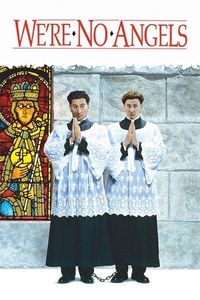
    (On Cable TV, September 2021) On paper, We’re No Angels sounds unusual enough to be interesting. A remake of a 1955 film I’m unfamiliar with, it stars Robert de Niro and Sean Penn as two convicts who, during the 1930s, travel north to Canada but end up in an upstate New York monastery (shot in British Columbia) through a set of unusual circumstances, where they are mistaken for priests and develop a conscience. The big names are on the creative side as well: script from David Mamet, directed by Neil Jordan, with the female lead played by Demi Moore and an unbelievably young John C. Reilly in a minor role. Alas, the result quickly becomes underwhelming. Shot in dull shades of brown to assert that they’re not romanticizing the period, We’re No Angels feels duller, dumber and far less interesting than it should be. It’s not quite a religious film and yet not a religious film either. For a putative comedy, it feels slow, laborious and (fatally) unfunny. It meanders like its characters, vaguely bidding its time until only so many minutes are left before the epiphany that announces the ending. We’re No Angels is too slickly produced to be terrible, but it’s still not all that good.
  • The Verdict (1982)

    The Verdict (1982)

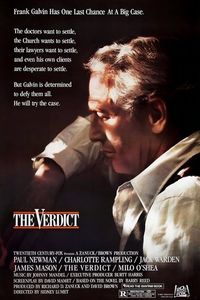
    (Disney Streaming, August 2021) The unsung hero of The Verdict is whoever who took the decision to cast Paul Newman in the lead role — what best way to portray a lawyer past his prime than to cast an aging movie idol? Newman still looks fantastic, of course (compare and contrast with how he looks in the roughly contemporary Absence of Malice), but the deliberate grey hairs, added fat and slower demeanour tell us everything we need to know, even before his character gets thrown out of a funeral in the opening scene. What follows, in keeping with the tone set early on, is an examination of justice with a jaundiced but not entirely cynical eye — as our burnt-out protagonist is handed an easy settlement but decides to push matters to a civil trial, and quickly gets enmeshed in dirty tactics and counter-tactics. If The Verdict remains compelling viewing today, it’s how it skirts the edges of an uplifting film with a gritty look at the less admirable aspects of civil law. Our protagonist isn’t above stealing mail; his opponent will spy on him; and in the film’s defining sequence, a slam-dunk testimony and piece of evidence that would, in another film, be the final blow are here (with some heavy dramatic license) judged inadmissible and struck from the record. But to get back to a crowd-friendly idealistic finale, it turns out that even inadmissible evidence can’t just be erased from memory. While the pacing of the film is a bit slow, especially at first, veteran director Sidney Lumet does keep good control over his material, gradually unfolding the layers of complexity in David Mamet’s narrative. (Unusually for Mamet, this first screenplay is adapted from existing material, and so his distinctive dialogue is not really present.)  Good supporting turns from Charlotte Rampling and the irreplaceable James Mason help round out the acting talent involved. The Verdict, then a box-office success and Oscar favourite from cerebral material and a strong narrative, is almost unusual today — but fret not, it’s still very enjoyable and the circa-1980 period has aged rather well… like its star.

  • Glengarry Glen Ross (1992)

    Glengarry Glen Ross (1992)

    (YouTube Streaming, December 2019) As befits its enduring popularity as a theatre piece for all-male casts, there aren’t that many better choices than Glengarry Glen Ross for pure actors’ showcases. A high-testosterone tale of crime, machismo, hustling and desperation, it’s two hours of shouting, posturing and profanity-laced dialogue. Directed unobtrusively enough by David Foley to create the ideal rain-soaked atmosphere for David Mamet’s dialogue, it leaves centre state to those who matter most: the actors. Even nearly thirty years later, it’s a dream ensemble: Where else can you see Al Pacino, Jack Lemmon, Alec Baldwin, Alan Arkin, Ed Harris, Kevin Spacey and Jonathan Pryce? Alex Baldwin, obviously, has the one-scene choice role here as the hotshot seller haranguing the troops into doing better and setting up the central conflict of the film—nearly everything that people usually quote from the film comes from his high-impact tirade—“ABC: Always Be Closing.”  The trickier fun of the script comes later as the men talk among each other and convince each other that can still do what they do best—convince people to give them money. It’s a reflection on masculinity and how it’s too often conflated with hustling, and no weakness can ever be displayed. Unlike many movies, it can be listened for the sheer joy of its dialogue as well as it can be watched for the physical staging. No matter how you cut it, Glengarry Glen Ross remains a highlight.

  • About Last Night… (1986)

    About Last Night… (1986)

    (In French, On Cable TV, June 2019) I came to About Last Night… the other way around, having seen (and really enjoyed) the 2014 remake before seeing the original. This one is set in 1980s Chicago (nicely using the city’s landmarks), and follows a yuppie couple as they connect, disconnect, and reconnect over the span of a year. Demi Moore and Rob Lowe are quite likable as the lead couple. In fact, this may be my favourite performances from them both—and that’s saying something considering Moore’s extensive career. The better than average dialogue clearly comes from David Mamet’s original theatrical play, and it shines even through the crude French translation doing its best to keep up with its rapid rhythm. It’s easy to see why some consider it to be a semi-classic romantic comedy: the execution is much better than the somewhat stock premise. And yet, and yet: this may be a generational thing or a recency bias, but I can’t quite muster the same affection toward the original About Last Night… than I have for its Los Angeles-set remake. It’s still good enough … but not quite as good.

  • The Edge (1997)

    The Edge (1997)

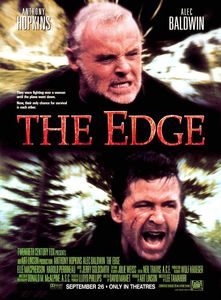
    (Netflix Streaming, December 2015) There’s some logic in seeing David Mamet tackling a wilderness-survival story.  Given Mamet’s career-long obsessions with masculinity and how men deal with each other, it’s ready to see the attraction in pitting a few men against nature in far-away Alaska, especially when two of the men are competing for the same woman.  Still, there’s a bit of a gulf between concept and execution, and if The Edge does well most of the time (especially in presenting a terrifying bear attack), there are a few issues with the result that keep it from being as good as it could be.  While Anthony Hopkins is interesting as a billionaire-bookworm-turning-super-survivalist (including a few choice macho one-liners), the very nature of his character seems a bit too close to wish-fulfillment.  (For that matter, the bear seems a bit too wilfully evil as well.)  Alec Balwdwin’s up to his usual borderline-slimy level, though.  Still, the scenery isn’t bad, and there are enough little twists and turns here and there to keep things interesting.  The Edge has stood up the test of time decently as well.

  • Phil Spector (2013)

    Phil Spector (2013)

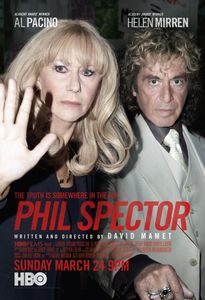
    (On Cable TV, September 2013) Given how little TV-as-TV I watch, I never expected to mark an entire Emmy category as “complete”, but in-between HBO’s Behind the Candelabra, Parade’s End, The Girl and now Phil Spector, I’m all caught-up with the 2013 “Primetime Emmy Award for Outstanding Lead Actor in a Miniseries or a Movie” category even before it’s awarded.  There’s certainly no finer reason to watch Phil Spector than to see good acting from Al Pacino and Helen Mirren, facing each other down as, respectively, a powerful music industry executive accused of murder and one of his defense lawyer.  It’s based the true story of Spector’s first trial (although not really, as the opening disclaimer sort-of-clarifies), but it’s perhaps best appreciated as a standalone court drama, featuring a pair of highly unusual characters.  Al Pacino is his usual intense self as Spector; he even gets a change to indulge in his signature rants late in the film.  Meanwhile, Mirren is in a class of her own as a hypochondriac but steel-nerved lawyer with an uncanny ability to defend her client no matter the circumstances.  (Phil Spector’s look at a high-priced defense, with war room and expert-driven strategies, is worth a look by itself.)  The film may indulge in showing the most eccentric aspect of Spector’s personality, but it’s also somewhat sympathetic to him, creating reasonable doubt that he may not have actually committed the murder for which he was accused.  Phil Spector remains a made-for-TV movie, but with David Mamet writing and directing for HBO, it features high-quality dialogue and decent production values: if nothing else, it’s a good way to enjoy good actors playing interesting people.  Al Pacino as Phil Spector?  That’s always worth watching.