David Mitchell

  • Greed (2019)

    Greed (2019)

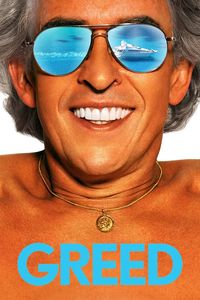
    (On Cable TV, January 2021) It takes much longer than expected for Greed to get up to speed. Much of that has to be blamed on the structure of the script, which initially feels as if it’s the result of an explosion involving three different screenplays: The life of a fashion mogul, the findings of his biographer, and the shenanigans surrounding his 60th birthday party. The film switches back and forth, not just in chronology, but also in treatment and focus, leaving viewers a bit unsure as to where to stand, and depriving the film from a clear narrative engine. Things settle down a bit in the second half, but Greed simply doesn’t manage to make the best use of the elements at its disposal. And what elements those are—Steve Coogan in his elements as a blowhard tycoon, Isla Fisher as a rich heiress, and iconoclastic writer/director Michael Winterbottom going after the ultra-rich by pointing out the immorality, illegality and illegitimacy of their fortunes. It should be fun, and with such added touches as David Mitchell as a socially uncomfortable biographer piecing together the truth, the very cute Dinita Gohil playing a pivotal part in the conclusion, some heartfelt social criticism, and a bit of aghast black comedy at the very end, Greed had the potential to be much better than it is. Winterbottom is no stranger to pointing out the flaws of the world, but this film is so inconsistent that he harms his message along the way. Still, there are laughs, some sharp character moments, decent-enough production values in portraying the demented lifestyle of the ultra-rich, and some crisp cinematography. It’s not what it should have been and it’s likely to leave viewers torn between mixed emotions, but Greed is still worth a look… if only for Coogan having another excuse to engage in long profanity-filled tirades.

  • Cloud Atlas (2012)

    Cloud Atlas (2012)

    (On Cable TV, October 2013) At a time where big-budget filmmaking seems to retreat in familiar narrative structures and a complete lack of daring, Cloud Atlas comes as a welcome break from the usual.  Clocking in at nearly three hours, it features six loosely-linked narratives spanning centuries and several known actors playing different roles in each story.  Heralding the return of the Wachowskis siblings to the big screen after a few quiet years (they co-direct three of the six stories, with Tom Tykwer directing the remainder of the film), Cloud Atlas is big, ambitious and offers things that cinema doesn’t often get to showcase.  It is, in many ways, a singular movie experience, and one that deserves to be contemplated rather than simply liked or disliked.  As an adaptation of David Mitchell’s sprawling novel, it’s an excellent, even audacious re-working: the film’s structure works in ways that the novel couldn’t, and still ends up a fiercely cinematic work.  Most of the actors playing multiple roles seem to have a lot of fun, with particular notice to Tom Hanks (who gets to tweak his usual good-guy persona), Halle Berry (who gets one of her best roles yet as a 1970s journalist), an often-unrecognizable Hugh Grant, as well as gleefully multifaceted Jim Broadbent and Hugo Weaving –who even gets to play both assassin and nurse. (Some roles don’t work as well, such as when actors get to play outside their ethnicity or gender, but that happens.) The six stories interlock in subtle ways, suggesting both reincarnation of personalities and malleability of interpretation once truth becomes fiction.  For all of the good things about Cloud Atlas, it’s almost too easy to forget that this is not an easy or even completely successful film: You have to give it at least 30 minutes for the six stories to earn narrative interest, and there’s a sense that the film is definitely not tight or focused: it often appears to run off on tangents and forced similarities, and certainly will not please anyone looking for solid links between all elements of the picture.  Still, for jaded moviegoers, Cloud Atlas is as close as it gets to a truly new experience within the big-budget framework: it tries many new things, succeeds spectacularly well at some of them and leaves hungry for a bit more.  I could go on, but the film is too big to be adequately described within the constraints of a capsule review.