Dean Martin

  • King of Cool (2021)

    (On Cable TV, November 2021) It took me a while to understand the true appeal of Dean Martin. Not because he wasn’t remarkable — his leading-man presence in well-known films such as the original Ocean’s Eleven is obvious even today, and few people won’t have heard at least one of his crooner songs. But the more you dig, especially in material that hasn’t been as well-preserved as his classic movies, the more you discover the true breadth of his achievements. That he was Jerry Lewis’ straight-man partner in their comedy duo days is something that isn’t as prominent now than seventy years ago (especially given the evanescence of cabaret comedy), but then you have plenty of lesser-known films to show the effectiveness of their act. There are plenty of films and songs to testify as to his careers as actor and singer, but his remarkably long-lived variety show is now best remembered for the celebrated “Tony Martin and Frank Sinatra Christmas Special.”  Oh, and he was a leading member of the celebrated Rat Pack, alongside Sinatra and Davis. In other words, Martin did a lot and had at least four separate careers that would have been enough for anyone else. Trying to put this in a single documentary is a lot, but the filmmakers behind King of Cool do about as well as anyone else could have been expected. (One could quibble as to whether Steve MacQueen is the King of Cool, but the film explains that this was a moniker bestowed upon Martin by none other than Elvis Presley.)  Taking a largely chronological approach to Martin’s life, the film chronicles his early days as the son of Italian immigrants (and whose mother tongue was not English), his early days as a boxer, his struggling debut as a cabaret act, the spark of his partnership with Jerry Lewis, the factors that led to their breakup (simply put: Lewis hogging too much of the spotlight), his reinvention as a boozy crooner in the footsteps of Joe. E. Lewis (albeit with practised casualness and apple juice in the glass), his family life across three wives and several children, and his later years, as they included a reconciliation with Lewis. It’s quite a bit and King of Cool does best when it focuses on the nuts and bolts of his career, testimonies from contemporaries and more recent celebrities (including some surprisingly poignant material from RZA) and testimony from family members. There’s a good line in there about how death gives back the dead person at their best rather than the sometimes-sad old person they have become. Where King of Cool overreaches is in trying to find the hidden key to a man who was far less of a boozy cool crooner than his persona became — in trying to find the “Rosebud,” they end up with a dish representing family, which is not bad but presented with perhaps a bit too much enthusiasm to be credible as the answer. Still, it’s a good thing that the documentary could capture the recollection of several people who knew him or people associated with him (including some effective moments with Lewis’ son). It goes without saying that this is not a documentary fit to question its subject: as a friends-and-family thing, it doesn’t poke too much as Lewis’ tumultuous marital history nor portrays him as anything but a victim of Lewis’ solo ambitions. But so it goes in that subgenre — the film becomes a pointer to more in-depth material rather than an in-depth analysis. Even then, there’s a lot to like in the result — Martin was indeed the King of Cool, and the contact high of even a quick overview of his career is still impressive.

    (Second viewing, July 2022) Hmmm. The good thing about King of Cool is that it made me interested enough in Dean Martin to read more about him. The not-so-good thing is that now that I’ve dug deeper into the topic (most notably through Karina Longworth’s magistral ten hours You Must Remember This podcast series on Martin and Sammy Davis Jr.’s careers), I’m far less impressed by the documentary’s deceptive conclusions. I should not be surprised. Movie biographical documentaries are highly selective at best, and often hagiographic by their nature. When you’re building something on footage of friends and family reminiscing on camera, there’s a built-in incentive to be nice about the subject of those fond memories. No one will accept sitting down to talk about their father if the documentary is going to be a warts-and-all piece. (It gets worse when the family produces the film.) All of this to say that asking for second opinions about Dean Martin blows up the “family man” narrative offered in King of Cool. Martin was in many ways an admirable figure — not all that interested in partying to excess with his Rat Pack fellows, consciously not drinking even as he played up a boozy crooner, a savvy investor who eventually provided generational wealth to his children after making some terrible financial decisions early in his career, and someone who — being King of Cool — always maintained a distance between his true self and his public persona. Alas, that same distance could mean that Martin was aloof and uninterested in deeper connections: Other biographical sources highlight the carefully metered time he’d spend with his kids, then retire to watch TV alone; the many romantic dalliances amounting to nothing; the rift with Jerry Lewis being partially a reflection of his reluctance to communicate; the inglorious final years of Martin’s life in which he preferred television and alcohol to his family. Very little of this makes its way to King of Cool, with some omissions looking like deceptions — after their infamous on-air telethon reunion late in their lives, it took months if not years before Lewis and Martin regularly spoke again, for instance. And its concluding idea of the key to Martin’s character being a baked dish representing family seems even more like a stretch born out of desperation by filmmakers trying to provide an emotional climax. Make no mistake: Dean Martin was a fascinating figure defined by his cool. But going to the end of that idea means going to some darker places that this documentary is not interested in exploring. It’s selling us a romantic, glamorous image of a figure that’s far more interesting with his flaws than some sanitized family-man portrait. It’s an entertaining portrait, but it should be approached as a stepping-stone to a more thorough understanding of Dean Martin.
  • Marriage on the Rocks (1965)

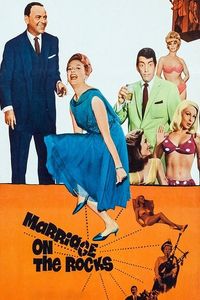
    Marriage on the Rocks (1965)

    (On Cable TV, September 2019) While almost forgotten today, Marriage on the Rocks offers the still-amusing spectacle of seeing Frank Sinatra and Dean Martin as romantic rivals — the first one married, the second proudly single but still pining after the other man’s wife (played by Deborah Kerr). An attempt to transpose the 1930s comedy of remarriage in the 1960s, the film gets kicking in high gear when Sinatra’s character and his bored wife accidentally divorce while in Mexico, and she uses the episode to make him squirm a bit. Contrivances happen, and soon enough she’s just as accidentally wedded to her old flame. Don’t fret — there’s not even a suggestion of inappropriate hanky-panky here even as Sinatra’s character takes the accidental marriage in stride, moves out and encourages his friend to take his place as the head of the household. Comedy is often found in aberrant human behaviour and there’s plenty of that at play here, as the characters experience offence, revenge and counter-revenge. It ends a bit abruptly, but happily. Of course, the fun here is in seeing old Rat-packers Sinatra and Martin banter as friends and then rivals. Among minor amusements is the fact that Sinatra’s daughter Nancy plays Sinatra’s character’s daughter, and a pre-Star Trek DeForest Kelly is seen in a minor role. Marriage on the Rocks is hardly a perfect film — it has some curious lulls, and the style of the film seems stuck in that curious mid-1960s period where the studios were creatively exhausted and beginning to see the possibilities offered by New Hollywood, but not yet ready to make the jump. At times, Marriage on the Rocks feels tamer than the 1930s comedies of remarriage despite its 1960s setting, not quite able to take on the naughtiness of the (innocuous) sex comedies of the time. One suspects that any film featuring the biggest two Rat Packers simply could not get away with racier stuff — their audience was older and less forgiving than the teenage hordes that would redefine American cinema a few years later.

  • At War with the Army (1950)

    (On TV, September 2019) If anyone is looking for proofs of the United States’ history as a martial society, I’d like to provide a very long list of film comedies that only exist because a good chunk of the paying public was intimately familiar with how military service worked. Such comedies are meant to appeal to veterans, conscripts and their families in affectionately ribbing the habits of the army. By 1950, a good chunk of the American male population had still-vivid memories of their wartime service, and that’s clearly what At War with the Army was relying on, with its portrayal of barracks life with overbearing superiors, nonsensical bureaucracy, obstacle courses, family trouble and relationship between fellow soldiers. By the time the film launches into a mess-hall musical number titled “Beans,” well, you already know everything about the film. For generations of viewers, much of the draw of the film is in seeing Dean Martin and Jerry Lewis in the lead roles, playing off their stage persona to sing, goof-off or parody other movies along the way. Lewis is silly, Martin is suave and that’s quite enough to power the entire thing. Of course, some of the material is only funny in the abstract today — most of the twenty-first century audience has no direct knowledge of military service other than through films. But At War with the Army still works because Lewis and Martin are good at what they do: entertainers simply using military service as a scaffolding on which to hang their comic set-pieces.

  • Murderers’ Row (1966)

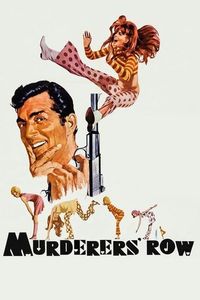
    Murderers’ Row (1966)

    (On TV, September 2021) Dean Martin is back as suave spy-photographer-womanizer Matt Helm in Murderers’ Row, a follow up to The Silencers: another Bond parody in which attractive co-stars help him foil dastardly plans. This second of four Helm movies is certainly in-line with the first: we get Helm at home with a plethora of gadgets optimized for the playboy lifestyle (pouring drinks in glasses, pouring women in pools), we get Dean Martin songs on the soundtrack (with another affectionate jab at Frank Sinatra), we get cartoonish villains, we get sexy co-stars. Indeed, Murderers’ Row benefits from a terrific co-star — none other than 1960s vintage Ann-Margret as a scientist’s daughter who comes to help the protagonist. The tone here is also an extension of the previous film: a mix of sex comedy in describing Helm’s alcoholic libidinous life, of spy thriller over-the-top evil plans, and of curiously restrained comedy to glue everything together. Spectacular sights include hovercrafts and an entire third act shot on a vast industrial construction site. It’s sort-of-fun if you can stomach Murderers’ Row’s good-natured sexism (if such a thing can exist), although it often feels — as with its predecessor—that it can’t quite commit to the comedy and leaves many jokes on the table. The pacing is also an issue, as the film seems far denser and more interesting in its first act, only to grow lax and repetitive in the second. Still, Martin is quite good at essentially playing his own rat-pack persona and if this is the kind of thing to make you smile, then Murderer’s Row should count as one of the better Bond imitators of the era.

  • The Sons of Katie Elder (1965)

    The Sons of Katie Elder (1965)

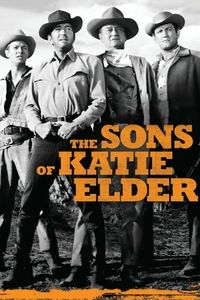
    (YouTube Streaming, August 2021) I’ve been scratching my head for a few minutes in order to find something to say about The Sons of Katie Elder, and it’s harder than you’d think. It’s a western, in colour, from a period in Hollywood history where the studios were running on empty — repeating familiar formulas without quite understanding why audiences were getting tired of them. The film, to be clear, is not a dud: it’s competently-made, with an effective hook (four brothers come back home for their mother’s funeral, and start fighting the resident evil businessman) and some big names on the cast. I’m not a fan of John Wayne, but there’s also Dean Martin to keep things interesting—plus George Hamilton and a young Dennis Hopper. On the other hand, The Sons of Katie Elder is a western film in a very traditional mould, riffing off some questionable frontier justice ideas. It’s watchable, but not particularly memorable. And that, perhaps, is the most lapidary review of all — what else is there to say when the result provokes so little reaction?

  • Kiss Me, Stupid (1964)

    (On Cable TV, August 2021) One of the sure-fire ways to build an effective comedy is to get the characters to behave in ways that would be entirely contrary to expectations or common sense. So it is that by the time writer-director Billy Wilder gets cracking on the premise of Kiss Me, Stupid, he has a man doing everything he can to ensure that his wife has sex with a famous singer. Of course, she’s not really his wife and there’s a significant reward for him if he gets in the singer’s good graces, but that’s not the point — the point is seeing Ray Walston (as the man) setting up Dean Martin (obviously the singer) with Kim Novak (the “wife”) in flagrant contravention of all moral good sense. Getting there is half the fun, and getting out of it is the rest. Although the film lacks a clear climax and generally feels like lower-tier Wilder (it’s not one of his most popular features), there are plenty of good moments, starting with Martin spoofing himself by seamlessly going from his show to an exaggerated womanizing parody of his stage persona. (Some of the early plans for the film sound wilder — but Peter Sellers had a heart attack and Marilyn Monroe died, landing us with Walston and Kim Novak.) The result does feel more overtly ribald as other Wilder films of the time and not quite as witty, but as a 1960s sex comedy, Kiss Me, Stupid is not a bad pick at all.

  • Hollywood or Bust (1956)

    (On Cable TV, July 2021) The Martin and Lewis comedy duo may have been legendary during the ten years it ran, but today is usually a footnote to Dean Martin and Jerry Lewis’ later solo careers. Hollywood or Bust came at the very end of their decade-long partnership, past the point when Martin was itching to get out of their contract considering that Lewis was getting all of the attention as the more overly comic half of the pair. That pressure is clearly at play here, as the film features Martin as a fast-talking hustler who is forced to partner with nerdy Lewis when they jointly win a car and decide to head southwest to Los Angeles. There are a few obvious resonances with the later Rain Man, but much of Hollywood or Bust is self-obviously about seeing Martin as the smooth talker and having to real with the insufferable Lewis along the way (and his big dog, because big dogs are comedy). There are plenty of period references for those well-versed in the period (including some worshipful shots of Anita Ekberg) and perhaps the best feature of the film is the capture (in colour!) of what a country-spanning road trip could mean before the rise of affordable commercial aviation. The gags are all over the place — if you’re the kind of person who laughs at Jerry Lewis antics, then the film will go over much better than otherwise. I liked it well enough (especially as the film reaches Hollywood and reaches into self-referential gags on the Paramount studio lot), but part of it is seeing earlier incarnations of familiar actors known for subsequent roads. You can certainly see echoes of Matt Helm and the Buddy Love here — although now that I know that Hollywood or Bust was made during a period of considerable tension between Martin and Lewis, I’m curious to see them at their best.

  • Some Came Running (1958)

    Some Came Running (1958)

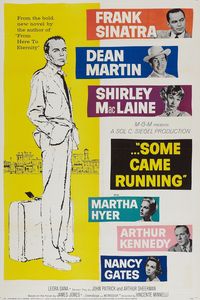
    (On Cable TV, May 2021) For a rather low-key drama, it’s interesting to see how often Some Came Running comes up in classic film discussions. The facts are that this is a film directed by Vincente Minelli and adapted from a doorstop best-selling novel, that it starred Frank Sinatra, Dean Martin and Shirley MacLaine, that good chunks of it were shot on location in a small middle-America town and that it was an example of widescreen colour cinematography at a time when Hollywood dramas usually went for black-and-white Academy ratio. That last factor does help explain the film’s longevity, as it remains more accessible on modern widescreen colour displays than many of its contemporaries. The story is small-potato stuff, as a writer-turned-veteran (Sinatra) returns to his hometown after a long absence, with a loose woman (MacLaine) in tow, and reunites with his brother (Arthur Kennedy), later befriending a likable gambler (Martin). While the original novel is reportedly 1,200 pages long, this stripped-down adaptation fits everything in slightly more than two hours and seems almost lackadaisical in its drive to the ending. But a host of reasons explain why the film stuck in the popular imagination. For one thing, it got five Academy Award nominations (including MacLaine’s first). It was the first screen pairing of Sinatra and Martin, prefiguring the Brat Pack series of movies they’d do together. Its location shooting comes complete with wild tales of fans mobbing Sinatra, wild nights of partying with Martin, and made such an impression that you can still tour Madison, Indiana to see the shooting locations. Minelli’s widescreen colour direction was much admired among fellow directors. None of this really improves the middle-of-the-road impression left by Some Came Running, but sometimes it’s instructive to realize why a film endures… especially if it doesn’t have to do with its quality.

    (Second viewing, On Cable TV, August 2021) It’s almost a subgenre of American cinema: the small-town drama –usually adapted from a novel– in which a prodigal son returns after some time spent away, usually in the military or in a big city that has changed him forever, and how he realizes he can’t come back home. (On the flip side, you have the Hallmark romantic Christmas comedy in which the prodigal daughter returns home, rekindles a past romance with a local hunk, and realizes she can stay home forever.)  Some Came Running is both exemplary and distinctive in how it clearly plays with the building blocks of the genre, but brings a few unusual things along – such as having Shirley MacLaine as a floozy accompanying the protagonist, or how the protagonist rolls up the military aspect, the writerly aspect and the spent-time-in-a-big-city aspect into one character. Frank Sinatra is quite good in the lead role, with a smaller-than-expected part for fellow rat-packer Tony Martin. The small-town aspect is convincingly portrayed (TCM has a lovely companion piece detailing the mayhem caused when Sinatra and Martin stopped into Madison, Indiana for a few weeks of shooting), but the film itself often feels like a collage of elements not necessarily fitting together: by the time even local gangsters get involved, it’s as if the narrative has grown bored with the whole “can’t come home again” theme and reached for more exciting genre elements as trick shots. Some Came Running is watchable without being particularly memorable, but then again, it’s in good company in its subgenre.

  • Bells are Ringing (1960)

    Bells are Ringing (1960)

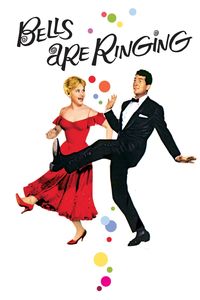
    (On Cable TV, January 2021) In cinema history, Bells are Ringing is noteworthy for being the final film of two well-known names. It was actress Judy Holliday’s final film before her death a few years later. Perhaps more significantly, it was Arthur Freed’s last musical film as the head of the famous MGM Freed Unit, which was responsible for putting together a twenty-year run of many of the most celebrated movie musicals of Hollywood’s Golden Age. This aura of finality seems appropriate, considering the tired nature of the results on-screen. Adapted from a Broadway play with the usual problems of stage adaptations relative to original musicals, Bells Are Ringing is far more laborious to watch than you’d expect. Despite a mildly amusing premise about a Manhattan answering service operator getting drawn into the lives of her clients, it’s a surprisingly mild and unremarkable musical. While Holliday is not bad and Dean Martin adds much to the film as its male lead, the comedy is perfunctory, the songs are not memorable and the entire thing leaves without having left much of a trace. Of course, musicals were fast declining by 1960 and films like Bells are Ringing certainly contributed to this decline—there’s little here to reflect the heights of the form in the previous decade: little wit, little invention, little cinematic quality—and this from otherwise dependable director Vincente Minelli. I’m certainly not saying that Bells are Ringing is a bad film—but it’s average in wholly forgettable ways, which represents an underwhelming end of the line for the producer responsible for such all-time classics as Easter Parade, Singin’ in the Rain and The Band Wagon.

  • The Silencers (1966)

    The Silencers (1966)

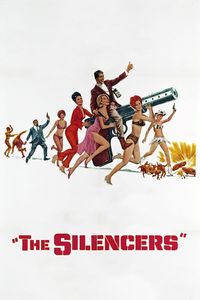
    (On Cable TV, October 2019) No doubt about it: The Silencers is a trip through time. First in the Matt Helm series of films made to lampoon the Bond series and featuring no less than Dean Martin, it’s like an authentic 1960s version of what Austin Powers was going for. Not as farcical, but certainly playing up the most ridiculous elements of the Bond formula: the women, the gadgets, the women, the lavish lifestyle, the women, the ridiculous villains and, of course, the women. (“NOT FOR CHILDREN,” shouts the poster after stating, “Girls, Gags and Gadgets: The Best Spy Thriller of Nineteen Sexty-Sex.”  But don’t worry—it’s tame by today’s standards.)  Rat-packer Martin is near-perfect as the suave womanizing agent Helm, whose conquests multiply throughout the movie. The women all look great, although classic Hollywood fans will be overjoyed to see the great Cyd Charisse strut her stuff in two dance sequences—her legs still go up to there, and she looks fantastic with longer hair. Don’t pay any attention to the plot, though: It’s all familiar plot devices meant to string the gags in the correct order, including a car fully equipped with a driver-accessible minibar and switch-activated privacy drapes for, well, whatever spies do in this kind of movie. Alas, the villain is pointlessly stereotyped along Fu-Manchu lines. Still, The Silencers is a big broad caricature, fully capturing a kind of spoof that would later be re-imitated. I watched it on a whim, attracted by the casting of Charisse, but ended up liking it quite a bit.

    (Second Viewing, On Cable TV, June 2021) I thought I’d have another look at The Silencers after only a few months… if only to verify that my wild memory of the film wasn’t an invention. It wasn’t. Revisiting suave Bond-like secret agents in a hyperbolic fashion, this film stars Dean Martin as (what else?) a top-notch special operative who serially romances a succession of beautiful women (for late-1960s definitions of “beautiful” – despite Stella Stevens doing her best as a redhead, contemporary viewers may be more intrigued by Daliah Lavi as the bad girl with the black-and-white hairdo). If you see nothing else, simply watch the first fifteen minutes, which begins with three successive dance/stripping routines by sultry performers (the third being none other than Cyd Charisse), followed by an introduction to the protagonist at home, surrounded by fancy gadgets and bedroom partners. It’s wild enough that Austin Powers fans will feel at home. The weirdness doesn’t stop after that, what with Martin singing some of his standards at the drop of a hat (even tuning in the car radio away from Sinatra to his own song), and the villain being a rotund white guy made up to look Chinese. It all leads (as it should) to a villain’s lair confrontation. Clearly, The Silencers doesn’t take anything seriously and neither should you: it’s intended as a spoof of 1960s Bond movies and if it works despite the obvious sexism and racism, it’s largely because of Martin’s charm and the excessive nature of the gags. When the protagonist (who became a fashion photographer in retirement) daydreams about the girls of his photoshoots and the film briefly pauses to allow them to prance a little on screen, its unabashedly retrograde nature almost becomes cute. Much of the middle section of the film can’t quite measure up to the wild introduction or the cranked-up final act, but the result is not without distinction. Keep watching until the end of the credits, if only to see what’s been identified as the first post-credit comic sequence in the history of movies. (Although be aware – weirdly enough, the version of The Silencers shown on TCM apparently does not include that post-credit sequence, even if it’s well-documented online.)

  • Robin and the 7 Hoods (1964)

    Robin and the 7 Hoods (1964)

    (In French, On Cable TV, November 2018) Now Robin and the 7 Hoods is an interesting curio: A gangster musical, featuring Bing Crosby and the Rat Pack. Adding even more interest to the proceedings, the story is a retelling of Robin Hood in Prohibition-era Chicago. With a premise and cast like this, you can almost be forgiven for thinking that whatever is on-screen is a let-down from whatever idealized movie you could imagine. Depending on your taste, the film is either too talky, too long, not witty enough to fully capitalize on its potential, or to make good use of its long list of performers. Barbara Rush isn’t as good a Marian as she could have been, while we can quibble about the number of songs given to this or that actor/singer. All of this is true—Robin and the 7 Hoods is never mentioned as a major musical, and there’s a feeling that the material could be done quite a bit better. And yet … there are some really good moment in here. The highlight has to be the “Bang! Bang!” number featuring Sammy Davis, Jr. as a gun-crazy gangster shooting up the place. Another great sequence has a speakeasy transforming itself into a religious mission complete with gospel singers. Edward G. Robinson shows up briefly as an elderly gangster, while Frank Sinatra, Dean Martin (a bit wasted) and Bing Crosby (showing up too late) get to croon a few numbers. The colourful portrait of 1920s Chicago is a straight-up cliché, justifiably so in a silly musical comedy. I do wish Robin and the 7 Hoods would have been just a bit better, but I still had quite a good time watching it all. Just the thrill of discovery does account for much of it.