Dianne Wiest

  • Cops and Robbersons (1994)

    Cops and Robbersons (1994)

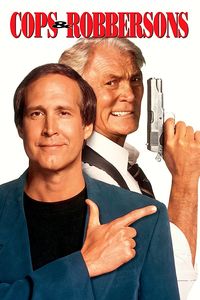
    (In French, On Cable TV, June 2021) I haven’t held back in calling out Chevy Chase as one of the unfunniest comedy stars of the 1980s — while his shtick occasionally works (I’m a big, big fan of Christmas Vacation), it’s often smarmy to an intolerable degree, and it’s interesting to see that it got worse with time, until his hubris grew too big for audiences to like. After his 1980s heydays, he experienced flop after flop in the early 1990s, with Cops and Robbersons arguably being the nail in his box-office coffin — you can just look at his filmography before and after 1995 to see a striking difference. To be fair, the problem with Cops and Robbersons isn’t just Chase — but other than “this is not a great script,” most of the specific problems with the film can be summarized as “Chase.”  It could have been much, much worse — rather than being portrayed as an “irresistible” ladies’ man as in Fletch or Memoirs of an Invisible Man, Chase here reverts to a variation on his bumbling suburban dad persona made famous in the Vacations films. A familiar character played on autopilot — with the same largely being true of Jack Palance as a misanthropic hard-boiled veteran cop forced to play Granddad in moving to the suburbs for a stakeout. The casting of Dianne Wiest as a funny mom is slightly perplexing considering her persona and the sitcom nature of the gags, but that’s among the least of the film’s problems. The main issue here is that the script has one good idea (encapsulated in the too-cute title) executed in very familiar riffs. You’ll say that this does make it look like plenty of other mainstream comedies of the time and you’d be right — the failure mode of Cops and Robbersons is being overly familiar, and that’s better than being actively obnoxious as other Chase films. Still, that doesn’t make it a better film — and for Chase it was a three-strikes-you’re-out kind of career realignment, not helped along by his abysmal reputation off-screen. When egomaniacs get humbled, not all of them repent and change their ways — some simply take their ball and go home.

  • The Scout (1994)

    The Scout (1994)

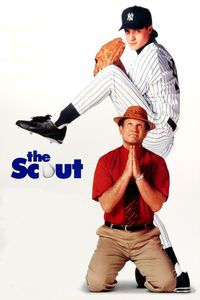
    (On TV, May 2021) You can watch The Scout for its casting (Albert Brooks and Brendan Fraser with a little bit of Dianne Wiest — an interesting combination), or for its focus on baseball, or for its premise in following a disgraced baseball scout finding “the best baseball player that ever lived” in Mexico. What you won’t do, however, is watch it because it’s any good, since in chasing down far too many rabbits (baseball excellence, scout aiming for redemption, protagonist with central trauma, mental illness treatment, satire of celebrity media) and too many tones (anything from heartwarming pseudo-parental bonding to broad comedy), The Scout loses itself into a jumble of different ideas imperfectly executed. It’s not a difficult film to watch nor is it all that obnoxious, but it is a mess and it ends up raising more questions than satisfaction. At least Fraser is not bad (in a role that portends his take on George of the Jungle, oddly enough) and baseball fans will probably enjoy the look at mid-1990s New York Yankees, but otherwise, it’s more frustrating than anything else.

  • Let Them All Talk (2020)

    Let Them All Talk (2020)

    (On Cable TV, December 2020) How did Let Them All Talk go so wrong? It has a genius-level director, an impeccable cast (even just with Meryl Streep, Candice Bergen and Dianne Wiest), the backdrop of an ocean liner, a writer-as-protagonist, the always-cute Gemma Chan, and yet it all falls flat. One of my favourite settings in fiction is the ocean liner – a vast but enclosed space in which dramas can play out on a very romantic stage. But director Steven Soderbergh somehow manages to make it all look and feel so banal. The dialogue is trite and uninteresting, the characters are bland and over-privileged (Oh, no, you based your book on my life and my life is now ruined – get a grip over yourself) and the directing is both flat and unremarkable. Really, it’s as if Soderbergh went on an all-destroying mission to leech away all energy from what he had at his disposal. Part of it can be explained by the film’s production, heavy on naturalistic light and staging, as well (more crucially) on rambling improvised dialogue. But that’s the price to pay for Soderbergh’s unquenchable thirst for experimentation: Sometimes, you get a masterpiece, and other times, you get the antithesis of that. At least there’s Chan to make it slightly better.

  • Parenthood (1989)

    Parenthood (1989)

    (On Cable TV, April 2019) At first, Parenthood looks like your usual middle-of-the-road Steve Martin comedy, with enough silliness and hijinks to cover up a lack of thematic intentions. Much like Cheaper by the Dozen, in fact. But as Parenthood develops, it gains a significant amount of sentiment and profundity as a multifaceted exploration of parenthood from toddlers to, well, far older kids. There’s quite a bit of Martin silliness (including a rather triumphant sequence as a fake cowboy that finally gets the character to earn a win after a film designed to undercut him at each instance) but it’s all in the service of larger interests. You can see the deeper themes at play in the film’s very entertaining daydream sequences, two of them contrasting extremes of fatherhood success. But it’s not all laughter as the film touches upon some dramatic material even as it’s designed as a comedy—parental anxiety is a real thing. With an ensemble cast but a stronger more interconnected plot than many episodic films, Parenthood steadily gains steam throughout its run. It helps when it knocks holes to deepen its initially-stock characters, such as when a teenage Keanu Reeves delivers sage advice to a young and nearly unrecognizable Joaquin Phoenix. Mary Steenburgen is as lovely as ever, while Dianne West delivers an Oscar-nominated performance. All told, Parenthood delivers more than what you could expect from later-era Steve Martin comedies—it’s occasionally silly for sure, but it does deliver on more nuanced material as well.

  • Synecdoche, New York (2008)

    Synecdoche, New York (2008)

    (On DVD, February 2018) I have a long list of annoyances when it comes to movies, and at first glance Synecdoche, New York seems to hit an impressive number of them. It’s consciously made to annoy viewers, to revel in their darkest fears, to rush to the worst ending imaginable, to become self-involved in its own inscrutable metafictional games, to screw with expectations for no reasons. Coming from the reliably twisted mind of writer/director Charlie Kaufman, this is a film that jumps in-between high concept, dream sequences, a background apocalypse, characters taking each other’s roles, intense symbolism and decades of events compressed in barely more than two hours. It barely explains what it’s doing, leaving viewers to ponder and search for fascinating readings about the film’s means and meanings. Heck, the lead character may not even be himself. I have been infuriated by tamer movies. Adding to the potential disaster, the DVD version of the film does not have English subtitles, making my life much harder as I was watching the film in less-than-ideal audio circumstances. (I eventually found and read a copy of the script to make sure that I hadn’t missed anything important, and was relieved to find that I hadn’t.)  But, for lack of a better expression, Synecdoche, New York worked its magic over me. The relentless gloom of the film quickly becomes a comedy, and once you accept that the film will make more emotional sense than a purely narrative one, it becomes a curiously enjoyable experience. The metafictional book-reading scene set aboard a plane flight had me laughing, which is not something I would have anticipated from a movie that features a greatest hits selection of every single fear that adults can have, from being estranged from loved ones, to progressive illness, to being made completely redundant, to not being forgiven, to surviving the end of the world, and so on. Gloriously ambitious, Synecdoche, New York is about everything. Philip Seymour Hoffman turns in one of his great performances as the tortured hero, ably supported by cast as varied as Catherine Keener, Tom Noonan and Dianne Wiest — the last of which has an unsettling and memorable role. Adding to the strangeness, Samantha Morton and Emily Watson are rather eye-catching here, which is really weird given that I usually don’t rank them particularly high on my own list of sex-symbol actresses. Ultimately, Synecdoche, New York’s unrepentant refusal to be ordinary is what sets it apart. I’ll leave viewers to decide if it’s best seen cold or not (this is not a movie that can be spoiled), but any second viewing should be done after gorging oneself with various commentaries, interpretations and lengthy analyses of the film. It’s incredibly rich material for discussion, and I’m as surprised as anyone to like the film as much as I did.

  • Hannah and her Sisters (1986)

    Hannah and her Sisters (1986)

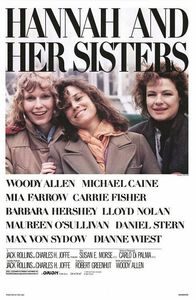
    (On TV, March 2017) As I’m watching Woody Allen’s filmography in scattered chronological order, I’m struck by how his works seems best approached sequentially—there are definitely phases in his work, and they partially seem to be addressing previous movies. Hannah and Her Sisters does echo other Allen movies—Manhattan (which I saw between watching this film and writing this review) in tone and setting, I’m told that there’s something significant about Mia Farrow’s casting, and there’s a continuity here between Allen’s nebbish hypochondriac and the rest of his screen persona. Absent most of those guideposts, however, Hannah and her Sisters feels a bit … slight as a standalone. It’s nowhere near a bad movie: the quality of the dialogue, twisted psychodrama of unstable pairings and Allen’s own very entertaining persona ensure that this is a quality film. But in trying to find out what makes this a lauded top-tier component of Allen’s filmography, answers don’t come as readily. Part of the problem, I suspect, is that Hannah and Her Sisters does things that have since then been done more frequently—Northeastern romantic dramas about a close-knit group of friends and family? Might as well tag an entire sub-genre of independent dramas … at least two of them featuring Jason Bateman. Familiarity, of course, is trumped by execution and so Hannah and Her Sisters does go far on Allen’s script. Allen himself is his own best male spokesman, although Michael Caine and Max von Sydow both have their moments. Still, the spotlight is on the sisters: Mia Farrow is terrific as the titular Hannah, while Barbara Hershey remains captivating thirty years later and Dianne Wiest completes the trio as something of a screw-up. There’s a little bit of weirdness about the age of the characters—although I suspect that’s largely because Allen plays a character much younger than he is, and I can’t reliably tell the age of the female characters. It’s watchable enough, but I’m not sure I found in Hannah and her Sisters the spark that makes an average film become a good one. I may want to temper my expectations—after all, not every Woody Allen movie is a great one, even in the latter period with which I’m most familiar.