Dick van Dyke

  • The Comic (1969)

    The Comic (1969)

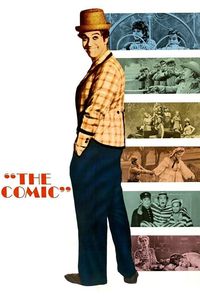
    (On Cable TV, March 2021) There’s a lot to like in The Comic for fans of early silent comedy — with Dick Van Dyke playing a silent comedian struggling to stay relevant in a world moving forward, the film ends up being a melancholic take on the careers of people such as Buster Keaton and Harold Lloyd, whose careers never quite adapted to the sound era. Still, let’s not read too much into the film’s character as a version of those two — the protagonist here is a terrible person marginally made tolerable by a talent for a very specific kind of physical comedy that became far less popular after the end of silent cinema. The rest of the film, narrated from the casket, doesn’t get any better for him — divorce follows his adultery, his son disappears from his life and a trip to Europe doesn’t improve his fortune at all. It’s not hard to understand why Dick Van Dyke is perfect for the role, as he plays the slapstick perfectly in silent film sequences faithfully re-created by writer/director Carl Reiner — aside from the too-good visual quality, you’d swear those were real silent films. There’s also quite a bit of more dramatic material for Van Dyke to play, as his character just keeps digging himself deeper into a hole and refuses to move on with the times while alienating everyone who does. (This is where the Keaton comparisons most definitely end — Keaton’s fall from grace had more to do with a bad contract that led to many damaging outcomes, such as alcoholism: he otherwise kept working until his death, including as a gagman to MGM and a mentor to younger comedians such as Red Skelton.)  This is another entry in the sad-films-about-comedians subgenre but it’s not entirely glum nor unjustified: the lead character is not admirable outside his performances, and the entire film feels closer to tragedy than humiliation. The post-mortem narration does help take the edge off, obviously, although I don’t think that the film quite closes the loop on that. Still, while The Comic is not as funny an experience as many would like (the final shot is a big sad statement), there’s quite a bit here for fans of Van Dyke, Reiner or silent cinema to chew on.
  • Chitty Chitty Bang Bang (1968)

    Chitty Chitty Bang Bang (1968)

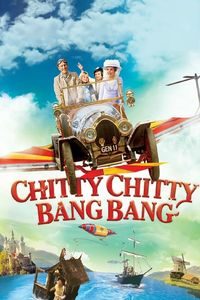
    (On TV, January 2018) I didn’t end up enjoying Chitty Chitty Bang Bang all that much, which is strange given that I certainly expected to like it. Dick Van Dyke, Sally Ann Howes, fancy retro-technology … what’s not to like? The film is a minor reference in Science Fiction fannish circles, so I finally got some of the jokes. Even the opening credit sequence has a few promising surprises, from a Roald Dahl script of an Ian Fleming story. What a pedigree! For a while, it looks as if the film is off to a good start with an eccentric inventor, a big musical sequence set in a candy factory and enough quirky ideas to keep things interesting. I even had an audible “ah ha” as I recognized the source of a verbal tic (“toot sweet”) of an acquaintance of mine. Somehow, though, along the way Chitty Chitty Bang Bang sort of lost me. The radically different second act takes us to an unpleasant place, and while I was momentarily fascinated by the film all over again during the “music box doll” sequence, the film seemed less interesting as it went on. It wasn’t what I was expecting.

  • Mary Poppins (1964)

    Mary Poppins (1964)

    (In French, Video on-Demand, September 2015) I had seen bits and pieces of Mary Poppins over the years, but never the entire thing from beginning to end.  So it is that “I can see why this is a classic” jostles with “wow, this is a long movie” as my first conclusions.  Clocking in at nearly 140 minutes, Mary Poppins unevenly goes from one set-piece to another, flirting with plotlessness before finally delivering something near the very end.  It’s obviously a musical, meaning that is comes with a Bollywoodian intent to cover all emotional bases during its lengthy running time, no matter the loss in economical storytelling along the way.  There’s also an argument to be made that in 1964, audiences were far more accepting of a meandering movie experience and that today’s 90-minutes feature competes with far many more entertainment options.  So be it –let’s simply say that the film often drags.  Still, it would be churlish to ignore the reasons why Mary Poppins remains a cultural touchstone: the charm of it all, the great performances by Julie Andrews and Dick van Dyke (whose physical energy in the film remains astonishing), plentiful special effects, the catchy tunes, the family-first message, the set-pieces that do work well.  (My own favourites include the partially-animated Jolly Holiday, Supercalifragilisticexpialidocious (of course) and the rooftop Chim-Chim-Cheree)  Must of the film feels dated, but in doing so has acquired a further patina of whimsy that can’t be replicated by modern films.  (Well, except for the use of suffragette activism as a motivation for a mother ignoring her kids –that’s even more annoying than it must have been at the time.)  While I itch for some editing power in making this film more focused from beginning to end, the end result is still a classic for the ages.  Note: The French version may be competently translated, but it’s nowhere near the catchiness of the original English soundtrack.