Don Ameche

  • The Three Musketeers (1939)

    The Three Musketeers (1939)

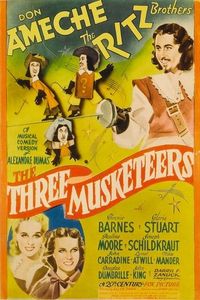
    (On TV, July 2021) There have been many different takes on Alexandre Dumas’ The Three Musketeers throughout cinema’s history — it’s a fun story fit to be reinterpreted however filmmakers want, either by focusing on the adventure, the action, the historical fancy or the relationships between the characters. But there’s only one version featuring Don Ameche and the other musketeers (The Ritz Brothers comedy trio) lustily singing their way through the plot. The reinterpretation of the story as a musical comedy is smoother than you’d think — the grander-than-life nature of the Musketeers, having been a good fit for oversized personalities such as Douglas Fairbanks and Gene Kelly, also works in the heightened reality of movie musicals. Having Ameche happily walk and sing through his numbers reinforces the essential vitality of D’Artagnan’s character as much as any sword-fight would. This being said, the tension between delivering on the bare bones of the book’s plot and letting Ameche and the Ritz Brothers do their comic things grows worse over time — sure, you can do whatever you want in the first half-hour of the film, but eventually you have to get down to the business of plotting, and that’s when this version of The Three Musketeers gets creaky. Still, there are a few rather wonderful moments here if you’re not overly attached to the original (and reading modern reviews, it’s clear that twenty-first century audiences have been conditioned to be far more tolerant of comedic takes on classic material) and it does help this version of The Three Musketeers remain curiously distinctive even eighty years and many other remakes later.
  • Moon Over Miami (1941)

    Moon Over Miami (1941)

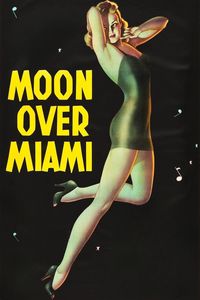
    (On Cable TV, June 2021) While Moon over Miami doesn’t do many things wrong (although I could do without its “Solitary Seminole” number) — and, in fact, does most things right, I’m not convinced it goes much beyond that to achieve its fullest potential. The building blocks of the narrative are solid enough, with two sisters blowing through their meager inheritance with a last-chance trip to Miami in order to seduce and marry millionaires. (Not much of a twenty-first century model… or is it?)  The film’s single biggest asset becomes its setting, taking a look at a very different Miami but also letting its distinctive atmosphere influence both the looks of the film (which was partially shot on location) and the nature of some of the musical numbers to incorporate some Latin material. Don Ameche and Betty Grable make for good romantic leads, and the film gets a boost from being shot in colour when there’s so much material here that would have been duller in then-standard black-and-white. Another unexpected bonus: Seeing noted choreographer Hermes Pan on-screen as a dance partner. Director Walter Lang keeps the pieces moving pleasantly enough, although his track record on other musicals reflects a heavy-handed approach that doesn’t go for comic material. And that’s perhaps where Moon Over Miami meets its limits: despite some good and promising material, it doesn’t deliver on its fullest potential. It’s amusing but not comic, its musical numbers are lively but not memorable and the result should be more interesting but merely settles for a pleasant time. I strongly suspect that a similar film made ten years later, as musicals were perfecting their approach, would have been far more striking.

  • The Feminine Touch (1941)

    The Feminine Touch (1941)

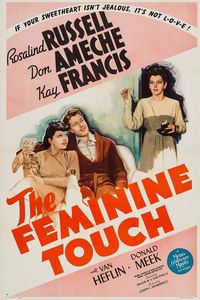
    (On Cable TV, May 2021) One of my favourite kinds of comedy, especially in the Classic Hollywood era, if when the entire premise of the film causes characters to act in counter-natural ways. The Feminine Touch has that as a driving principle: the idea that an academic working on a book about jealousy would be blithely unable to be jealous, even despite ample provocations from his wife. The story does get more complex when other characters are introduced with non-mutual infatuations for other characters. Notable players here include Don Ameche as a comic/romantic lead playing the academic author, Rosalind Russell as his scheming wife trying to get a reaction out of him, Van Heflin as a romantic pretender, and Kay Francis as the fourth point in this romantic quadrangle. While The Feminine Touch is more charming and amusing than outright funny, it does culminate into a rather spectacular scuffle between the leads, and that’s a nice capper to an entertaining film. There’s a pretty good bit involving Van Heflin sporting an uncharacteristic beard and wolfish attitude. The material here is better than usual for a romantic comedy, and if you’re a fan of any of those actors (if not all four of them, because this is a seriously good cast), then The Feminine Touch is a can’t miss.

  • Heaven Can Wait (1943)

    Heaven Can Wait (1943)

    (On DVD, September 2019) I started watching Heaven Can Wait reluctantly, convinced that it was going to be the original that led to the 1978’s Heaven Can Wait remake (which I really don’t like). But the Heaven can Wait original is called Here Comes Mr. Jordan and this is a completely different film. It ends up being a comedy by none other than Ernst Lubitsch, featuring Don Ameche recounting his life to the Devil in order to be admitted in Hell. As with most of Lubitsch’s films, it features a rather good script (adapted from a theatrical play, hence the strong dialogue) filled with clever touches, and an unobtrusive directing style that makes it absorbing viewing. Gene Tierney holds the female lead, with ample chemistry with Ameche when it counts. It’s a film made by people aware that there’s a jaded audience on the other side of the screen, eager to be seduced by a film but having been disappointed before. As a result, it feels as if Heaven Can Wait is constantly nodding at its audience, comforting them when it wants to and surprising them in other ways. It’s quite a likable movie, and it’s one of many that affirms Lubitsch’s strong touch on the material he directed.