Donald Pleasence

  • Warrior of the Lost World (1984)

    Warrior of the Lost World (1984)

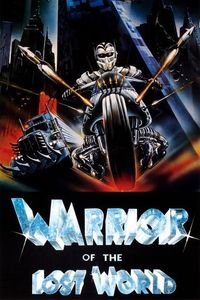
    (In French, On Cable TV, October 2021) As someone who has read metric tons of written Science Fiction, I’m probably more sensitive to bad Science Fiction than most people, and tripe like Warrior of the Lost World makes me seethe on a number of levels. It’s not just dumb science fiction filled with stolen clichés and cheap shortcuts—it’s painfully unimaginative and content to rely on material that would be too juvenile for teenage audiences. Much of the story is an obvious rip-off from the Mad Max series, with some generic authoritarian government nonsense (complete with red-white-black imagery not at all derived from Nazi Germany) on top of it. Our protagonist (Robert Ginty) looks like Chuck Norris, rides the country with his “smart” motorcycle (a thrice-talking machine so detestable that we can only cheer when it’s brutally-but-not-enough destroyed toward the end of the film) and gets rid of the oppressive regime. A few semi-known names fill up the cast, from Donald Pleasence as the top bald villain to Fred Williamson as a traitorous sidekick and Persis Khambatta (with a fuller head of hair than in Star Trek: The Motion Picture) as the mandatory love interest—plus I will never be unhappy to see Geretta Geretta pop up even in small roles. An extruded product of the 1980s Italian film industry (which had an unfortunate specialty of churning out cheap knockoffs of popular film), Warrior of the Lost World is post-apocalyptic science fiction at its laziest. There’s some money in the car chases and semi-familiar names in the cast, but that’s really not enough to masquerade the creative bankruptcy of everything else. Semi-notorious in the bad-movie genre (it was a Mystery Science Theater 3000 pick), it’s barely useful as a means of recalibrating expectations vis-à-vis dumb-but-expensive Hollywood films, but that’s not much of a barometer.
  • The Uncanny (1977)

    The Uncanny (1977)

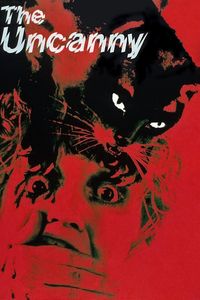
    (In French, On Cable TV, March 2021) I suppose that if you look long enough, you’ll find horror movies on every imaginable topic. The Uncanny brings us closer to the fullest understanding of this axiom by featuring no less than three stories about the evil of cats, and a framing device to hang it all together. A late-1970s Montréal-based English-Canadian production, it’s clearly made on a small budget and technically rough around the edges. Fortunately, there’s a bit of a story to go with it. The framing device, as we eventually discover, has to do with a publisher meeting the author of a manuscript documenting how cats are the evil force controlling the world — and the three stories are meant to illustrate the thesis. In the first one, cats take revenge upon their mistress’s murderer. In the second, a young girl avenges her cat’s disappearance through witchcraft. In the third, a cat takes revenge on a Classic Hollywood actor for murdering her mistress. By the time we get back to the framing device, cats are ready to kill in order to protect their secret, and they’re theatrical enough to wait until their target is walking down picturesque stairs). You get the idea: cats and revenge are this film’s main themes, with a budget that doesn’t quite allow more than two or three sets per story. While well-known names such as Peter Cushing and Donald Pleasence show up briefly, the main attractions here are the short stories. If they don’t quite work, just wait a few minutes and there will be another. The pacing is not that good — nearly every story has its lulls, especially when it’s obvious how they’re going to end. Still, as a concept, it’s cute, and French-Canadian viewers may be surprised to recognize some old-school actors and actresses in minor roles.

  • Terror in the Aisles (1984)

    Terror in the Aisles (1984)

    (In French, On Cable TV, October 2020) I’m favourably predisposed toward anthology films—handled correctly à la That’s Entertainment, they can combine an educational quality with some great entertainment matter. But Terror in the Aisles does seem to miss its target. Supposedly an exploration of horror cinema narrated by Donald Pleasence and Nancy Allen as if they are in a movie theatre watching a horror film (a conceit that doesn’t quite work), it features excerpts of films from the 1930s to the early 1980s. Unfortunately, the chatter that accompanies the excerpts is definitely introductory material: While the film features footage of Hitchcock providing his well-known explanation of the difference between suspense and surprise, the rest of the film seems satisfied with familiar platitudes. The choice of the excerpts can also be suspicious: There’s a lengthy excerpt from Nighthawks that did make me want to see the film, but seems out of place in a film about horror. Much of the material is loosely grouped along thematic lines, which does add to the sense of wasted opportunities: by 1984, horror cinema was fresh from a decade of radical change after the rise and crash of slasher movies, the hybridization of themes (as with Alien, equally at ease in horror and SF), and the far-gorier material made for an increasingly distinct horror audience (à la Italian horror wave). Very little of this is covered in Terror in the Aisles, and one can’t really blame the lack of perspective when those trends were already obvious years before. I really would have enjoyed an assessment of the horror genre circa 1984, but this isn’t what this is meant to do—it feels closer to a mainstream cash-in on the horror craze of the time, not digging too deep for fear of losing their non-fan audience. For those who are knowledgeable about the genre, there is some value in being reminded of better movies and playing “name that movie” when the film doesn’t. Amusingly enough, the most interesting section of Terror in the Aisles is the one about horror spoofs because it features films that, to put it bluntly, have not withstood the test of time, and thus qualify as unfamiliar fresh material for anyone watching from the twenty-first century.

  • Alone in the Dark (1982)

    Alone in the Dark (1982)

    (In French, On Cable TV, September 2020) Coming at the tail end of the 1979–1982 slasher craze, Alone in the Dark definitely knew what it was doing in revolving around a handful of psycho killers escaping from an insane asylum during a power outage and targeting their psychiatrist. Quickly shifting to home-invasion thriller, the film clearly upholds the tropes of the subgenre, and doesn’t care much about narrative cohesion. The biggest draw of the film, even today, is a cast that throws in Jack Palance, Donald Pleasence and Martin Landau together as psychiatrists and psychopaths. (Elsewhere in the film, Lin Shaye has an early brief role.) Better executed than average by writer-director Jack Sholder, Alone in the Dark does, however, remain a first-wave slasher—interesting if you’re into the whole psychopaths-with-knives thing; otherwise not very much.

    (Second Viewing, On Cable TV, January 2021) Not remembering my first viewing, it took me a few false starts before I was able to make it (again) through Alone in the Dark. Either I stopped midway through, or I left it running while I was doing something else and realized by the end of it that I was never compelled to follow what was happening. When I finally sat down to watch with (mostly) undivided attention, I’m not sure I got much more out of it. The first half-hour does have something worth paying attention to: As a psychologist takes residence at an insane asylum, he has trouble connecting to a close-knit foursome of violent criminals, who blame him for the death of their previous psychiatrist. When a power outage strikes, they soon escape and head for his residence. The rest of the film, alas, is more or less a home-invasion thriller, albeit with a twist that can unfortunately be seen (or rather not seen) from the very introduction of the antagonists. If there’s any reason to watch the film, it’s probably for the casting of a few familiar actors: Jack Palance, Martin Landau and Donald Pleasence all have substantial roles here, with none other than Lin Shaye (who finally achieved horror stardom three decades later!) making a short appearance early in the movie. Alone is the Dark does work well in its execution, but it does boil down to a very average early-1980s horror film. That may not sound like much (it partially explains why I didn’t even remember seeing the film a few months ago), but it’s slightly more interesting than the omnipresent slashers of that time.