Donna Reed

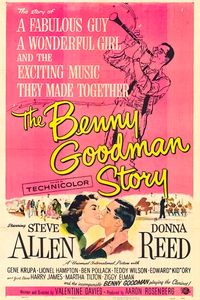
  • The Benny Goodman Story (1956)

    The Benny Goodman Story (1956)

    (On TV, October 2020) I never expected to have watched so many movies about American band leaders, even less having an opinion on them, but we’re in the middle of a pandemic and weirder things are happening. There aren’t many clearer illustrations of how American pop culture has evolved as how band leaders have been replaced by other kinds of stars (usually lead singers of musical groups) in the popular imagination. Now, I’ve had a soft spot for Benny Goodman for plenty of reasons—Goodman was image-conscious, he regularly showed up in Hollywood movies between 1937 and 1948 and as luck would have it, I ended up watching his only featured role in Sweet and Low-Down a few weeks before The Benny Goodman Story. Here, Steve Allen (who would go on to become an exemplary talk-show host) has a credible take on Goodman, round glasses and general bonhomie included. The film is clearly in the Hollywood biopic mould, focused on his long-running romance with Alice Hammond (Donna Reed), whose character comes to exemplify the acceptance of Goodman’s brand of “hot” jazz by the American mainstream. There’s plenty of music to go along, and his classic cover of “Sing, Sing, Sing” is kept for the very end of the film. The Benny Goodman Story is an enjoyable film (and it’s just as good as something you listen to while doing other things) and a decent immortalization of Goodman. There’s some illustrative value here for jazz enthusiasts in depicting the transition of the art form into a more modern form, as well as a modest message of integration along the way.

  • From Here to Eternity (1953)

    From Here to Eternity (1953)

    (On Cable TV, May 2018) For all of the continued acclaim of From Here to Eternity as a classic piece of Hollywood Cinema, the film itself is often a disappointment. From its descriptions, you could maybe expect a sweeping drama set in pre-Pearl Harbor Hawaii, with high romance being interrupted by the beginning of the war. Alas, that’s just you going from the iconic beach scene and hazy memories of Michael Bay’s Pearl Harbor—the reality of From Here to Eternity has more to do with it being an adaptation of a gritty dramatic novel in which nobody gets a happy ending. On the menu: a sordid affair (one of many) between a traumatized housewife and an indecisive soldier; physical abuse in the military; a character falling for a high-end prostitute (oh, OK, “hostess”); and the Japanese on their way to ruin the melodrama right before the end. Also on the menu; terrifying dumb decisions from the characters to ensure that they will not get what they want (often dying in the process). As a period piece, From Here to Eternity is not that successful—until the Japanese attack, the film feels far too intimate to reflect the reality of living on a military base and the way it spends nearly all of its time in small sets does undercuts its bigger ambitions. The image of the beach romance suggested by the film’s reputation is far worse in context: Not only is the beach frolicking limited to a few seconds, it’s in support of an adulterous relationship that’s not particularly admirable, and it leads straight to a soliloquy of intense personal grief. Frame the picture of Burt Lancaster and Deborah Kerr smooching if you want, but don’t expect the film to heighten the fantasy. This being said, much of this reaction is a reaction to the film’s sterling reputation—taken on its own, From Here to Eternity does remain a good dramatic piece, anchored by able performances by Lancaster, Montgomery Clift and (especially) Frank Sinatra, with Kerr and Donna Reed on the distaff side. Still, reading about the film (and the changes from the original novel) is often more interesting than the film itself. Overinflated expectations or under-delivering period piece—I can’t decide for now (and I suspect that watching three WW2 movies in a row due to Memorial weekend doesn’t help), although I am glad to have seen it to complete that bit of Hollywood History.