Doris Day

  • Billy Rose’s Jumbo (1962)

    Billy Rose’s Jumbo (1962)

    (On Cable TV, November 2020) Musicals had practically gone out of vogue by the early 1960s and genre epicentre MGM was clearly looking to recapture some of their past glory with Billy Rose’s Jumbo, a wide-scale musical set in the colourful world of the circus. Film scholars tell us that the project was in development for decades, starting in the 1930s, before the studio greenlit the film. The result is clearly meant to be expansive—with its succession of numbers taking advantage of circus iconography (Busby Berkeley was involved, in what I believe was his last film project), it’s meant to be a throwback to the glory days of MGM musicals. The result is not bad—especially for the 1960s, where the quality of musicals generally took a nosedive—but it does take a while to build up some interest. Doris Day stars as the daughter of the circus owner, with none other than Jimmy Durante playing her father. (There’s even a recreation of his classic “What elephant?’ gag.)  Both have impressive solo circus numbers, but I’m not smart enough to guess what part of their performances was theirs and what (if anything) was done by a double. Billy Rose’s Jumbo is watchable enough from a twenty-first century perspective, but if anyone tried to guess its production year, they’d probably peg it as a mid-1950s film—which explains why it wasn’t a box-office success and why it did not reignite the MGM musical era. That’s too bad for the filmmakers and studio, but, on the other hand, it has produced a musical for the ages, a bright colourful take on the circus world that you can very well pair with the more serious The Greatest Show on Earth for a double-shot of 1950s circuses.

  • That Touch of Mink (1962)

    That Touch of Mink (1962)

    (On Cable TV, November 2020) Film scholars are quick to note that That Touch of Mink really wasn’t Cary Grant’s favourite film. By that time in his career, thirty years in the business, Grant felt that his best years were behind him: he was getting more difficult to sell as a romantic lead (something that would be apparent in the following year’s Charade, otherwise a high point of his career), his favourite directors were slowing down or retiring, and American society was changing in unpredictable ways. Having formed his own production company, he backed That Touch of Mink as a good commercial prospect and was proven right when the film finished fourth at the 1962 box office. Thematically, the film fits squarely with the low-key, somewhat quaintly charming sex comedies of the early 1960s—playing with the idea of more permissive social mores without quite bringing itself to embrace the thought. As a result, the film occasionally feels like a throwback to earlier movies, as Grant and Doris Day engage in a whirlwind romance punctuated by the question of “will they or won’t they?” There are quite a few engaging period details here, from an extended sequence in an automat, baseball legend cameos, a scene set inside a Univac computer room and a funny supporting role from Gig Young as an academic acting as Grant’s conscience. Unfortunately, it also comes with a side order of homophobic panic, a less than impressive ending and a first act that, with slight variations, plays like a humourless take on the opening for Written on the Wind. Then there’s the age of the leads: Grant was a seasoned 58-year-old, while Day herself was 38, playing a character easily fifteen years younger. That Touch of Mink is watchable, even amusing and certainly charming for fans of Grant or Day… but really not a career high point for anyone.

  • Please Don’t Eat the Daisies (1960)

    Please Don’t Eat the Daisies (1960)

    (On Cable TV, October 2020) There’s a lot to like in Please Don’t Eat the Daisies, whether it’s the pairing of Doris Day and David Niven, the story of a Manhattanite family moving to a fixer-upper in the country, or a farce about a theatrical critic reaping the rewards (and perils) of fame. Combined with bright clean 1960s cinematography, the film becomes a solid comic hit—not quite a classic, but good enough to sustain amused viewing. Day not only gets to play comedy, but play and sing a little big (including a bit of “Que Sera, Sera”), while Niven is his usual unflappable self even when he’s being flapped. The multiple subplots (adapted from a book of comic essays by Jean Kerr) are enough to keep the film going through its running time, but there’s a lack of cohesion to the entire enterprise, with the spot light moving from one strand of narrative threads to another without quite bringing it together, either during the film itself, or in what’s supposed to be a big finale. Please Don’t Eat the Daisies could have been quite a bit better, but it’s rather charming in its current state, and not a bad moment in Day and Niven’s company.

    (On Cable TV, January 2021) A second look at Please Don’t Eat the Daisies with a few added months’ worth of Doris Day appreciations means that the focus of the film shifts a bit—While it’s always fun to see David Niven as a pompous theatrical critic experience various issues at a critical junction in his life, a second viewing is free to go past the obvious showmanship of Niven’s performance to dwell on Day’s solid turn and help distinguish the very different halves of the film’s structure. Much of the fun of the film remains intact, having to do with a Manhattan-based theatrical critic (Niven) who finds himself forced to move out in the far suburbs ninety minutes away from Manhattan and face a few professional challenges while that’s going on. The film somewhat changes gears halfway through, and while that initially feels like a let-down of sorts if the urban lifestyle drew you in, it works a little bit better when you expect it the second time around. What’s clearer as well is how this second half suits Day’s character: The film is clearly meant to be a vehicle of sorts for her as well: while the role first highlights her innocuous domesticity as it begins in the city (where her husband is the toast of the town), the last half of the film gets more and more focused on her strengths—keeping house and playing with kids, yes, but also dancing and singing as only a popular singer could do. (Her rendition of “Que Sera Sera” is even featured.)  Meanwhile, the lack of judgment from Niven’s character gets harder to ignore or dismiss: Never mind the pompous mannerism that the film associates with the profession of a critic, it’s his entire behaviour that becomes suspect the moment he steps away from Manhattan, getting in a pointless argument at his kids’ school and playing with matrimonial fire with a once-criticized actress. I can appreciate the parallels with Mr. Blandings Build his Dream House as well—but I’ve long been fascinated with the idea of renouncing to live in Manhattan.

  • The Tunnel of Love (1958)

    The Tunnel of Love (1958)

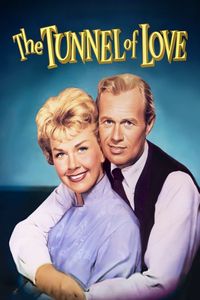
    (On Cable TV, September 2020) The late 1950s were a turning point for legendary singer-dancer-actor Gene Kelly: getting older, he turned his MGM fame into an opportunity to start directing movies. The best known of them probably remains Hello Dolly!, but the first would be the comparatively little-known The Tunnel of Love, a romantic comedy that pushes some disquieting buttons, such as marital infidelity. (Heck—much of the film’s later half is built on the suggestion of infidelity leading to a pregnancy leading to a baby being adopted by the man and his increasingly furious wife.) With such touchy material, it’s no wonder if the film flopped and the critics were not kind—with a number of contemporary reviews being particularly uncomfortable about the boundaries that the film was pushing in terms of sexual frankness. The Tunnel of Love feels tame today, but there’s still some material in here that seems cruel to the female lead: a combination of patriarchal aloofness and contrived avoidance of essential discussions that makes the film less than pleasant to watch even today. (This is one of those films where the plot falls apart if the two main characters had good ongoing communication.) Filmed in black-and-white, it also carries a connotation of seriousness that other colour comedies of the time didn’t have. Richard Widmark is not entirely suited to a role that crucially carries the film—Doris Day, meanwhile, is more pitiable than comic as his long-suffering wife. The direction itself is somewhat unremarkable, perhaps more noteworthy for the topic matter than the actual craftsmanship that it demonstrates. Kelly would later do much better as a director: even in the same infidelity-comedy ballpark, A Guide for the Married Man, ten years later, would be funnier and more interesting to watch, probably buoyed by changing mores and acceptance of a saucy topic matter.

  • Pillow Talk (1959)

    Pillow Talk (1959)

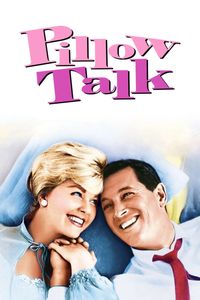
    (On Cable TV, May 2020) Doris Day may now be known better for her late-career chaste and demure roles, but she was a feminist icon in many of her earlier movies—independent, feisty, with a good job, and not willing to compromise on her choices of romantic partners. Pillow Talk is somewhere between those poles, but closer to the female-empowerment side. Naughty then but almost wholesome now, it’s the story of a Manhattan career girl who falls in love with a fellow user of a telephone party line—an early precursor to the gentle sex comedies of the early 1960s. (If you liked Mad Men, there’s a bit of this in here.) The technological limitations of a party line clearly date this, but the Oscar-winning script remains compelling, with plenty of well-used voiceovers reinforcing the comedy of the plot. Pillow Talk’s biggest assets remain its lead actors, with Doris Day and Rock Hudson sharing the screen for the first of three times (you’ll understand why the fuss after watching the film), and supported by notables such as Thelma Ritter (nominated for an Academy Award) and Tony Randall in a very Tony Randallish role. Perry Blackwell is also a bit of a highlight as a sassy lounge singer. Pillow Talk also works well as a glorious Eastmancolor time capsule through comfortable-class late-1950s Manhattan apartments, with three-way split screens to further enliven things. There’s some uncomfortable irony in having Hudson’s character insinuate (with malice) that someone else is gay. Other than this slip-up, Pillow Talk is quite entertaining and its familiarity with various tropes certainly helps spruce things up. Meanwhile, Day gets a bit of a glow-up over previous roles and makes it work to her advantage.

  • The Man Who Knew Too Much (1956)

    The Man Who Knew Too Much (1956)

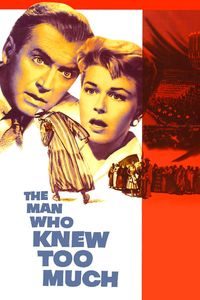
    (On Cable TV, December 2017) I distinctly remember the cymbal climax of The Man Who Knew Too Much from boyhood memories, so technically this would be a second viewing … but given that I only remembered that, let’s not pretend that I’m revisiting it. After all, watching it today I’m more interested in seeing another Alfred Hitchcock movie starring James Stewart and Doris Day. The result is in line with expectations, although I’ll note that overall, and compared to other Hitchcock movies of the same era, The Man Who Knew Too Much feels more average than it should. It’s overlong, with some sequences milking the same emotions to diminishing return. It takes much longer than it should to get started, and the “Que Sera, Sera” climax, while effective, is extended far too long after the cymbal moment to be as satisfying as it could be. Even Stewart, as good as he is, seems to be coasting on an average performance in an average film. Some of the plot curlicues are suspiciously convenient (such as having Day’s character being a retired yet still famous singer) but that’s to be expected. Still, for all of what’s not so good about The Man Who Knew Too Much, it’s still a Hitchcock film from the director’s competent period, with likable smart leads in Stewart and not-so-icy blonde Day. The suspense is well handled and if the film feels lacking today, it’s largely because it has set the standard through which modern thrillers are examined. As an entry through Hitchcock’s filmography, it’s a painless enough viewing.