Dorothy Gish

  • The Whistle at Eaton Falls (1951)

    The Whistle at Eaton Falls (1951)

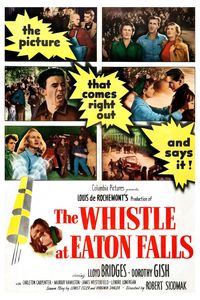
    (On Cable TV, May 2021) Turner Classic Movies often uses its annual Film Festival to virtually resurrect films that have been nearly forgotten. Typically using a recent studio restoration as a pretext for a “world premiere,” they unearth a surprisingly steady stream of films from the archives, polishing them off and giving them a new chance at modern viewership. The Whistle at Eaton Falls is a movie that has time-travelled very well, considering that it’s about a factory town dealing with new technology, efficiency efforts and the inevitable layoffs. The cast has some strong highlights, with Lloyd Bridges in the lead role, and notables such as Dorothy Gish and Ernest Borgnine in supporting roles. The restoration simply looks crisp and terrific, with impeccable sound. Best of all is the small-town atmosphere that turns into a pressure cooker, as commercial imperatives threaten to split the community apart. (Fortunately, there’s a happy ending.)  The emphasis on characters trying to do the right thing in the face of capitalist imperatives, navigating between owners and unions, does add some depth to a film that doesn’t fit neatly into the big genres of the early 1950s. The Whistle at Eaton Falls is not a spectacular film, but it’s a satisfying one, and it can be watched more easily than you’d think. Another solid case for film restoration.
  • Orphans of the Storm (1921)

    Orphans of the Storm (1921)

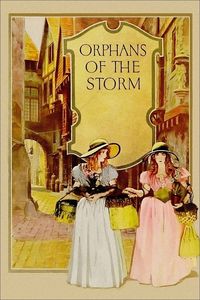
    (YouTube Streaming, February 2021) When it comes to early film director D.W. Griffith’s work, I should probably take a look at his best-known work rather than more minor productions such as Orphans of the Storm, a film about two orphan girls during the French Revolution. Still, you can often learn more about average entries than masterpieces, and it doesn’t take two minutes for Griffith to start lecturing through opening title cards that “The lesson — the French Revolution RIGHTLY overthrew a BAD government. But we in America should be careful lest we with a GOOD government mistake fanatics for leaders and exchange our decent law and order for Anarchy and Bolshevism.” (Emphasis his.)  This naïve political science lesson sounds stupid coming from someone whose infamously racist Birth of a Nation led to a resurgence of the Klu Klux Klan, but that’s Griffith for you. Cheerfully using the French Revolution to score domestic political points, Orphans of the Storm is perhaps best enjoyed as a showcase for Lillian and Dorothy Gish, as well as for Griffith’s undeniable talent, even at this early stage of cinema history, for re-creating lavish historical scenes with hundreds of extras. The story itself is the kind of melodramatic hokum that was in vogue at the time, adapted from a well-known novel and featuring not only orphans, revolution and anti-aristocratic resentment, but plot-convenient blindness as well. It’s… interesting in the way many first-rate 1920s silent productions are, which is to say that it’s often a slog to get through the historically relevant material. I still have a few more Griffith movies in my future as a cinephile, but I’m not really looking forward to any of them.