Dr. Seuss

  • The Cat in the Hat (2003)

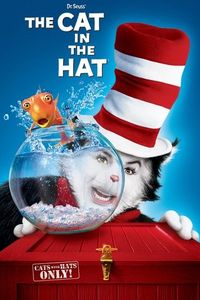
    The Cat in the Hat (2003)

    (On Cable TV, October 2021) Star power is a double-edged sword, as The Cat in the Hat certainly shows. On the plus side, you’ve got Mike Myers in fine form showboating through a script very loosely inspired by the classic Dr. Seuss book, almost literally chewing through scenery and making asides to the camera (and the adults watching) in an energetic, nay, anarchic fashion. On the minus side, this unbridled performance is utterly unlike the spirit of the Seuss book and it doesn’t take much for the irritation to set in. Add to that the grotesque catlike makeup given to Myers and you’ve got something that requires some indulgence to tolerate. Considering that I’m not all that attached to Seuss’ work (his material isn’t as popular in my native French), deviations from the original story don’t really bother me—in fact, considering the made-up word salad often found in Seuss’ work, I’d rather not focus too much on being faithful. But Myers can be exasperating in manic mode, and there isn’t a single wall left standing when he’s done breaking the sets down. The wink-wink-nudge-nudge jokes he addresses to the adults are a baffling departure of what the book stands for—maybe funny in a desacralization fashion, but certainly not family-appropriate. The Cat in the Hat is at least as colourful as it’s hyperactive: everything is shot in bright colours and fantastic designs that don’t have much to do with realism. It’s a good thing that the result is only 82 minutes, because any longer would have been too much. There are some wonderful stories of Mike Myers being a very unpleasant person working on the film, and those anecdotes do fit really well with the theory that he had an oversized influence on the result, improvising material rather than sticking to the vision. Ah well—the Seuss estate made some hasty changes to its movie adaptation rights following The Cat in the Hat, and seeing the results since then (three much-better animated versions of classic Seuss tales), we can see that the debacle actually served a purpose.

  • How the Grinch Stole Christmas! (1966)

    How the Grinch Stole Christmas! (1966)

    (Second viewing, On TV, December 2018) This being December and all, I thought it was an appropriate time for revisiting the first classic adaptation of Dr. Seuss’ How the Grinch Stole Christmas. I distinctly recall seeing it as a kid—or at least the sequence in which the Grinch’s machine folds upon itself, which stuck in mind as one of the coolest things ever. With Chuck Jones as the director and Boris Karloff as the narrator, there’s even some serious star-power included. Alas, time has not been kind to a middle-aged second look at the film. It’s very familiar by now, and I do wonder how much of the film’s reputation runs almost entirely on nostalgia. Short and not quite as impressive (on a technical level) as I had remembered it, How the Grinch Stole Christmas does still have a very nice (if overused) message. Still, I can’t help but being disappointed. But considering that the entire thing is barely 26 minutes long, I should probably just stop here.

  • Horton Hears a Who! (2008)

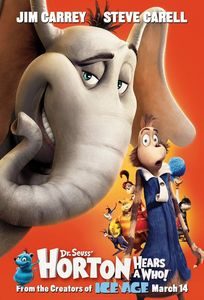
    Horton Hears a Who! (2008)

    (On Cable TV, December 2016) Big, colourful and bold, Horton Hears a Who! Is nonetheless a wholly average animated film. I don’t mean this as a slam: After all, the bare minimum for a kid’s movie these days is something that won’t make adults run away screaming after the fifth repetition. In this regard, Horton Hears a Who! is decently successful: There’s a lot to look at in terms of animation, and the story is serviceable enough to string along the set pieces. There’s a good moment of needle-in-a-haystack despair late in the move that’s a bit heavier than I expected for a film for young audiences. While I’m told that the film is greatly expanded from the original book, much of Dr. Seuss’s particular whimsy is captured in the film’s aesthetics. (Unfortunately, I happen to dislike the Seuss style…) Voice performances are fine, the animation is decent … but the film as a whole remains just this side of forgettable. At least it’s not actively unpleasant, and that’s already something.

  • The Lorax (2012)

    The Lorax (2012)

    (On Cable TV, June 2013) There’s a basic and inherent self-contradiction in seeing big-budget Hollywood productions espouse the virtues of environmentalism: The vast expenditure of effort and resources required to make, distribute and promote those films is staggering, and given the mere-entertainment result it’s hard to reconcile it with the good that an equivalent amount of money could have been done had it been spent on concrete projects.  But then again, entertainment can inspire… and I just spent 90 minutes watching a film while I could have been picking up litter at the nearest riverfront, so who am I to criticize?  Taken on its own terms The Lorax is at least entertaining enough, and responsible enough in the message it’s teaching to its audience.  While the whimsy of Dr. Seuss’ original book is completely squashed by the de-rigueur aesthetics of modern action-packed animated features, this film adaptation contains a few effective moments, a sympathetic pair of protagonists, a colorful vision of a fantasy world and a few decent action sequences.  The animation, coming from Illumination Entertainment, is a top-notch blend of technical savvy, bright colors and effective direction.  The musical numbers are generally good, especially when they manage to advance the plot along the way.  While The Lorax may strike a few as hypocritical, it’s relatively enjoyable once you get past the most obvious issues.