
Dudley Moore

  • Santa Claus: The Movie (1985)

    Santa Claus: The Movie (1985)

    (In French, On Cable TV, December 2021) There’s a subgenre of Christmas movies that I call the Santa Procedural — a film where a good chunk of the running time is spent discussing how Santa came to be, how he manages to deliver those presents, and/or try to fit him in the real world. The Santa Clause, Klaus and Arthur Christmas all have various elements of those, and I suppose that it’s my fault for somehow not seeing the 1985 Santa Claus: The Movie as a predecessor to all of those. Starting in historical times, this is a film showing us how the various elements of the Santa Claus mythology came together, then moves to the 1980s to show the Claus legacy threatened by a renegade elf and an amoral businessman intent on replacing Claus by the toy industry. (What young readers don’t know is that this is a documentary… wait, am I kidding?)  While Santa Claus: The Movie does have a few noteworthy names in the cast (notably Dudley Moore as an elf and John Lithgow as the businessman), the result remains more interesting than good. The use of dull fantasy elements and kids’ movie contrivances such as the “Super-Duper Looper” weakens the result, while the pacing is inconsistent. Santa Claus: The Movie, limited by a common-denominator script, inconsistent set design and the state of mid-1980s special effects technology, doesn’t quite convince and doesn’t quite create a nostalgic sentiment either. Still, it can be worth a look for the more engineering-minded viewers, especially when you measure it against later and better works in the same procedural subgenre.
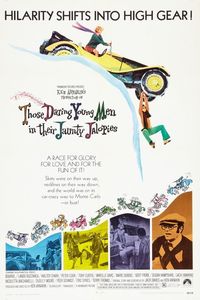
  • Monte Carlo or Bust! aka Those Daring Young Men in Their Jaunty Jalopies (1969)

    Monte Carlo or Bust! aka Those Daring Young Men in Their Jaunty Jalopies (1969)

    (On TV, June 2021) If you’re noticing a slight titling resemblance between Those Daring Young Men in Their Jaunty Jalopies and the better known Those Magnificent Men in Their Flying Machines, well, that’s not an accident: Monte Carlo or Bust! was made as a sequel to the earlier flying film, and the American release simply retitled the result to make it even more clearly related to its 1965 predecessor. The premise is a ground-bound variant, the characters are similar but not meant to be related (even if some of the cast is the same, no character is meant to carry from one to the other), and the style is very similar: Random comic mayhem across a large ensemble cast, structured around a race that’s never as simple as it would appear in the first place. Terry-Thomas plays a large part in this film, but the ensemble cast includes such notables as Tony Curtis (who, for extra bonus points, also played a racer in the similarly-themed but funnier The Great Race), Dudley Moore, and Gert Fröbe. The 1920s setting means that we’re back in a somewhat heroic era for racing, with many mishaps along the way that would do not exist in a more modern age. Monte Carlo or Bust is decently amusing, but it is not snappy: at slightly more than two hours, it’s very much an epic comedy that favours large-scale practical gags rather than tight dialogue or fast pacing. There’s a little bit of romance to make it sweeter, but the overall impression remains of an amiable, often spectacular sort of comedy. It hasn’t aged as well as it should, but it keeps some of its period charm.

  • Like Father Like Son (1987)

    Like Father Like Son (1987)

    (In French, On Cable TV, June 2020) The popularity of body-switching comedies during the 1980s is mystifying but not unexplainable, as any comedian who’s worth their SAG card would jump at the opportunity to goof off as someone else. Dudley Moore certainly hams it up playing a teenager switched in an adult body in Like Father Like Son—but Kirk Cameron is far from being as interesting playing the adult in a teenager’s body. The film noticeably becomes duller toward the middle, as scenes drag on without much wit, and loose ends are left dangling all over the place. Like Father Like Son is seemingly assembled from standard plot pieces, all the way to the usual plot resolution and moralistic restrictions (no, there won’t be any switched-body hanky-panky—this is PG-13 after all!) It’s all a bit too middle-of-the-road to be fully interesting.

  • Best Defense (1984)

    Best Defense (1984)

    (In French, On Cable TV, February 2020) I’m glad I read about Best Defense’s troubled production before writing this review, because it turns out that what I liked best about it are almost accidental consequences of an attempt to save the film from a critical savaging. From the get-go, the film offers two timelines: One, in 1982, with a bumbling engineer trying to perfect a piece of military equipment, and another in 1984 of a soldier having to use the equipment in a military engagement. Already, this dual-timeline structure is far more interesting than the norm. But as it turns out, the 1984 subplot was added in reshoots when the 1982 scenes proved too terrible to exist by themselves. In that, at least, the studio acknowledged reality. Unexplainably relying on Dudley Moore as a protagonist (the more I see of Moore’s movies, the less I like his comic persona), the bulk of Best Defense tries to convince us that it’s worth cheering for an incompetent, lecherous would-be-adulterous idiot. (Has Moore played anything else?) Needless to say, this has aged poorly these days, especially during an American administration that has nakedly shown the consequences of incompetence. If you can manage to get over his performance, the film gets far more interesting when it plays with its dual timelines, the actions of 1982 having consequences in 1984, as none other than Eddie Murphy (then exploding as a megastar, and clearly funnier than Moore, even in showboating) playing the soldier struggling with the engineer-designed equipment. Amusingly enough, the film anticipates the Iraqi invasion of Kuwait eight years before it happened—although let’s not see in this anything but a lucky coincidence. The result is a bit of a mess—an intriguing structure that was bolted upon a far less interesting film. Murphy escapes from the film mostly intact, along with Kate Capshaw as the voice of reason to man-child Moore. Best Defense is interesting but for all the wrong reasons—and I’m not going to recommend it to any unsuspecting audience.

  • 10 (1979)

    10 (1979)

    (In French, On TV, March 2019) If you’re looking for where that picture of Bo Derek in cornrows and bikini comes from—it comes from 10. If you’re looking for the origins of Maurice Ravel’s Boléro reputation as a naughty piece—it also comes from 10. If you’re wondering about movies in which an older man obsessively stalks a significantly younger woman—yeah, OK, 10 didn’t come up with that, but it’s certainly blatant about it. What worked in 1979, however, isn’t necessarily so warmly greeted decades later—the shtick of having a middle-aged man instantly fall for the bride of another man, to the point of following them on their honeymoon doesn’t get many laughs nowadays. In fact, 10 feels like an obnoxious film about a middle-aged white man going through a midlife crisis by lusting after a teenager. It’s very much a sex comedy from comedy veteran Blake Edwards, except that the laughs now feel forced. Pratfalls and goofs from a character can be endearing or annoying depending on our attachment to the character but here, despite Dudley Moore’s natural charm, he just comes across as a lout. I don’t think such a film as 10 would be acceptable today, and that’s welcome progress.

  • Arthur (1981)

    Arthur (1981)

    (In French, On Cable TV, December 2018) Here’s a useless bit of childhood memory: Back when I was a boy, there was a French-Canadian TV show hosted by René Homier-Roy that offered viewers a choice between two movies to watch—viewers could call in during the following week, and pick the movie they wanted to see. Homier-Roy (a legend in French-Canadian broadcasting) would often pit 1981’s Arthur against other picks, nudging viewers toward it … only to be disappointed when viewers inevitably picked the other film. I only mention this because this is the kind of childhood memory that sticks in mind and leads middle-aged men to finally sit down and see what the fuss was about. Alas, the childhood curiosity was better than the adult review: While I can see how Arthur may have appealed to certain audiences in 1981, it feels like a stultifying bore in 2018. I’ll admit that my overall lack of interest in Liza Minnelli may have something to do with it—given that she’s the film’s love interest and hence the goal to motivate everything else, a lack of interest there means severely limiting the film’s appeal. More successful is Dudley Moore’s portrayal of the title character—a wealthy heir seemingly content in drinking himself to a constant stupor, and indulging in a few eccentricities along the way. He’s slated to marry another heiress, but then comes Minnelli’s character—a lower-class young woman—to change his ways. Arthur is really a belated coming-of-age romantic comedy, as an adult character who never had a reason to grow up suddenly has to—notably through the death of a surrogate father. There’s a touch of sadness to Arthur that prevents it from being an all-out feel-good romantic comedy, something reinforced with the gritty backdrop of early-1980s New York City. It works, but I was not as charmed or as amused as I expected it to be—but perhaps I’m unfairly comparing it to the shallowed but funnier 2011 remake. Sorry, René: I too would still pick something other than Arthur if you offered me the choice.