
Elizabeth Debicki

  • The Burnt Orange Heresy (2019)

    The Burnt Orange Heresy (2019)

    (On Cable TV, May 2021) As someone who’s constantly fascinated by the modern art world, it was easy to slip into The Burnt Orange Heresy’s opening scenes, as the worst kind of art critic (the lying kind) begins an affair with a whip-smart woman who is pretty good at naked bedroom repartee. He’s played by Claes Bang, whose good looks and turn as an art curator in The Square clearly prepared him for the role; she’s played by Elizabeth Debicki, who gets steadily more interesting with every film. But what begins as a chilly romance soon becomes something else and then something else again, as they are invited to the estate of a multimillionaire that also acts as the residence of a reclusive artist. That pair is played by the unlikely duo of Mick Jagger and Donald Sutherland, bringing additional interest to the result. A second act delving into more art-world intricacies follows, helped along with Sutherland’s easy likability. But then The Burnt Orange Heresy finally cashes in on its vague forebodingness by turning into a thriller in which many characters die in not-very-believable ways. It’s ironic that I, an at-times over-strident genre fiction fan, would bemoan the film’s turn into murder — after all, it’s adapted from a novel and it’s not as if we’re led at any point to assume that this is going to be a frothy romantic comedy. Still, the murdery section of the film isn’t nearly as interesting as what comes before it, and it’s by that metric that I allow myself to be disappointed by the third act. It doesn’t make The Burnt Orange Heresy any less interesting, but it does give it a scattered, inconsistent impression that lingers on long after the credits roll.

  • Tenet (2020)

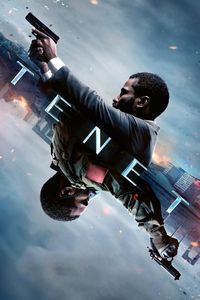
    Tenet (2020)

    (Video on-Demand, January 2021) I’m favourably predisposed toward anything from writer-director Christopher Nolan, but it’s not an uncritical stance, especially when Tenet doesn’t quite manage to meet its own objectives. It’s certainly, unmistakably a Nolan film: You can quickly recognize his thematic preoccupation with time, his love for spy thrillers, his willingness to play with narrative structure and the thematic winks toward filmmaking. You can once again experience the cool palette of colours, the crisp cinematography, the bombastic score and many of his usual favourite actors. (The theatrical experience of watching Tenet was reportedly marred by inappropriate sound mixing, but that doesn’t seem to be the case on home video—and I watch movies with subtitles anyway.)  But Nolan can be too clever for his own good, and Tenet’s gimmick—reversing the time flow—is intriguing at first, then nonsensical in its details, then fascinating again when it leads to big novel action sequences, then incomprehensible again when you start asking questions. Tenet hovers perilously on the edge of disbelief, sometimes retreating to the unquestioning safety of a slam-bang action sequence, at other times hampered by its own confusion. I did love much of the first half-hour for the way it sets up a high-octane modern spy thriller, as if James Bond dove in Science Fiction and reinvigorated its formula. John David Washington makes for a good action hero, and while I’m already steadily growing more favourable to Robert Pattinson, this is the film that reassured me that he’s going to age into a great career. Elizabeth Debicki improves the longer the film goes on, ultimately getting up to Widows-level shenanigans late in the third act. Michael Caine has a terrific one-scene cameo, and Dimple Kapadia is also quite intriguing in a strong supporting role. Still, the star here is Nolan, as he builds an ambitious film that goes back and forth in its temporal narrative and delivers impressive showpieces. Fans of time-travel movies will learn to recognize the usual touches of the genre—Tenet is a film that benefits from a second watch, or reading a thorough analysis of it shortly after first viewing. The action sequence at the middle of the film is easily better than the too-chaotic conclusion that mars the third act—I recognize what Nolan was trying to do, but much of it simply appears confusing for confusion’s sake—or worse for visuals that don’t fit into the overall logic of the film. Compared to the luminous clarity of Inception, Tenet feels undercooked, leading viewers to ask questions about plausibility that are not to the film’s benefit. I still had a good time watching it, but I can’t help but remain unsatisfied by the result—it’s 75% of a great movie, and while that’s far preferable to most contemporary thrillers, it falls short of what Nolan usually delivers.

  • Widows (2018)

    Widows (2018)

    (On Cable TV, July 2019) At first glance, it felt strange to have acclaimed writer-director Steve MacQueen tackle a seemingly straightforward thriller project—his movies so far aimed at more mainstream dramatic sensibilities. But “let’s wait and see” is the right kind of attitude in response to such news, and from the get-go Widows proves that MacQueen certainly know what he’s doing. Delivering on thrills while digging far deeper in its characters than most genre films, Widows tackles the heist genre with a desperate urgency for its soon-to-be-destitute characters, delivering car chases and suspense while offering a plot where a surprising number of characters aren’t always what they seem. Genre expectations are frequently dashed, whether we’re shown a municipal race where white-heir vs. black-activist isn’t a straightforward choice, where initial character impressions are misleading, and where we’re offered quite a different heist team than usual. Comparisons with Ocean’s Eight are instructive, in that Widows doesn’t think heists are comic, goes for straight hard cash rather than fancy jewelry and spends much of its time in preparation rather than execution. The ridiculously talented ensemble cast is wondrous enough—Viola Davis is ferocious here, sometimes even sexy; Colin Farrell turns in a nicely nuanced portrait that goes beyond that of an antagonist the audience is primed to hate; Robert Duvall is remarkable in three short scenes; Elizabeth Debicki is a revelation (she’s a familiar face, but never used as well as here); Michelle Rodriguez fulfills some of the promise she’s had as a dramatic actress; Liam Neeson turns in an inversion of his usual action hero roles; and Daniel Kaluuya makes for a fearsome antagonist. But the MVP here remains MacQueen, who sets up some shots so beautifully that you only realize what they mean at the end of them, with long soaring camera takes and an ability to deliver exciting action sequences like a seasoned action professional. Widows is a complete and satisfying package for crime fiction fans—a socially relevant tale of heist and personal growth, using disfavoured and marginalized heroes to heighten the stakes beyond what they usually are. There’s a place for both the comic Ocean’s series of movies and for Widows, but since there’s been a death of Widows-like films lately, this one is a welcome sight.