Elizabeth Pena

  • Vibes (1988)

    Vibes (1988)

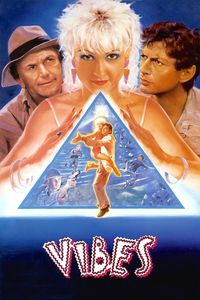
    (On Cable TV, March 2021) I’m not sure if the cast or the loopy premise is what makes Vibes worth a look despite not being that much of a good movie. It does start in a very weird, very dated way, as volunteers are matter-of-fact tested for psychic powers and the evidence is portrayed as incontrovertible. This, apparently, isn’t a big deal in the universe of the film, but rather a setup for a romantic comedy in which a psychometrist (a young and gangly Jeff Goldblum) meets cute with a trance-medium (Cindy Lauper!) that gets otherworldly information from an unheard spirit guide. Both of them are then hired under false pretence to find a treasure high up Ecuador’s mountains by a mysterious man (Peter Falk). It all leads to a mixture of romance and paranormal adventure, enlivened by a deliberately awkward performance from Goldblum and a bubbly take from Lauper. The casting surprises continue into the supporting role, what with Julian Sands popping up as an antagonist, an early turn by Elizabeth Peña in arresting lingerie, and Steve Buscemi in a brief role as a no-good boyfriend. Unfortunately, even the off-kilter opening and the intriguing cast can’t quite manage to make Vibes a success — at best, it’s an entirely forgettable film that struggles with the ideas and actors at its disposal. At worst, it feels like a cynical product, taking some woo-woo themes and awkwardly grafting it onto a formula blend of familiar genres and narratives. Still, the verdict is in, and the cast remains the best reason to seek out the film: Goldblum is definitely worth a look, and so is Lauper in one of her few acting roles.

  • Ana Maria in Novela Land (2015)

    Ana Maria in Novela Land (2015)

    (In French, On TV, May 2020) I suppose that the high-concept was so irresistible that it had to be done at some point: Why not a cute romantic comedy in which an obsessed telenovela fan switches places with the star of her favourite series? In the hands of writer-director Georgina Garcia Riedel, Ana Maria in Novela Land does tap into some of the insanity and stylistic excesses of the stereotypical telenovelas. It does help that it stars Edy Ganem, a preposterously attractive and likable lead actress who looks completely at home in the hyper-sexy nature of telenovelas. While it may not completely deliver on the premise, it’s pleasant enough to watch and is even (like its inspiration) occasionally racy within the confines of the rating. There are a few very interesting casting choices in supporting roles—Elizabeth Peña’s last role, Luis Guzman as the heavy and Sung Kang as a Korean soap opera star. A few quirks and moments don’t quite make cohesive sense—bathroom, zombies, musical segments and Korean soap—which reinforces the feeling that while this is not bad, it’s also a bit scattered and unfocused in how it approaches its premise. A measure of Ana Maria in Novela Land’s imperfect success is to be found in the film’s length feeling overlong even at barely 89 minutes. Still, it’s watchable enough.

  • Down and out in Beverly Hills (1986)

    Down and out in Beverly Hills (1986)

    (In French, On Cable TV, November 2019) There’s something quite provincial in Hollywood making a movie about class differences in Beverly Hills—I can’t figure out whether Down and out in Beverly Hills is hypocritical or self-flagellating, although with writer-director Paul Mazursky at the helm, it’s closer to a gentle critique than outright satire. The plot gets moving once a bum nearly drowns in a rich family’s house, and they welcome him out of a sense of guilt. But the bum (as is tradition) sees clearer and thinks farther than his new dysfunctional family and before long sorts out all kinds of big and small problems. The plot schematics are obvious, but the film does a little bit better on moment-to-moment viewing thanks to a capable cast. In between Nick Nolte, Bette Midler, Richard Dreyfuss and a young Elizabeth Peña (plus Little Richard as a neighbour), the film does have its charms, and recognizably aims for more than just the laughs. Thematically, I’m bothered by how the film doesn’t seem to have the courage of its convictions—I’m not sure that the dysfunctional family won’t be back to dysfunction within the week. This may be a consequence of Mazursky not quite going for comedy and not quite going for drama—Down and Out in Beverly Hills ends up being a less-than-satisfying hybrid, watchable but not admirable.

  • La Bamba (1987)

    La Bamba (1987)

    (In French, On TV, April 2019) It happened more than a decade and a half before I was born, but I’m still surprisingly mournful about The Day the Music Died — The February 1959 plane crash that killed Buddy Holly, Ritchie Valens, and “The Big Bopper” J. P. Richardson. Much of the story has been told in another film (1978’s The Buddy Holly Story), but La Bamba focuses on the life of Richie Valens, who died just as he was gathering attention as a rocker. The film is thin but satisfying, spending a lot of time on the rags-to-fame aspect of Valens’s life, occasionally delivering a musical number along the way. From a story perspective, it’s not much and not particularly uplifting (the film, knowing that many viewers already know the end of the story, heavily prefigures its ending by focusing on Valens’s fear of dying in a plane crash even from the first scene), so much of the appeal depends on the film’s musical numbers. Fortunately, there are a few high-powered numbers along the way, not only from Valens (“Donna” but especially his rock-and-roll take on the until-then folk song “La Bamba”) but also other musicians from the early rock-and-roll era in its fun and carefree atmosphere. The centrepiece of La Bamba, of course, is Lou Diamond Phillips’s first on-screen role, a tough part that requires good acting and performing skills. Fortunately, Phillips nails it—his stage performances are very enjoyable once he hits the big time in the film’s second half, with some underrated support from Esai Morales as his brother and Elizabeth Peña as his sister-in-law. While La Bamba isn’t perfect (I would have liked to see more time spent with the musicians) and seems cut short just as dramatically as Valens’s own career, it does have a few strong moments and its credit sequence, after a sombre ending, ends by highlighting its biggest strength once more—an uncut shot of Phillips performing “La Bamba” one more time.

  • *batteries not included (1987)

    *batteries not included (1987)

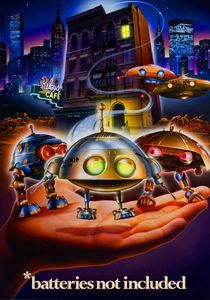
    (Second Viewing, On TV, March 2019) I must have seen *batteries not included as a teenager in the early 1990s, and remembered a strange mix between special effects work and unabashed sentimentality. As it turns out, that’s not too far away from an impression left by a second middle-aged look at the film, as the film blends then-top-notch special effects work with a script that wears its heart on its sleeve at multiple levels. The premise focuses on an old building in the middle of an area cleared for high-rise development. As you’d expect, the villains are real estate developers doing their best to force the tenants to move out. It just so happens that alien creatures then enter the picture, nesting on top of the building and helping with minor repairs and good actions throughout the building. The rest goes on from there, with no one really being surprised at how it ends. Director Matthew Robbins keeps a good balance between special effects showcases (some of them still quite effective) and more humanistic moments. The film is built on a nice unity of place, to the point where it feels off-putting when the action eventually leaves the apartment block. It’s sentimental for sure, but it’s difficult to dislike a film so optimistic—although the “baby alien” creature is pushing things. For cinephiles, what’s perhaps most remarkable about *batteries not included is the number of known names from different eras assembled for the occasion: It’s one of the last recognizable roles for veteran actor Hume Cronyn, a decent performance from his wife Jessica Tandy, a rather young Elizabeth Pena, and a screenwriting debut for Brad Bird. Predictable but not bad, *batteries not included still works as a film for the entire family.