Elizabeth Taylor

  • Giant (1956)

    Giant (1956)

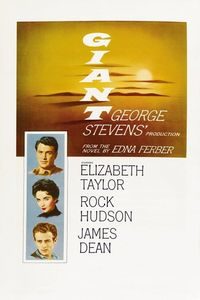
    (On Cable TV, May 2018) As a swan song for James Dean, Giant is a fitting statement. A vast family generational drama set in the vast expanses of oil-rich Texas, Giant begins as our newlywed heroine (the ever-captivating Elizabeth Taylor) moves from the East Coast to arid Texas, and befriends a ranch hand (Dean). One semi-accidental death later, the ranch hand inherits some land that proves to be soaked with oil. Over the next few decades, he develops an empire, leading to a climactic confrontation at the opening of his grand hotel where long-held feuds are detonated. Dean manages to play both a young cowboy and an aging industrialist, holding his own not only against Taylor, but also Rock Hudson as the ranch owner who ends up butting heads with his ex-employee. If Giant has a flaw, it’s that it’s a really, really long movie at three hours and twenty-one minutes. I don’t mind the multi-decade scope as much as the length of each individual scene—time and time again, the film takes forever to make a point that could have been made far more efficiently. Surprisingly enough, I don’t quite dislike Dean’s performance—he’s mopey in the film’s first half, but rural mopey rather than urban mopey or suburban mopey such as in his other two films and as such sidesteps his caricatures that have emerged since then. In the film’s last half, he effectively becomes a drunken unhappy industrialist and actually sells the role rather well despite playing decades older than he was at the time. My other issue with Giant is how it doesn’t reach a climax as much as it blows up over a lengthy period at the hotel, then moves to a roadside diner for a moral climax that actually makes the film’s conclusion feel far smaller. That’s what you get from working from a novel as source material, though—whether you have the guts to change what doesn’t make sense on the screen, or you get criticized for it. The film has endured rather well—its anti-racism streak is still surprisingly relevant, and its anti-sexism message also comes across. The film also shows with a decent amount of detail the transition from Texas’ ranching heritage to its more modern oil extraction boom. I may not like Giant all that much, but I respect it a lot, and I frankly find it disappointing that it got beaten by as frothy a spectacle as Around the World in 80 Days for the Best Picture Oscar.

  • Who’s Afraid of Virginia Woolf? (1966)

    Who’s Afraid of Virginia Woolf? (1966)

    (On Cable TV, January 2018) Whew. Some movies are entertainment, some are a spectacle, but Who’s Afraid of Virginia Woolf? feels like a roller derby of emotional destruction. Set among the world of northeastern academics, what first feels like a quasi-parody of mainstream drama quickly turns ugly as a middle-aged history teacher and his wife start arguing, then bring in another younger couple in the clash for “fun and games.”  Nobody escapes unscathed, especially the audience. A solid drama (with streaks of dark but undeniable comedy) becomes something special by virtue of its actors—Not only do Elizabeth Taylor and Richard Burton play the lead couple viciously squabbling, but they were married to each other at the time. Neither Taylor nor Burton have done anything better in their career—Burton, in particular, progressively shrugs off a meek drink-holding character to best his co-star in merciless put-downs. As for Taylor, it’s still impressive to see how she’d transform herself from a sex symbol to a frumpy shrewish housewife for the purposes of the film. (Not that it’s completely successful—even overweight and made-up with aging lines, Taylor-being-Taylor still looks better than anyone else.)  The film was shocking then for its frank language, but it’s still somewhat disturbing today due to its pure harshness: the film’s four characters constantly tear themselves down in the worst possible ways, and score hits on bystanders even when attacking each other. It’s as good as dialogue-driven drama gets, and it’s still remarkably effective today (albeit maybe a touch too long). As a capstone to the Taylor-Burton relationship, though, Who’s Afraid of Virginia Woolf? carries a weight that goes simply beyond a great movie.

  • Cleopatra (1963)

    Cleopatra (1963)

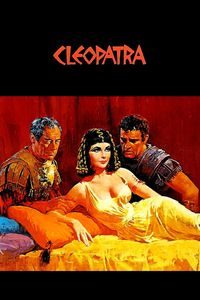
    (On TV, January 2018) Some films are epic enough that they transcend time, and so Cleopatra remains even today a reference for excess in filmmaking. Long a yardstick for the most expensive movie ever produced, Cleopatra is still notable today for the lavishness of its super-production, whether it’s re-creating Cairo or Rome at the height of their power, putting hundreds of extras on-screen or giving more than sixty different costumes to its title character. And then there’s Elizabeth Taylor herself—while people of my generation mostly remember Taylor as an older woman of multiple marriages and excessive makeup, movies like Cleopatra firmly justify why she was a sex symbol for most of her career. Compelling even when the melodrama around her gets too thick to be taken seriously, Taylor is the film’s centrepiece and offers an unqualified reason to watch the film despite the nearly oppressive running time. Not that she’s the only reason: Seeing her play off future-husband Richard Burton is a great way to get into one of cinema history’s most remarkable romance and an insight in the frenzy that their affair created in mid-sixties pop culture and tabloid reporting. Spread the viewing over two evenings if you can—there’s an intermission and a somewhat different tone to the film’s two halves: the first half (Cleopatra and Julius Caesar) is better, but the second half (Cleopatra and Burton’s Mark Anthony) is more interesting. Cleopatra should have been much shorter, but there’s a lot of stuff shown on-screen, and more peak-era Taylor is never a bad thing.

  • Cat on a Hot Tin Roof (1958)

    Cat on a Hot Tin Roof (1958)

    (On DVD, December 2017) There’s something oddly satisfying, in theatrically-inspired movies, in seeing the way the script piles on a series of interpersonal conflict in the first half, only to detonate them all in the second. Cat on a Hot Tin Roof does it better than most, helped along by terrific dialogue from playwright Tennessee Williams, the dramatic intensity of Paul Newman and Elizabeth Taylor in the lead roles, and some able assistance from Burl Ives as the patriarch whose impending death forms the catalyst of all conflicts. Despite some surprisingly comic moments, this is a fairly heavy film, especially when all the emotional bandages are removed at the big conflicts within the small cast of character are allowed to explode. Despite some glaring coyness (the homosexual themes of the relationship between the lead male character and his mourned friend hay not be expressly mentioned, but they’re glaringly obvious), Cat on a Hot Tin Roof hits its dramatic peak in time for its third act, punctuated by a thunderstorm. Taylor is in fine form here, showing the extent of her dramatic range even as illness and personal tragedy befell her during the film’s shooting (her husband died in a plane crash midway through production, which had to be halted to accommodate her grief). The result is still worth a look sixty years later as a good example of what fifties dramas could be, even when hobbled by the Hays Code and social conventions of the time.