Emily Mortimer

  • Transsiberian (2008)

    Transsiberian (2008)

    (On TV, October 2021) Between cinematic strengths and weaknesses, there’s a whole spectrum of mediocre annoyances that will strike some viewers as trivial and others as irritants. So it is that while I’m not ready to condemn Transsiberian as a terrible thriller, it’s just annoying enough that I can’t bring myself to recommend it. Coming from the dark era of the late 2000s, where ugly cinematography was the rage, the film follows an American couple (Emily Mortimer and Woody Harrelson playing an intellectual) as it travels from China to Moscow on the Transsiberian railroad. Of course, it’s a thriller, not a travelogue, so before long they’re stuck with sordid travel companions, drug trafficking and a sinister police officer (Ben Kingsley, effective but clearly slumming it). The suspense is mildly effective, but the film plays a strangely divided game between this ugly, quasi-monochrome cinematography and a lurid storyline that’s about as far away from the grittiness of the visuals. The characters are annoying, and the film doesn’t help by turning them into bloodthirsty killers. A slow start saps initial goodwill, and an overextended finale clearly shows how much it has overstayed its welcome by that point. The train setting is familiar, but the film doesn’t seem to be using all of the opportunities at its disposal to crank up the tension and stick to some kind of spatial unity. Writer-director Brad Anderson’s filmography is incredibly inconsistent, going from the best (The Machinist) to the worst (The Vanishing on 7th Street) and it’s not Transsiberian that makes it any better or worse.

  • The Bookshop (2017)

    The Bookshop (2017)

    (On Cable TV, April 2021) I can recognize a strong, strong bibliophilic wish-fulfillment aspect to The Bookshop, largely by virtue of being a bibliophile myself. Taking place in a 1950s backwater coastal English town, it’s about a woman (Emily Mortimer) bringing civilization to the unenlightened masses by opening a bookshop in a poorly maintained property. But things don’t play out harmoniously, as she comes in conflict with an influential local woman (Patricia Clarkson, unusually malevolent) who had her own plans for the property… and the prejudices of the local population. This being an adaptation of a book aimed at readers, we’re meant to nod in recognition, as some of the time’s literary sensations become plot elements:  One stuffy character’s enthusiasm for Bradbury’s Fahrenheit 451 immediately brands him as a likable character (well, he is played by Bill Nighy), while we know that Nabokov’s Lolita is going to cause some trouble for the protagonist. Where The Bookshop does distinguish itself from expectations, however, is in the somewhat less-than-triumphant finale where the forces of (literary) enlightenment don’t win the fight. You can certainly argue that the defeat reinforces the “you, dear readers, are terrific!” message in showing what happens when the ignorant masses get their way. It’s not necessarily the conclusion we might have hoped for, but it is announced by somewhat austere cinematography that doesn’t miss a chance to show how damp and drafty the setting can be. The Bookshop is meant as a quiet and perhaps even contemplative film — don’t expect any big confrontations, as even the head-to-head arguments between characters are handled with quite a bit of British restraint. It may be manipulative, but it’s not an unpleasant watch: It plays a lot like a rainy-afternoon kind of book.

  • The Pink Panther (2006)

    The Pink Panther (2006)

    (On TV, March 2017) The dangers with slapstick comedies are numerous. Badly handled, they become juvenile, offensive, repetitive and annoying. Well-done, preferably combined with other kinds of humour, slapstick can bring a lot of energy in a comedy. The Steve Martin remake of The Pink Panther doesn’t avoid the worst pitfalls of its subgenre, but it generally succeeds more than it fails, and crucially gets significantly better toward the end. The point of the movie is the character of Inspecteur Clouseau, often bumbling, usually disaster-prone but (this is important) someone who can eventually piece together the mystery in the end. So it is that the first half of The Pink Panther accumulates all of the problems of slapstick. It’s brought down to a kids’ movie worst-common-denominator level, has little subtlety or wit, keeps doubling-down on gags that aren’t funny in the first place and often skirt discomfort at the physical violence of some jokes. Clouseau’s antics are more likely to make audience cringe than laugh. But here and there, we can see signs that the film knows what it’s doing. A few recurring gags and over-the-top madness combine to have a cyclist crash into a newsstand that then explodes, earning the first laugh of the film and reassuring us that the filmmakers are truly going for excess. As the movie goes on, we get to understand its sense of humour better and succumb (at least occasionally) to it. The ending, during which Clouseau pieces everything together in a dazzling sequence of deductions, does quite a bit to endear us to the movie, even as flawed as it is—it’s one thing to have a completely incompetent hero, but it’s much better to see them pull it together in the end. Martin is decent as Clouseau—my memories of Peter Sellers as the original Clouseau are so far away that I don’t have a lot of material for comparison, but he sells both the verbal and the physical comedy. Meanwhile, Jean Reno has a rare (and imposing) clean-shaven role as a sidekick, Kevin Kline has the sadistic-boss role wrapped up, Emily Mortimer is unusually cute as the romantic interest (she gets two or three of the film’s best scenes) and Beyoncé Knowles shows up in a bid to be taken seriously as a comic actress, with middling results. Jason Statham and Clive Owen also very briefly show up in too-small roles. The Pink Panther isn’t particularly good, but it is occasionally effective, and its dedication to slapstick makes for an unusual entry in today’s comedy styling.

  • Our Idiot Brother (2011)

    Our Idiot Brother (2011)

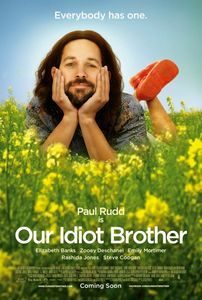
    (On cable TV, April 2012) There’s something almost archetypical in the holy fool that Paul Rudd plays so loosely in Our Idiot Brother: a childish man with no perceptive filters and an almost-infinite good faith in his fellow humans, the titular brother becomes a catalyst for dramatic change when he’s forced to spend time with his three sisters and their families.  The specific of the plot becomes secondary to the character work and the conflagration when too much unfiltered truth exposes everyone’s illusions.  The trailer makes the film look like a laugh-a-minute, but the actual film is more measured and demands to be taken more slowly.  In the roles of the three sisters, Elizabeth Banks, Zooey Deschanel, and Emily Mortimer do fine work, but it’s really Rudd who holds the film on his shoulders.  With all the self-deluded characters, painful confrontations and elaborate rationalizations, Our Idiot Brother becomes a profoundly humanistic film.  As a result, and with the help of a conclusion in which everything predictably goes well, it’s a charming, likable and self-assured film.  It may be a bit too gentle and slow-paced to please those looking for laugh-a-minute hilarity, but when a film has so much charisma, it doesn’t really matter.

  • The 51st State aka Formula 51 (2001)

    The 51st State aka Formula 51 (2001)

    (In theaters, October 2002) If “Samuel L. Jackson in a kilt” doesn’t raise your eyebrow and your interest, that’s fine, move along, nothing to see here… but for everyone else, Formula 51 is a fun little crime comedy. Dynamically directed by Hong Kong action maven Ronny Yu, this film follows the adventures of a very American chemist (Jackson, wearing a kilt throughout) stuck trying to make a drug deal in Liverpool, UK with the help of a reluctant sidekick (Robert Carlyle) while under the gun of a hired assassin (the unspeakably cute Emily Mortimer). Oh, there’s also Meat Loaf, as “The Lizard”. I’m not going to pretend that this is a classic for the ages, but there are quite a few fun moments here and there, from a dynamic opening credit sequence to a golf-club whuppin’ to a car chase (where both leads go “aaah!” at the same time, thereby fulfilling a basic requirement of buddy comedies) to plenty of double-crosses. It’s crunchy good fun, though there’s a bit too much spilt bodily fluids to be clean fun. There’s some amusing material on British/American differences, which is fitting for a Canada-Britain collaboration, I suppose. Younger fans of action/crime comedies should consider checking this one out. More mature viewers may wish to pass…