Emma Roberts

  • Holidate (2020)

    (Netflix Streaming, October 2021) If, like me, you’re wondering where all of the mid-budgeted studio romantic comedies have gone, take heart: the streaming revolution is among us, and with it the return of such movies dumped overboard by superhero-chasing studios. Holidate, from Netflix, is not just a romantic comedy according to the rules of the genre, but a self-aware one that keeps poking and prodding at the conventions before giving in to them. The premise is simple: a single attractive young woman and a single attractive young man agree to date each other for the holidays, saving them the trouble of finding someone to accompany them to themed parties and family events. We all know where it’s going and so do the characters, who openly comment on silly movie conventions even as they each share a ridiculous amount of chemistry. There are plenty of subplots, quirky supporting characters and set-pieces to go around (ensuring that the film concludes with every character happily paired), as well as enough laughs to bolster the comedy part of this romantic comedy. Alas, Holidate is perhaps a bit too modern, because it can’t help itself from excessive profanity (not that bothersome) and excessive violence (bothersome—can we have just one romantic comedy without amputation these days?) in the pursuit of finger puns. (One notes that the script was written by a woman.)  The ending could have been slightly stronger (although the choral “JACKSON!” is a nice touch) and less drawn-out, but it does the job. Neither Emma Roberts nor Luke Bracey are anywhere near my list of favourite actors, but they do well here—even if Kristin Chenoweth reliably steals nearly every scene she’s in. Chicago is used as a somewhat generic backdrop, but director John Whitesell keeps things moving with some energy, especially in scenes set in big parties. I wasn’t expecting much from Holidate, but the result is more aggressively comedic than I expected, and just romantic enough to be effective.

  • Who We Are Now (2017)

    Who We Are Now (2017)

    (On Cable TV, May 2021) Golly gee, Who We Are Now is such a boring film. I’m obviously speaking for myself here — I’m sure that other people will find far more resonance in this tale of a troubled single ex-con trying to regain custody of her child. But writer/director Matthew Newton’s approach is decidedly gritty and low-key — so much so that it doesn’t take much time to start eyeing the exit. Our main character is a deeply flawed and self-destructive person — fresh out of prison, romancing a veteran for dubious reasons, and not always able to demonstrate why she should get custody of her daughter back from her more stable sister. Of course, the deck is stacked in her favour — Who We Are Now is a mainstream American movie, and it just wouldn’t do to suggest that she’s not the best person for the task… even when she acts in ways that most people (outside the frame of a movie in which she is the protagonist) would find unacceptable. This being said, Julianne Nicholson is not bad as the flawed protagonist, Emma Roberts distinguishes herself as a very idealistic lawyer (under the sometimes-rough tutelage of a mentor played by Jimmy Smith) and the film wraps up in a way that may be conventional and predictable but not actively irritating to audiences willing to stick through the entire journey. This being said, there are far more distinctive and memorable films out there, even in the straight-up dramatic genre. Who We Are Now is about as generic as its title, and a chore to get through.

  • Nerve (2016)

    Nerve (2016)

    (On Cable TV, April 2017) Mark me down as pleasantly surprised by energetic teenage techno-thriller Nerve. It’s got an intriguing premise coupled with a rather good execution, and it doesn’t take itself all that seriously nor pretend that it’s anything other than what it is. Adapted from a novel (but wisely choosing to lighten up the original material), Nerve takes current anxieties about social media and puts them into a blender. What comes out is a mobile game in which participants are asked to perform increasingly dangerous dares for an audience of thousands. Smartphones are essential, and so are throngs of followers. Our heroine (Emma Roberts, rather good) falls into the rabbit-hole by accident, but it doesn’t take a long time for her to be stuck alongside a bad-boy teammate (Dave Franco, decent enough) as the stakes increase. (Elsewhere in casting, fans of Orange is the New Black will be amused to see two of the series’ distinctive actresses, Kimiko Glenn and Samira Wiley, back on-screen albeit not necessarily together.) While clearly aimed at a teenage audience, Nerve does benefit from directors Henry Joost and Ariel Schulman’s sense for the zeitgeist and keeping things moving. New York City makes for a fun playground to the action, and the film doesn’t quite shy away from ruminating on the viewer’s complicity in outlandish internet stunts. It’s a teenage film that couldn’t exist as such if it had been made for adults, and that’s quite a distinction by itself. Otherwise, Nerve is a tight 96-minutes thriller, perfect to watch as long as expectations are kept low enough to be surprised.

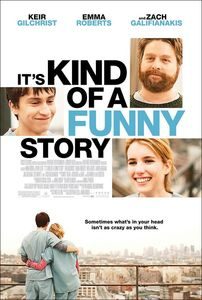
  • It’s Kind of a Funny Story (2010)

    It’s Kind of a Funny Story (2010)

    (Netflix Streaming, March 2017) From its first few off-beat moments, It’s Kind of a Funny Story finds strong kinship in the kind of modest teen dramedies adapted from novels that would become so popular in the 2010s. The literary origins of the script make for a more unusual premise and issues (namely: depression and institutionalization) that hit harder than the average teen movie. Keir Gilchrist is fine as the mostly-mopey protagonist, a depressed teenager who voluntarily checks into a psychiatric hold after a suicide attempt. It doesn’t spoil anything to say that he gets better over the course of the film, encountering friendship and possibly love along the way. Zach Galifianakis in fine form is the wildcard of the story, while Emma Roberts is cute enough as a likely love interest counterbalancing Zoe Kravitz’s more superficial false flame. Otherwise, it’s a movie perhaps more notable for the fractured way in which the first half-hour is handled, leading to a more conventionally heartfelt conclusion. It’s good without being great, although it does hold up decently as a teen drama. Likable, hopeful, occasionally good for a few laughs, It’s Kind of a Funny Story lives up to its title but don’t expect much more.