Ernest Hemingway

  • The Old Man and the Sea (1958)

    The Old Man and the Sea (1958)

    (On Cable TV, April 2021) If you didn’t already know that Ernest Hemingway’s The Old Man and the Sea was a classic of American literature, simply watching the 1958 film adaptation will clue you in. Handled with an omnipresent reverence for the written text, this film often feels like a narrated novel given the amount of slavish adherence it shows toward Hemingway’s voice. Spencer Tracy delivers both the lead performance as the titular Old Man (appearing in nearly every shot of the film) and the voice-overs taken from what I presume must be excerpts of the novel describing his actions as well. Most commentators agree that the film is not only slavishly faithful to the text, but is among the most faithful screen adaptations ever made. Of course, being slavishly faithful does not mean a great movie — especially given the technical requirements of showing a drawn-out fishing battle between man and marlin. The special effects clearly don’t hold up today, and even threaten to overwhelm the rest of the film. Still, Tracy gives it all he’s got, and he got an Oscar nomination out of it. Still, The Old Man and the Sea is a more interesting film than most, if only because of the way it illustrates the pitfalls of an overly reverential screen adaptation. By the end of it, you won’t agree so much with the “original text is sacred’ school of Hollywood adaptation commentary.
  • The Snows of Kilimanjaro (1952)

    The Snows of Kilimanjaro (1952)

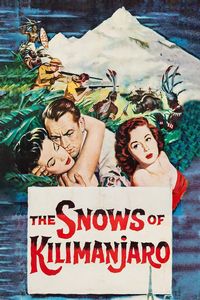
    (On Cable TV, November 2020) Some movies come with impressive pedigrees, and so The Snows of Kilimanjaro can boast of being based on a Hemingway short story. It’s certainly in the grand dramatic tradition of other Hemingway adaptations: The framing device has Gregory Peck playing a writer dying on the slopes of Mount Kilimanjaro and flashing back to earlier episodes of his life. You can see here an early attempt at the kind of epic film that would come to dominate the later half of the decade: going through decades of history and many foreign locations (although much of the film is visibly shot in the studio), it’s meant as a grand tragic statement, a sweeping romance and a summing-up-a-life kind of film. The effect is slightly ruined by the unexpectedly happy ending invented for the film, although it does end the film on a more positive note than you’d expect. Some of the resonances with other Hemingway stories get predictable (oh no, another love interest killed while working in ambulances during the Spanish Civil War!), but that only counts if you’re familiar with the Hemingway-Hollywood corpus. Otherwise, The Snows of Kilimanjaro is very close to what we think of when we picture “old-school Hollywood romantic drama” for better or for worse—I found it a bit long, a bit predictable, a bit dull and a bit overdone. But so it goes.

  • The Killers (1946)

    The Killers (1946)

    (On Cable TV, October 2019) There’s a lot to love in The Killers for fans of classic noir, whether it’s the unusual structure, archetypical characters, glum script, or good dialogue. Burt Lancaster makes his film debut here, and Ava Gardner ignited her career thanks to her performance. It’s all very twisty with a man consenting to his own murder and the film flashing back to what could possibly explain such an event. The opening moments of the film (directly adapted from a Hemingway story) are immediately absorbing, with manly pursuit such as boxing and robbery being touched upon on the way to the end. In many ways, The Killers is pure noir to a fault—if you’re a fan of the genre as I am, you won’t need anything more to appreciate the film, while those who don’t care for noir (is that possible?) won’t see anything here to make them change their minds.

  • For Whom the Bell Tolls (1943)

    For Whom the Bell Tolls (1943)

    (On Cable TV, September 2019) You could be forgiven for thinking, at first glance, that Farewell to Arms and For Whom the Bell Tolls are the same movie—after all, aren’t they both Hemingway novel adaptations featuring Cary Grant as a man who fall in love with a woman during wartime? Well, yes, but there are more than a few differences. For Whom the Bell Tolls, having been made ten years later, features colour cinematography, numerous exteriors, Ingrid Bergman (with short hair), more grandiose wartime sequences, fewer classical-Hollywood touches, and more assurance in how it presents its story. As a long (…very long…) look at the life of rebels during the Spanish Civil War, it spends quite a bit of time detailing life in the bush, tensions between combatants and the love story between our two leads. Cary Grant is his usual solid yet unusually bland self, playing opposite Ingrid Bergman but with both of them being outshined by Katina Paxinou’s harsh-talking hard-living character. (Paxinou won an Oscar for the role, and you can immediately see why.) Given that our protagonist is a dynamiter, there are a few explosions to make things far more interesting. Alas, the film will try anyone’s patience at nearly three hours complete with introduction and intermission.  In trying to adapt a novel as faithfully as possible, the script forgets that movies work differently and the entire thing feels far too long. Still, it’s well executed, occasionally moving, explosively exciting at times. But For Whom the Bell Tolls could have been shorter. And it does end on a note very similar to that of Farewell to Arms, triumphant Hollywood cues outshining tragedy and all.

  • A Farewell to Arms (1932)

    A Farewell to Arms (1932)

    (On Cable TV, September 2019) Despite the technical refinements and permissive storytelling possibilities of today’s cinema, there’s something to be said about the classic Hollywood style of the 1930s. At times overwrought, earnest, melodramatic and shamelessly manipulative, it’s still a style that has weathered the decades remarkably well. You can look at A Farewell to Arms in many ways—as a contemporary adaptation of an autobiographical Ernest Hemingway classic piece of literature, as a showcase for Gary Cooper and Helen Hayes, as an archetypical wartime romantic drama. It’s all of these things, bolstered by capable leads supported by a well-oiled Hollywood machine even in the early 1930s. But the image I keep of A Farewell to Arms is the final shot, as a scene of unparalleled tragedy (the heroine dies after a stillborn child, just as the armistice is declared) is completely transformed into a triumphant, angelic moment: Our hero boldly lifting the body of his dead wife, choir music booming and the camera looking up as he carries her away. It’s pure classic Hollywood, manipulating us in not feeling too bad despite the heartbreaking facts of the moment. It’s quite an achievement, and it ends up taking a lot of the sting out of what could have been a miserable experience. No wonder that Hemingway hated it. But don’t worry—the book is still on the shelves, intact. Whereas the film itself has swept along generations of viewers.

  • To Have and to Have Not (1944)

    To Have and to Have Not (1944)

    (On Cable TV, March 2019) On paper and on the screen, you really have Classic Hollywood running on overdrive in To Have and to Have Not: Let’s see—Howard Hawks directing from a script by William Faulkner from a story/treatment by Ernest Hemingway; Humphrey Bogart and Lauren Bacall as the lead couple, while they were having an affair behind the cameras that would lead to their marriage later on. Coming from Warner Brothers, there’s an obvious kinship here to be made with Casablanca, especially as the story delves into wartime shenanigans between the French Resistance and the Vichy government. Bogart himself clearly plays his own screen persona as the tough and glum smuggler, while Bacall (despite her young age) delivers an exemplary Hawksian-woman performance with more iconic lines of dialogue than most actors get in an entire career. None of this is particularly new (although the Hemingway/Faulkner collaboration is noteworthy), but it’s fun to have another go-around when it works so well—and the Bogart/Bacall chemistry would itself lead to a few encores. Typically for Hawks, there are a few choice quotes, and the direction is limpid, going to the heart of what you can do with Bogart-as-a-rogue and a luminescent Bacall as a strong wartime dame. Not quite noir but certainly not fluffy, To Have and to Have Not is so much fun to watch (although you may want to space your viewing away from Casablanca due to the inevitable parallels) that it ends a bit abruptly, although not without having Bogart shoot a guy, as it should be. The work of several craftsmen all working at the best of their abilities, it’s quite a treat, but also a good example of what the studio system could do when it was firing on all cylinders.