Esther Williams

  • The Hoodlum Saint (1946)

    The Hoodlum Saint (1946)

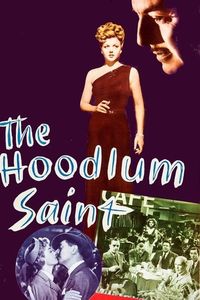
    (On Cable TV, September 2021) Contemporary reviews of The Hoodlum Saint greeted the film with some suspicion — after all, both headliners William Powell and Esther Williams here play characters that noticeably part from their usual screen persona, in a story that’s not fun and games. Williams never sets foot in water — she plays a rather conventional love interest as a foil for Powell’s character — who’s an amoral conman who occasionally sees the light of doing good. Again, it’s not one of his usual roles: he’s a bit too cold, too hard, too criminal for it to qualify as a role fit for Powell’s persona. (Meanwhile, more contemporary viewers may be surprised by Angela Lansbury playing a nightclub singer who turns evil in the last act.) The story itself spans more than a decade as our two leads meet, fall for each other, see their paths diverse and then converge again. It takes us from the aftermath of The Great War all the way to the early 1930s, with an interesting portrayal of exuberant financial speculation in the lead-up to the Great Crash of 1929. Some of the plotting gets arbitrary and melodramatic, but the finale puts all of the pieces back in place. The Hoodlum Saint is not a terrible film: there’s usually something interesting going on, and Powell as a conman without his usual suaveness makes for a darkly compelling variation. Even in a conventional role, Williams proves herself to be more than an aqua-musical bathing beauty, while Lansbury gets a few good moments. But you can see the limits of the film and why it dangerously toys with expectations along the way. It probably plays better today than it did then, but it’s still not quite as good as it could have been.
  • Thrill of a Romance (1945)

    Thrill of a Romance (1945)

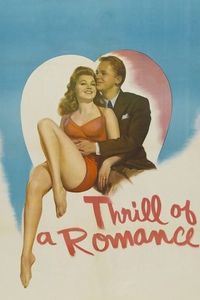
    (On Cable TV, September 2021) If my notes are correct, Thrill of a Romance is the first film in which MGM had a better idea of what to do with swimming sensation Esther Williams — after being introduced in Bathing Beauty, she here had the benefit of being a proven quantity: an Olympian-level athlete who looked good enough to headline in a new and very specific genre: the aqua-musical. Accordingly, she’s here paired up with Van Johnson (in the first of four films together) and you can see the specific elements of her subgenre being put together. Other than the swimming sequences, the film is a comedy with a few songs added to please musical fans. Opera signer Lauritz Melchior shows up (he’d pop up again in This Time for Keeps), there’s a handsome military officer to act as love interest, and the film goes to the luxurious hotel Monte Belva for much of its shenanigans. Williams herself is captivating under water, acceptable enough above it — she’s not bad (an achievement by itself considering that she wasn’t trained as an actress) but several other stars at the time could have given more personality to the role. Still, it’s an agreeable enough musical — made as World War II was wrapping up, so still very much intent on raising morale on the home front. It’s pleasant and amiable, with Johnson and Williams proving an effective pairing. On the other hand — Thrill of a Romance is not particularly memorable, especially if you’re in the middle of a Williams marathon where they all start feeling like the same movie.

  • This Time for Keeps (1947)

    This Time for Keeps (1947)

    (On Cable TV, August 2021) While I like the idea of Esther Williams successfully transitioning from an Olympic medallist to a musical film lead, she wasn’t necessarily a compelling performer out of the water. Competent, sure, but not exceptionally beautiful, dramatically powerful or able to sing or dance at another level. But she did embody that idea of the girl-next-door with a special talent, and MGM liked it so much that they invested heavily in the things that made her special, including creating a very specific subgenre, the aqua-musical, around her. This Time for Keeps may not be a particularly good movie, but it’s a great example of the form: Here we have Williams as a swimming professional surrounded by far more talented vocalists as a way to introduce music in the film. This includes Jimmy Durante as an older family friend, who gets an excuse to play around the piano for performances of “A Little Bit This and a Little Bit That” (leading into his classic “Inka Dinka Doo”) and a fun performance piece called “I’m the Guy Who Found the Lost Chord” — his overall performance is more dramatic than in most films, but he lets comedically loose as soon as he approaches a piano. More serious performers include co-star Johnny Johnston, singing in a very conventional fashion, and opera signer Lauritz Melchior — leading to a blend of musical styles that may or may not be too heavy for the kind of melodramatic romance that This Time for Keeps is aiming for. Durante, in particular, seems torn between a desire to be in a dramatic performance and his natural talent as a comedic entertainer. The plot doesn’t do itself any favours by playing heavily on some tired ideas (like familial approval) or under-developing some ideas that don’t quite fit in the framework. But those issues should be familiar to MGM musical fans — the form typically meant mixing plenty of elements in a single film, in the hope that they would come together for broad appeal. It does not work as well here as in other films, probably because of the lesser emphasis on comedy to the benefit of a dubious melodrama. Oh well — Williams is fantastic in the water and likable outside of it, Durante is funny, you get to listen to some opera, and the setting is not without its forested rustic attraction. It could have been worse, but there is definitely better.

  • On an Island with You (1948)

    On an Island with You (1948)

    (On Cable TV, June 2021) One of the differences between casual filmgoers and confirmed cinephiles is often the amount of meta-knowledge that the later carry around — including extensive knowledge of actors and their personas. That’s usually an advantage—except when it isn’t, for instance when an all-star cast comes together to produce something decidedly underwhelming. Such is the case with On an Island with You, a minor MGM musical of the late 1940s that brings together a truly interesting cast but doesn’t really do much with them. I mean: Esther Williams, Ricardo Montalban, Cyd Charisse and Jimmy Durante are four strong performers that could have been brought together in a way to play to their strengths. But what they get to do here is, at best, a pale shadow of their potential. With a script that’s only mildly funny or musical, On an Island with You struggles to establish itself as something worth remembering — the look at a film production is intermittently interesting, and doesn’t lead to any highlights. It’s probably important to note that MGM intended the film to be a success — while the film wasn’t part of their flagship Freed unit, it was shot on location in expensive Technicolor and clearly found a good audience during its theatrical run. But it clearly fell into disfavour since then — much better musicals with better roles for its stars followed, and its premise of having its female lead kidnapped by its male lead (assorted with misogynist remarks that would have most audiences up in arms) certainly hasn’t helped the film find new fans in the years since then. As a result, On an Island with You now ranks as a minor MGM musical, barely seen when compared to the better films of the era. Audiences aren’t wrong on this one, so beware if you’re tracking down the filmography of the actors involved. Too much knowledge can create false expectations!

  • Bathing Beauty (1944)

    Bathing Beauty (1944)

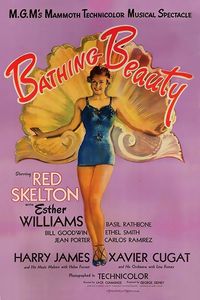
    (On Cable TV, May 2021) There’s probably one heck of a box-set (or, these days, “digital collection”) in some distant future in which Red Skelton’s early-1940s films are brought together to give a better appreciation of the incredible run he had as a comic performer at the time. No, his broad ingratiating style isn’t to everyone’s liking. No, the films are not usually high art. But he usually gave it everything he had and he was blessed with some of the era’s most amazing actresses as co-leads, whether it’s Eleanor Powell, Ann Sothern, Lucille Ball, Virginia O’Brien or, in the case of Bathing Beauty, aquatic athlete Esther Williams. The story is contrived to the point of bewilderment (what with a newly married couple not consummating the marriage, and the husband chasing her back to the college she works at) but that’s part of the point, as Skelton plays a virtual stranger chasing a woman while claiming, “but I’m her husband!”  There’s quite a bit of idiot plotting required in making it work, but Skelton’s comedic style is one that easily accommodates such shenanigans as indulged by director George Sidney. As usual for a Williams film, there are a number of musical interludes and aquatic sequences that have cemented her enduring image. (The final sequence, choreographer by Busby Berkeley, is a favourite for re-creations and homages, especially in Berkeley retrospectives.)  There’s a silliness to the college comedy that feels timeless, some snappy tunes and an overall amiability that makes Bathing Beauty hard to dislike. It’s also, crucially, a good showcase for Skelton’s talents, and a reminder of why he was a box-office draw at that time.

  • Neptune’s Daughter (1949)

    Neptune’s Daughter (1949)

    (On Cable TV, December 2020) I’m not that taken by Neptune’s Daughter as a film, but it does have a few interesting elements. The plot has something to do with an aquatic dancer (Esther Williams, obviously), a South American polo player (the great Richardo Montalban), a bumbling masseur taking on another identity (Red Skelton, equal to himself) and the dancer’s lovesick sister (Betty Garrett, confusingly playing a “Betty Barrett”). With such a blend of acting sensibilities, it’s perhaps inevitable that the film splits in halves – a romantic duo between Williams and Montalban, and a comic strand headlined by Skelton and Garrett. The romance has the advantage of being more broadly appealing than the often-thick comedy, but those who are receptive to the comedy will find it much more entertaining than the more ordinary romantic couple. This is best exemplified by the duelling interpretation of “Baby It’s Cold Outside,” which somehow makes its debut here: a bit dull on the romantic side, but considerably more entertaining with the comedians. Despite Montalban getting a good role as a romantic lead, the film is still filled with stereotypes that wouldn’t pass muster today, or at least be heavily questioned – especially Mel Blanc’s rare on-screen role and voice he’d later use for Speedy Gonzales. Technicolour cinematography does improve the film. If you’re going down the list of the Williams or Skelton films, Neptune’s Daughter is clearly not top-tier material. But it still has enough to be entertaining if you’re in the right frame of mind.

  • Dangerous When Wet (1953)

    Dangerous When Wet (1953)

    (On Cable TV, September 2020) There were a lot of movie musicals in the 1950s, and they can’t all be memorable or effective. Dangerous When Wet, to its credit, does have a semi-memorable hook, what with noted aquatic actor/dancer Esther Williams as the elder daughter of a family of fitness freaks. When their eccentric nature is discovered by a promoter who develops a crush on Williams’s character, he contrives a way to stay close to them by proposing a publicity stunt to have them swim across the English Channel. So far so distinctive, and the film’s most memorable sequence has Esther “swimming” with Tom and Jerry in an animated segment that brings to mind a similar sequence in Gene Kelly’s Anchors Aweigh. The rest of Dangerous When Wet is hit and miss—the opening act in rural America is decently funny, but the film seems to scatter once it heads to Europe and goes back and forth across the channel as an international love triangle develops and resolves itself. Williams herself is a likable presence, although she can’t be as eccentric as the supporting characters that make up her film family. Still, the film suffers from having few snappy tunes or expansive showcase sequences—the Tom and Jerry number is nice, but it’s not over the top. Still, if you’re attuned to the “voice” of 1950s MGM musicals, Dangerous When Wet is a representative example of the form: it can be watched easily, does have a few laughs along the way and features a likable heroine in Williams.

  • Easy to Wed (1946)

    Easy to Wed (1946)

    (On Cable TV, September 2020) Considering that Libeled Lady is one of the great comedies of the 1930s, I wasn’t sure that a decade-later remake could be all that good. But Easy to Wed turns out to be one of those remakes under the form of a musical comedy, and a much more farcical tone thanks to actors going for laughs over fidelity to the first film. Van Johnson, Esther Williams and Lucille Ball sing and strut their stuff (in and under water, in Williams’ predictable case) to end up making something so pleasantly different from the original that it becomes its own thing. As a bonus, you can see in Ball’s scene-stealing performance the kernels of her later Lucy character. If you like musicals, Easy to Wed is not a bad remake—but be sure to see Libeled Lady for a better movie.

  • Take Me Out to the Ball Game (1949)

    Take Me Out to the Ball Game (1949)

    (On Cable TV, March 2020) Part of the fun of watching Hollywood history is seeing talented performers getting paired up even when the match isn’t quite harmonious. Frank Sinatra—brilliant singer. Gene Kelly—terrific dancer. Both of them together? Well, you have to see Take Me Out to the Ball Game how they play together… and having Esther Williams as the female lead doesn’t hurt either. A prestige song-and-dance show from MGM (in Technicolour!), it blends its leads’ skills with America’s sport and the usual trappings of musical comedies. The highlight is the theme song, but there are a few good moments elsewhere too: Esther Williams inevitably dips into a pool at some point, and while director Busby Berkeley’s imprint on the film is faint (he only shot a small portion of it, and the rest was reportedly completed by Kelly and Stanley Donen), there are still traces of it in the finished product. On the other hand, there’s some weird stuff as well: the references to suicide and pedophilia in the middle of an upbeat wolf-whistling song are a bit off-putting to say the least. Also not quite as controlled for twenty-first century viewers: double standards in how a determined woman is portrayed compared to the equally persistent male characters. Ah well—this is from the late 1940s, after all. Still, a muddled average and no high peaks means that Take Me Out to the Ball Game suffers in comparison to other Sinatra/Kelly vehicles like On the Town and Anchors Aweigh. They can’t all be perfect. In this case, it still means we get Sinatra singing and Kelly dancing.

  • That’s Entertainment! (1974)

    That’s Entertainment! (1974)

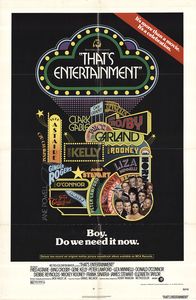
    (On Cable TV, December 2018) In the running for the title of the greatest clip show ever made, That’s Entertainment! does have the advantage of great source material to draw from: nothing less than the heydays of MGM musicals, featuring greats such as Fred Astaire, Gene Kelly and so many others that it would be exhausting to list them all. Various stars such as James Stewart, Bing Crosby and Elizabeth Taylor introduce some of the archival segments. Helmed by writer/director Jack Haley Jr. from MGM’s library extensive library, the film is a pure celebration of musicals as an art form, and of MGM as a powerhouse studio. Ironically, the film also acts as a tombstone for the classical MGM—filmed on the studio’s backlot, That’s Entertainment! presents the MGM studios right after they were sold off to finance the studio’s debts. As a result, the backdrop behind the presenters is decrepit, rusted, faded, overgrown with weeds, showing Hollywood’s past grandeur in a documentary fashion. The contrast between that and the clip shows is astounding, as we get a quick greatest hits of MGM’s most memorable numbers and fascinating segments about Astaire, Kelly, Esther Williams and Judy Garland. That’s Entertainment! is an absolutely fascinating film, and it deserves its enduring popularity—TCM even used it, along with its sequels, as a perfect lead in to the New Year’s Eve celebrations. Now, I want a good affordable copy of it on Blu-Ray.