Farley Granger

  • They Live by Night (1948)

    They Live by Night (1948)

    (On Cable TV, May 2020) The “lovers on the run” subgenre of romantic tragedy and thrillers has a long history, and while it predates They Live by Night, the impact of that specific film over directors in later decades (including a slew of films in 1970s New Hollywood) remains significant. Farley Granger and Cathy O’Donnell star as, respectively, a young criminal on the run after a prison escape and a robbery, and an isolated young woman who takes care of him after he’s wounded in the robbery. Eventually, they decide to make a run for it, and get married along the way. Typical of criminals on the run during the Production Code era, it does not end well for them—hence the mystique of tragic romance that led to so many imitators, whether in France for La Nouvelle vague or in New Hollywood. But while its legacy is significant, it’s worth noting that They Live by Night is a pretty good film by itself. It holds the distinction of being the first film with a helicopter tracking shot (in fact, it’s almost the first shot in the film) and being acclaimed writer-director Nicholas Ray’s first film. As an early noir, it draws from the novel it was adapted from, as well as French Poetic Realism. It’s easily watchable, although romanticizing the bad-boy criminal remains just as problematic as it ever was. Still, it’s not a bad film, and viewers can have fun tracing the chain of influence from this to À bout de Souffle to Bonnie and Clyde to Natural Born Killers to even newer films about lovers on the run.
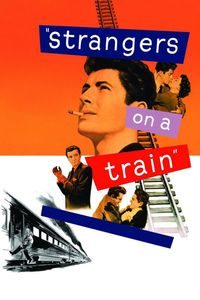
  • Strangers on a Train (1951)

    Strangers on a Train (1951)

    (On Cable TV, January 2018) I’m still working my way through the Hitchcock filmography, and while I think that most of his classics are from the late fifties, there are still quite a few good movies from outside that timeframe. The case in point here is 1951’s Stranger on a Train, a tense and non-nonsense (yet deceptively layered) thriller in which two strangers meet and don’t quite agree to swap murders. The problems come when one of the two men does his part of the deal he thought he had … and then comes to collect. Shot in striking film-noir black-and-white, it’s a much-better-than-competent work from an acknowledged master of the form. Farley Granger and Robert Walker are good in the lead roles, but the star here is Hitchcock and the script, which steadily tightens the screws on the lead character with ever-increasing complications. The climax, set on a park carrousel, works well as a final set-piece, but the fun of the film is in seeing the walls close in on the lead character. Old but still a model for suspense films, Strangers on a Train is still worth a look—it doesn’t quite measure up to Hitchcock’s masterpieces, but it’s a solid film in its own right.

  • Rope (1948)

    Rope (1948)

    (On DVD, December 2006) Any Hitchcock film is now regarded with respect, but even on its own, this cleverly-made thriller would be worth a look. The first and most obvious distinction of the film is how it’s conceived as a filmed play with a minimal amount of cuts: The lengthy segments lend an air of sustained tension to the storytelling, showcasing the skill of the actors. But beyond the surface, there’s a lot of subtext to the piece, whether it’s the references to the Leopold/Leob case, or the heavy allusions to homosexuality. James Stewart unfortunately looks like a boy-scout in the middle of all this, but his reassuring presence makes up for his lack of emotional involvement in the story. The technical fascination of the film’s making-of only adds to the interest of the film itself, making for a viewing experience that will reward viewers even sixty years later. Among other questions raised by the film is this one: Why hasn’t this type of film-making been attempted more often since, aside from oddities such as Mike Figgis’ Timecode?

    (Second Viewing, On Cable TV, June 2021) I thought a second viewing of Alfred Hitchcock’s Rope would damage the film – I remembered semi-fondly as an audacious but flawed experiment in “real time” one-cut cinema, but I expected to be disappointed in measuring it against many more recent examples of the form. Much to my surprise, I ended up liking as much, if not even more, this time around. For one thing, it’s obviously not a “real-time” film – the camera may move smoothly around the studio (with not-so-invisible cuts), but there’s clearly several hours of action crammed in 80 very efficient minutes, with the sun setting outside the confines of the set and people arriving, leaving and coming back to the action. James Stewart is quite good here as the man who figures out the murder mystery, but John Dall and Farley Granger are also quite good as the two young men who murder their classmate, then host a party while the body of their victim is hidden inside a chest visible to everyone as a buffet table. The party mixes inane chatter with far more portentous philosophical discussions outlining the thematic concerns at the heart of the film, all leading to a great conclusion. I don’t see the flaws of the film as much as I applaud its audaciousness and the way it manages to reach its objective – but that may say more about my evolution as a movie critic and the weight I now tend to place on high concepts. Hitchcock (working from a story by none other than Hume Cronyn!) does create an almost-subliminal sense of tension in the way standard film editing devices are avoided – the “can they pull this off?” is as meta-cinematic as it is plot-driven – and he pulls one of the most unusual cameos of his filmography here. Rope is a daredevil act by 1948 standards (through premise, execution and not-so-veiled references to homosexuality), and it still works really well for twenty-first century viewers. Don’t miss it.