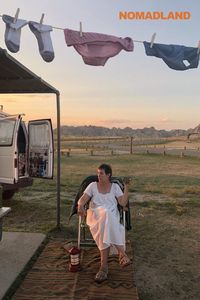
Frances McDormand

  • Nomadland (2020)

    Nomadland (2020)

    (Disney Streaming, April 2021) Something very expected happened in the twenty-four hours between seeing Nomadland and writing this review — it won the Academy Award for the Best picture of 2020. Working from the theory that the Academy Awards are a gigantic Public Relation exercise in which Hollywood tells the world how it wants to be seen, it was an incredibly predictable win. In a year where the COVID-19 pandemic upended nearly everything about the movie industry, in which the number of major studio releases plummeted to nearly nothing, in which diversity became a rallying cry, in which economic anxiety peaked even more as millions of Americans slid into poverty, well — Nomadland seemed like a distillation of many, many things. A film (inspired by a growing trend) about a woman choosing to live in her van, going from one seasonal job to another, it seemed like a distillation of decades’ worth of gradual civilizational decline. Written and directed by Asian-American woman, visually composed to emphasize the widescreen aspect ratios of American landscapes, Dickensian in its depiction of people overcoming misery, Nomadland doesn’t just check off all the boxes — in such a miserable year, it seems almost tailored to make Academy voters think that this is the film that they want people to think about when they think about Hollywood. But now that we’ve explained why it won the Big Trophy, let’s get to the heart of the matter: it’s actually a good movie. Not the most enjoyable one, certainly not my own favourite of the nominees (currently a race between The Trial of the Chicago 7 and Mank), probably not a film that people will flock to over and over again, but a good film nonetheless. It is, admittedly, a slow burn. I wouldn’t blame anyone for overloading on the misery of the first half-hour, as our protagonist finds herself driven to a “houseless” lifestyle that would be intolerable to most viewers, as we’re once again reminded of the inhumanity of Amazon, as the cold blue winter cinematography makes everything feel so much worse. Things get a bit better as she starts making inroads in the nomadic community, getting tips and help about the lifestyle. As the film goes on, it becomes clearer that this rootless existence is a choice more than an obligation: she not only turns down two offers for a permanent residence, she starts taking in the freedom that comes with a moving dwelling, taking in the spectacle of America and finding her friends here and there. The film ends on a much better note than it began, and Frances McDormand’s performance is about as raw as the film can get close to documentary. The mixture of actors and non-actors playing “themselves” reinforces writer-director Chloé Zhao’s intention to avoid conventional filmmaking technique, something echoed in the script’s refusal to highlight pivotal moments and instead dwell in the spaces in between. It’s not a perfect film—characters have the grating tendency to explain themselves as if to a journalist, which is so very much not the protagonist—call it a holdover of adapting a non-fiction book. But even in its imperfect, often uncomfortable state, Nomadland (No mad land?) is a sobering reflection, hopefully not a portent, and a striking piece of cinema in its own right. It highlights something new, humanizes it and leaves us to consider the flip side of the situation. Yes, that’s the film that people will see when the open up those “Cinema in 2020” retrospective articles.

  • Three Billboards Outside Ebbing, Missouri (2017)

    Three Billboards Outside Ebbing, Missouri (2017)

    (On Cable TV, October 2018) As I’ve grown up to become a cranky middle-aged movie reviewer who gets to complain that they don’t make them like they used to, here comes Three Billboards Outside Ebbing, Missouri to reassure me that while original mid-budget realistic drama movies are on life support, they’re not dead yet. It does help that even within the context of a contemporary adult setting, writer/director Martin McDonagh gets off to a roaring start with a strong premise: a small-town woman putting up three highly critical billboards demanding justice for her murdered daughter. The event sparks dramatic conflict across an ensemble cast of strong actors, reaching across a community to spur characters to action. As befits a film written by a playwright, Three Billboards Outside Ebbing, Missouri is an actor’s dream with several strong sequences, well-developed characters and a dark sense of comedy that keeps viewers interested from beginning to end. Frances McDormand now deservedly owns an Oscar for her performance here, but there’s a lot more good material from Sam Rockwell and Woody Harrelson. A strong plot means that the film’s 115 minutes go by in a flash, with a conclusion that provides some comfort but not an entirely wrapped-up happy ending. It’s quite a ride, and I couldn’t be happier to see how Three Billboards Outside Ebbing, Missouri leveraged its critical success to become a commercial one as well.

  • Mississippi Burning (1988)

    Mississippi Burning (1988)

    (On TV, March 2017) Issues-based thrillers aren’t always easy to watch, and there are certainly enough tough moments in Mississippi Burning to uphold this rule of thumb. But it’s also a thriller with a muscular anti-racism message that is also comforting given the atrocities portrayed in the film. The story of two FBI agents investigating the murder of three civil rights activists in rural Mississippi, this is a movie that pulls no punches in portraying the often-unbelievable racism of barely half a century ago. Quite a few buildings burn here, and the constant abuse suffered by the black characters is nothing short of revolting. While the film is certainly problematic in its white-saviour narrative, it’s also curiously frank in the way it embraces this aspect of itself: threatening, torturing and arresting unrepentant KKK members is the next best thing to punching a Nazi in the face in American cinema wish fulfillment, and Mississippi Burning certainly embraces this aggressive approach to the problem. Gene Hackman truly stars as a veteran FBI agent whose folksy bonhomie barely conceals a tough-and-violent approach whenever the chips are down. Contrasting him is Willem Dafoe is a curiously straitlaced role as a far more by-the-book supervisor who nonetheless gets to let his wilder instincts run free in the last act of the film. Frances McDormand also has a good turn as an acquiescent housewife who nonetheless gets a few shots in. Far more interesting than the “social issues drama” moniker would suggest, Mississippi Burning turns into a vengeful police thriller toward the end, with satisfying justice being delivered in spades. The relationship to the true events that inspired the story is incidental, the black characters definitely taking second place to the white protagonists but, in the end, it makes for curiously compelling cinema. This being said, Mississippi Burning is exactly the kind of film that other effective anti-racism movies such as The Help are meant to complement: it’s part of the story, but not all of it.