Francis Ford Coppola

  • Paris brûle-t-il? [Is Paris Burning?] (1966)

    Paris brûle-t-il? [Is Paris Burning?] (1966)

    (On TV, December 2021) I thought I had seen most of the big WW2 epic movies, but as it turned out, there was at least one more waiting for me—Paris brûle-t-il?, an epic French-American co-production re-creating the last moments of Paris’ Nazi occupation. Adapted from an eponymous book by Larry Collins and Dominique Lapierre, the script is from the legendary duo of Gore Vidal and Francis Ford Coppola. The ensemble cast is nothing short of amazing, what with such notables as Orson Welles, Kirk Douglas, Robert Stack, and Anthony Perkins on the American side, with Jean-Paul Belmondo, Alain Delon, Leslie Caron, Simone Signoret and Yves Montand on the French side (plus Gert Fröbe on the German side, among so many others). Few of them have more than a few scenes given the scattered chronicle structure fitting weeks of complex diplomatic and military manoeuvers in less than three hours. Shot in black-and-white (reportedly to accommodate green-fake Nazi flags draped over mid-1960s Paris, but also to integrate period footage), the film is rarely more striking than when it re-creates combat in eternally recognizable Paris neighbourhoods without the crutch of CGI. There’s a reason why the 1960s were the heyday for expansive re-creation of WW2: the conflict wasn’t as fresh, but the people were still there to make sure it was credible. Unexpectedly engrossing, Paris brûle-t-il? is an admirable dramatization of an episode of WW2 that could have gone differently, but ended up showcasing some enduring images of victory over the Nazis. It’s just about essential viewing for WW2 cinephiles, and the amazing cast certainly helps keep you interested in even the slightest new character.
  • You’re a Big Boy Now (1966)

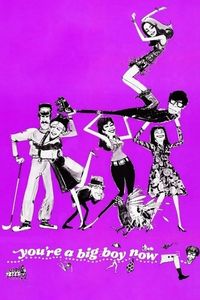
    You’re a Big Boy Now (1966)

    (On Cable TV, December 2021) I suppose that most twenty-first century viewers will come to You’re a Big Boy Now because it’s an early film by Francis Ford Coppola. Fortunately, it does have its charms aside from this pedigree — as a precursor to the New Hollywood era that would be unleashed during the following two years, it takes a decidedly un-classic approach in describing the formative experiences of a young aimless man. If you’re thinking that this sounds a lot like The Graduate (which came later), well yes — the similarities were even acknowledged by Mike Nichols as he began production on the later film. Considering that I’m not a big fan of The Graduate, it shouldn’t be surprising if I prefer You’re a Big Boy Now just a bit more — it’s not quite as self-absorbed, it’s more visually audacious and it’s often far funnier than its best-known equivalent. The portrait of mid-1960s Manhattan is often wonderful, especially when the film engages directly with its surroundings (such as the climactic chase sequence through a department store). As a piece of early New Hollywood, You’re a Big Boy Now is eloquent: you can sense the old way of doing movies being shattered here, a new audience being courted and a new style emerging. It still feels quite modern despite its age, and ends up a surprisingly satisfying early Coppola.

  • The Rain People (1969)

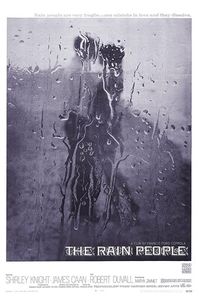
    The Rain People (1969)

    (On Cable TV, November 2021) As an aging movie reviewer who’s accumulating what’s laughably called “maturity,” I’ve gotten much better at not calling movies “boring and dull and pretentious” — there’s usually something good about everything and it’s my job to find what it is (or which audience it would serve best). But the fact that it doesn’t happen as often is not a guarantee that it doesn’t still happen and so, well: The Rain People is boring and dull and pretentious. There’s a reason for that:  Coming from writer-director Francis Ford Coppola in the burgeoning years of the New Hollywood, it gets to play with things that Classic Hollywood would not have allowed: An unsympathetic character leaving her loving husband out of sheer wanderlust; a gritty filmmaking style aping realism and delivering drudgery; an inconclusive conclusion without much in terms of character development. These, obviously, are the tools of literary fiction but in the characteristic zeal that marks, well, much of American history, the New Hollywood filmmakers went far overboard and later generations can only suffer through those early releases. There’s clearly a footnote in film history for The Rain People — not only as an early work from a major American director, but also a film featuring both James Caan and Robert Duvall prior to The Godfather. There’s an audience for those non-formulaic films with closer ties to written character drama than genre pictures — but even aging movie reviewers have their preferences, and I’m throwing my lot with the genre-obsessed plot-dominant camp that does not settle for boring and dull and pretentious.

  • Dementia 13 (1963)

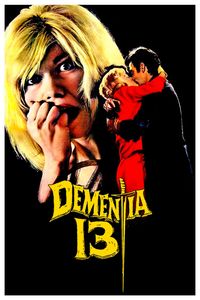
    Dementia 13 (1963)

    (On Cable TV, May 2021) If you’re into that whole “first film by famous filmmakers” thing, then Dementia 13 should be on your must-see list: it’s the directorial debut of writer-director Francis Ford Coppola, and it already shows his cinematic flair. The story itself isn’t anything special — a psychological thriller avowedly made by producer Roger Corman to cash in on the success of Psycho: There’s murder, gothic intrigue, gaslighting and a psycho killer. Where Dementia 13 does rather well, however, is in the execution: Director Coppola is markedly more ambitious than writer Coppola, and far more than producer Corman: Accordingly, his 70-minute potboiler thriller is elevated by atmospheric direction that almost takes the film into classic-horror territory rather than exploitation chiller. There’s no real way around the fact that Dementia 13 remains a cheap horror film, executed on a threadbare budget by someone with more ambition than means. But it’s that ambition that keeps the film intriguing today — you can trace a line from this to the atmosphere of Coppola’s 1992 take on Dracula without hesitation.

  • Tucker: The Man and His Dream (1988)

    Tucker: The Man and His Dream (1988)

    (In French, On TV, August 2019) There are some odd corners in Francis Ford Coppola’s filmography, and I think that Tucker: The Man and His Dream just may be one of my favourites. Starring Jeff Bridges, this is the story (adapted from real events) of Preston Tucker, who tried launching his automobile company in the late 1940s. The real story is not particularly inspiring on the surface: Tucker manufactured 51 automobiles, got sued for fraud, and died a few years later without having achieved more than an initial success. But in this movie, Hollywood goes to work with its movie magic: Tucker is portrayed as taking on the Big Three automobile manufacturers, his board of directors, skeptics, governments and yellow journalism. He’s portrayed as a crusader for automobile safety, for innovation, even for the very notion of a better future. It ends with a triumphant parade of sorts, as fifty Tuckers are brought in Chicago to demonstrate what he was able to achieve. Even knowing the real story isn’t enough to wipe the smile off our faces while watching this unusually cheerful feature. Tucker: The Man and His Dream was a passion project for Coppola, whose father invested in the company and who spent decades developing the project. His enthusiasm is infectious, as the film easily charms viewers into accepting its premise without question. It helps that the cinematography is a variation of bright colourful vintage nostalgia, everything appearing just a bit shinier and better than usual. It’s enough to make anyone wonder why Coppola didn’t make more feel-good movies.

  • Peggy Sue Got Married (1986)

    Peggy Sue Got Married (1986)

    (In French, On Cable TV, May 2019) There is a surprisingly robust subgenre of romantic time-travel movies out there, and Peggy Sue Got Married qualifies for inclusion even if it arguably hovers on the edge of it-was-all-a-dream justification. Here, no time-travel machine or magic potion: Our protagonist (played adequately by Kathleen Turner) faints at her high school reunion and wakes up in 1960 to relive her senior year. Much of Peggy Sue Got Married is a mixture of now-exasperating (because overdone) boomer nostalgia, with the expected comedy of a woman reliving her life with everything she’s learned over the next twenty-five years. Technology jokes, romantic do-overs and horrifying realizations about 1960 are all included. It feels very familiar (especially so close to the much more dynamic Back to the Future), but director Francis Ford Coppola keeps it together. For modern viewers, one of the best reasons to see Peggy Sue Got Married would be the grab-bag of before-they-were-famous actors, starting with Nicolas Cage but also including Joan Allen, Jim Carrey, Sofia Coppola and Helen Hunt. It works modestly, but it does work.

  • Finian’s Rainbow (1968)

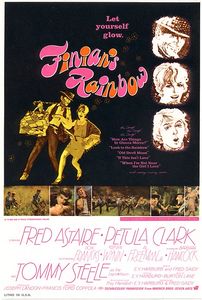
    Finian’s Rainbow (1968)

    (On Cable TV, December 2018) Being right doesn’t mean much when you’re late, and unfortunately that’s the first conclusion I get from watching Finian’s Rainbow, an old-fashioned musical that has the right moral values about racism but the rotten luck of making it to theatres one year after movies such as In the Heat of the Night and Guess who’s Coming to Dinner completely changed the Hollywood conversation about racial injustice in the United States. As New Hollywood was remaking the film industry in a far different image, Finian’s Rainbow was torn between new issues and old-fashioned style, featuring no less than Fred Astaire singing and dancing about racial injustice while dealing with a meddlesome leprechaun trying to get its gold back. Yeah… I’m not making this up. It’s a musical in the purest tradition of the form, but it would have been so much better had it been made ten years earlier. Astaire isn’t bad, but he looks truly old here—I mean: he never looked young even when he was, but here age has visibly caught up to him, and his great dance routines look almost dangerous. Petunia Clark is fine as his daughter, but much of the comedy and remarkable performances come from other players (including Tommy Steele as a hyper-caffeinated leprechaun) in this bizarre southern state/Irish-mythology mash-up. The film’s message against racial discrimination goes through an incredibly racist character being magically transformed into a black person (hello blackface) in time to travel with a small group of singers—the song is great (“The Begat”), but everything leading to it has issues of some sort. Plus, it’s directed by none other than Francis Ford Coppola. Finian’s Rainbow, as you can guess, is a strange blend—sometimes great, sometimes endearing, sometimes dumbfounding and sometimes uncomfortable. It’s certainly interesting, but I’m going to stop myself from calling it a must-watch.

    (Second Viewing, On Cable TV, March 2021) In retrospect, I’ve been too harsh on Finian’s Rainbow. Most of what struck me on a first viewing is still applicable to a second, but they don’t bother me nearly as much. Astaire looks old, but he does what he can and even the accumulating wrinkles can’t quite stop him from being an entertainer – and the film doesn’t focus nearly as much on him as it would have in earlier years. After all, he actually plays a father here. I’m also not quite as bothered by the film’s comic treatment of racism – it’s meant to be ridiculous, and the film does have its heart in the right place in mocking racists even when it’s recreating clichés along the way. I still don’t care all that much about the leprechaun and his gold, but some of the musical sequence staging (helmed by a young Francis Ford Coppola, once again worth highlighting) is vigorous and eye-catching. I still think Finian’s Rainbow has plenty of flaws, but they don’t annoy me as badly this second time around.

  • Rumble Fish (1983)

    Rumble Fish (1983)

    (On Cable TV, September 2017) I’m glad I saw Rumble Fish shortly after The Outsiders. Those two movies will forever remain a curio pairing of teenage dramas made back-to-back by writer/director Francis Ford Coppola, with much of the same cast and crew. But while they share themes and settings, they couldn’t be more different in execution, as The Outsiders plays everything straight, while Rumble Fish allows itself fanciful impressionistic segments that truly set it apart from the genre to which it belongs. From splashes of colour in an otherwise black-and-white film, to literate references, a very stylized fight, an out-of-body experience, unnatural skies and a noir aesthetics borrowed from German expressionism. The plot is almost inconsequential to the various moviemaking flourishes, but there’s still a heartfelt brother-to-brother relationship at the heart of it all. All of this being said, I still can’t quite commit to liking the film. On the other hand, I found it far more interesting than The Outsiders, and I’m far more likely to revisit Rumble Fish in a few years than most of the more ordinary films of its period. 

  • The Outsiders (1983)

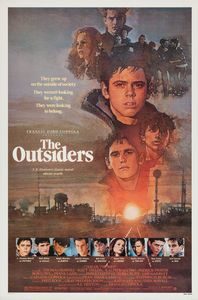
    The Outsiders (1983)

    (On TV, July 2017) It’s no exaggeration to say that the best thing about this film is the cast list. Consider a Coppola film featuring Matt Dillon, Ralph Macchio, Patrick Swayze, Rob Lowe, Diane Lane, Emilio Estevez and Tom Cruise. No wonder it still regularly plays on TV even thirty-five years later. Alas, the actual film itself feels underwhelming. While a good character study of late-sixties teenagers, The Outsiders feels rote and dull compared to other movies tackling the same topics. Some of the plot points feel needlessly melodramatic, while the overall pacing of the film feels dull. The cast is very young, so seeing even famous names is more interesting than satisfying. (Many of them have very small roles too—if you’re hoping for a big Tom Cruise performance, for instance, you will have to make do with only a few moments.) While The Outsiders definitely has some historical curiosity, I found the film a chore to get through, even considering the cast list.

  • Dracula aka Bram Stoker’s Dracula (1992)

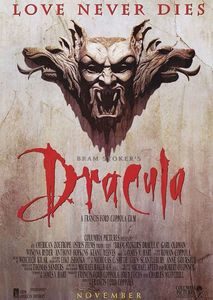
    Dracula aka Bram Stoker’s Dracula (1992)

    (On Cable TV, May 2016) My expectations were pleasantly exceeded by this Dracula’s grandiose and overdone take of Bram Stoker’s classic. I’m not sure what I was expecting, but the film’s blend of pre-digital special effects, unabashed naughtiness, over-the-top direction (thanks to Francis Ford Coppola), melodramatic acting and scenery-chewing restlessness made it feel remarkably fresh even twenty-five years later. Adapting the epistolary Stoker novel will always be difficult, but Dracula gives it a spirited go, with a blend of various techniques to evoke the letters of the original, operatic visuals, dramatic dialogue and go-for-broke modernity. The special effects are made even better by the lack of a digital safety net, but Gary Oldman and Anthony Hopkins provide all of the film’s spectacle via consciously overdone acting. The film has far more sex appeal than I’d expected, laying bare the Victorian metaphors and double entendres that were in the novel, and making good use of Winona Ryder and Sadie Frost. (Plus, hey: an early role for Monica Bellucci.) The sour note here remains Keanu Reeves, earnest but sleepwalking though a role that demanded far more energy. Still, this Dracula is a lot of fun in its own devilish way, and it’s this eagerness to be as flamboyant as possible that makes the film still well worth seeing a quarter of a century later.

  • The Godfather: Part III (1990)

    The Godfather: Part III (1990)

    (On DVD, December 2009) This “Part III” has a bad reputation only when it’s compared to its two classic predecessors.  While it’s pretty good filmmaking, it’s just not up to the standards set by its prequels.  It’s not bad when considered as a straight-up epilogue, but then it runs into the vexing issue of being nearly three hours long, which really isn’t appropriate for the type of story it tries to be in the Godfather universe.  Part of the problem is that by going to Italy and spending a lot of time dealing in Vatican business, The Godfather III gets farther and farther away from the all-American core that made the success of the first two films: The issues get more abstract and diffuse, and the plot seems to over-complexify itself.  There is a noticeable lull near the middle of the film, and all of it contributes to the feeling of an overlong experience.  Acting-wise, it’s Al Pacino and Andy Garcia’s show: Sofia Coppola may be the most attractive performer in the entire trilogy, but her much-derided performance, all mushy-mouthed and indifferent, is another of the reasons why she’s become a far better director than actress.  More happily, though, the film works more often than it doesn’t, and while some elements that made the first film now feel familiar (the opening celebration/introduction scene; the final operatic barrage of violence), it’s handled with a lot of lavish skill by director Francis Ford Coppola.  Conventional wisdom is correct: Not a bad film, but a let-down compared to its lineage.

  • The Godfather: Part II (1974)

    The Godfather: Part II (1974)

    (On DVD, December 2009) I may not entirely agree with assessments that this sequel is superior to the first film (which seems just a bit more focused that the follow-up), but there’s no denying that the two Godfather films feel inseparable: The first flows into the second one with fewer differences than one would expect, and the second one actually makes the first one feel even better when taken together.  Once again, a really young Al Pacino runs the show, although he’s joined (in entirely separate sequences) by an equally-young Robert de Niro.  Acting both as a prequel and sequel to the original, this “Part II” creaks at more than 200 minutes: the entire prequel alone could have been spun off in its own film.  The Godfather II itself has the feel of a vast epic, with multiple plot lines, grand lavish scenes (including another lengthy party sequence that acts as essential scene-setting), multiple locations, a bit of historical drama and a large cast of characters all headed for destruction.  Even then, there’s a lot that simply isn’t shown, and when the film ends, it feels as if it does so a few scenes too soon.  It’s the nature of the charm of the films that betrayal and violent death is always somewhere in the assumed background of the character’s action: one wrong answer and goodbye!  What may be The Godfather II’s most astonishing achievement is that it actually makes its predecessor even better, by presenting a story with even-bigger implications, digging into the characters and tying off a few grander arcs.  This is big, big-scale filmmaking by Francis Ford Coppola, and it’s a bit of a shame we don’t get such movies anymore.

  • The Godfather (1972)

    The Godfather (1972)

    (On DVD, December 2009) It’s easy to think that you know The Godfather without having actually seen The Godfather: Few movies have become as integral to American pop culture as this one: You have seen the parodies, heard the references, watched the rip-offs, caught bits and pieces of the TV broadcasts, maybe even played the video game.  But nothing replaces a good lengthy sit-down with the film from beginning to end: Clocking in at slightly less than three hours, The Godfather is a sumptuous piece of work.  Finely mastered, superbly written and featuring a cast of characters that directors would kill for (most notably an impossibly young Al Pacino), it remains an impressive piece of work even after nearly forty years of cultural impact.  Although the innovation of presenting gangster protagonists can’t be properly felt now compared to 1972, The Godfather keeps making an impact through sheer film artistry: All the pieces selected by director Francis Ford Coppola click together in a satisfying fashion, and the much-quoted segments only add to the film.  With a large cast of character and a story that sprawls over a decade following WW2, the script makes few concessions to inattentive viewers.  (It also takes risks that would doom other films, such as setting much of its first half-hour at a wedding reception.)  Most curiously, it’s also a film that feels more rounded by its equally masterful sequel.  Why is it that they don’t make movies like that anymore?