Frankie Avalon

  • Pajama Party (1964)

    Pajama Party (1964)

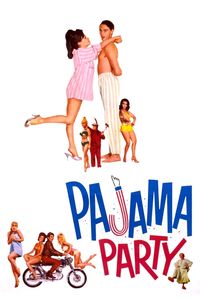
    (On Cable TV, May 2021) The Beach Party series is wild from beginning to end, so noting that fourth entry Pajama Party is only loosely related to the previous three, that it welcomes Buster Keaton to the series (playing a Native Indian stereotype, alas) and that it features an extraterrestrial invader who falls in love with a beach girl is really just par for the course. The leather-clad bikers are back, and so are Anette Funicello (in a leading role) and Frankie Avalon (in a distant supporting one). Bobbi Shaw plays a one-joke “ya-ya” Swedish bombshell, Dorothy Lamour pops up as a ghost of teenage musical comedies past, the popularity of the series clearly steers it toward a more deliberate approach, and throughout it all you can see the formalization of 1960s teenage culture. The humour in Pajama Party is now silly and quaint, but not necessarily terrible — it’s kind of fun to hang out on the beach with teenagers with the period fashions and music and without big problems. (Well, other than an impending alien invasion, although that’s dealt with fairly innocuously.) The Beach Party films are a package deal anyway — like one of them and there’s a chance you’ll like the others, but they’re best not consumed in rapid succession.
  • Panic in Year Zero! (1962)

    Panic in Year Zero! (1962)

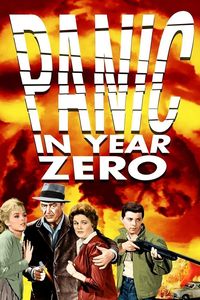
    (On TV, April 2021) If you want to understand in which kind of context the October Crisis happened in 1962, you may want to have a look at Panic in Year Zero!, a surprisingly effective Cold War nightmare in which an ordinary Los Angeles family out for a camping trip reacts to a nuclear attack on the United States, including the vaporization of Los Angeles. Better-prepared than most with a fully-loaded camping car, they still have to face many challenges before making it to relative safety. You may by misled by credits listing American International Pictures and Frankie Avalon — after all, their biggest hits of the 1960s were the frothy colour “Beach Party” comedies. But that came later—Panic in Year Zero! is a sober, dystopian take on something that seemed almost inevitable by the early 1962—massive nuclear exchanges between the United States and the Soviet Union. Millions of deaths and a complete breakdown of social order were the starting point of such survival films, and this one is no exception. Crisply directed by Ray Milland, who also stars as the patriarch making tough choices for his family, the film is a lower-budgeted but surprisingly credible exploration of the now-familiar scenario of a family having to survive a societal breakdown. Avalon plays the son of the family with a mixture of innocence and growing maturity, making a good contrast with his later fun screen persona. It’s largely an episodic film, with various incidents meant to show how mean and/or helpful various people can be in crisis. I suspect that the sheer number of post-apocalyptic films since 1962 has probably dulled the impact of Panic in Year Zero!, but it did get there early, and its mild-mannered take on a wide-scale crisis is an interesting period take that endures as a reflection of how it was seen at the time. The film makes for compulsively interesting viewing — a real surprise if ever you see it pop up.

  • Beach Party (1963)

    Beach Party (1963)

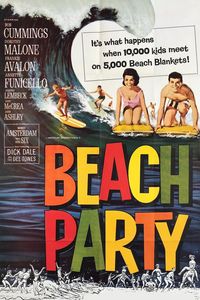
    (On Cable TV, January 2021) While Gidget may have sparked interest, it’s Beach Party that formally launched the “Beach Party” movie subgenre of the 1960s, featuring Frankie Avalon and Annette Funicello in a series of seven films that spawned about twice as many imitators. This first instalment, as usual, doesn’t quite have the formula nailed down: While most of the recurring players are there, while the tone is very similar, there’s some narrative weirdness in spending so much time on an academic character (played by Bob Cummings) studying teenage mating habits—with a beard so thick and out-of-place that it’s fated to come off at some point. It’s a character that exemplifies how dumb movies portray smart people, but the caricature is very much in line with the absurdist comedy style of the film, with some fourth-wall breaks along the way. It’s all in good fun—even Vincent Price joins in with a special cameo that heralds more to come in the series—although the musical numbers are a bit weaker than in the follow-ups. The key to the series is probably found in the unobjectionable material featured here—some flesh but no nudity, some inept bikers but no real threat, some tension but no breakups. Plus, an academic who learns better from the teenagers.

  • Muscle Beach Party (1964)

    Muscle Beach Party (1964)

    (On Cable TV, October 2020) What may be insufferable juvenilia to a generation may be a cultural artifact half a century later, and if contemporary reviews for Muscle Beach Party weren’t kind, I suspect that more modern takes on the film will revel in the mid-1960s California beach atmosphere. The second of the “Beach Party” series with Anette Funicello and Frankie Avalon, this sequel brings together the burgeoning surfer and bodybuilding cultures together in a comic setting, with an added dash of romantic spice as an Italian countess distracts Avalon from Funicello’s affections. Add some bouncy music (by the Beach Boys, the Del Tones and an insanely young Stevie Wonder), a late-movie cameo by Peter Lorre (with the film having the decency to literally stop in mid-frame as he makes an entrance) and you’ve got enough here for any sixties pop-culture enthusiast. Don Rickles and Buddy Hackett provide additional comedy. It’s all set against the then-newish concept of the “the teenager,” with California showing the way to the rest of the nation. Muscle Beach Party is really not sophisticated entertainment, but it is sunny fun and it’s now almost perfect as a time capsule of its time.

  • Ski Party (1965)

    Ski Party (1965)

    (On Cable TV, November 2019) The Beach Party series takes an odd but not entirely unpredictable turn in Ski Party, as part of the gang heads for the mountains for snow partying. Our two lead lads, played by Frankie Avalon and Dwayne Hickman, have the bright idea to disguise themselves as women to learn all about what they need to know in order to seduce. Many wacky hijinks then follow, in the somewhat anarchic type of comedy of the series. The film frequently breaks the fourth wall, with even terrible special effects being part of the fun. It’s reasonably entertaining as a comedy, but the real discovery of the film is its soundtrack, featuring on-screen appearance by Lesley Gore (“Sunshine, Lollipops, and Rainbows”) and James Brown (“I Got You [I Feel Good]”) as themselves. The charming silliness is infectious, and Ski Party itself feels fun even if it’s an insubstantial add-on to an already frivolous series.

  • Bikini Beach (1964)

    Bikini Beach (1964)

    (On TV, October 2019) Considering that Bikini Beach is the third of the Beach Party series films that I’ve seen, it’s fair to say that I’ve developed not only a slight fascination for these films, but also a better sense of what they share (Frankie Avalon, Annette Funicello, beach parties, surfing, dancing, teenage antics, and the least threatening biker in film history) and what they don’t. In Bikini Beach, we have a millionaire aiming to close the beach, a British rock star that could have been played by Mike Myers, some drag racing and a chimpanzee who’s not as smart as the teenagers as much as the teenagers are as dumb as it is. As with other films in the series, it’s meant to be dumb fun rather than high art and it succeeds reasonably well at giving us a taste of this very particular variation of the 1960s atmosphere. There are a few decent set-pieces here and there despite (or sometimes because) of the low budget and straightforward style. Avalon has fun portraying the British pop star (the influence of The Beatles isn’t subtle), drag racing is actually kind of interesting, and Harvey Lembeck once again gets a few smiles as Eric Von Zipper (a character that actually grew on me throughout the series). Bikini Beach isn’t the finest film of the series nor a particularly enlightened choice by itself, but it’s amusing enough in a time-capsule kind of way to be worth a look if that’s your kind of thing.

  • How to Stuff a Wild Bikini (1965)

    How to Stuff a Wild Bikini (1965)

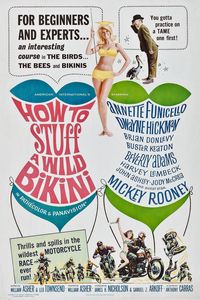
    (On Cable TV, September 2019) In the universe of sub-subgenres, the early-sixties beach party musical comedy is as weird and charming as it comes. The basic ingredients were a beach, a few teenagers, Frankie Avalon and Annette Funicello (both here in secondary roles), silly bikers, songs, and as much dumb comedy as one can stand. The result is … oddly refreshing, especially when compared to far more serious material. How to Stuff a Wild Bikini, sixth-of-seven movies in the series, features some magical nonsense headed by Buster Keaton in a supporting comic performance, staring at the screen after a particularly inane bit of dialogue saying “and that’s all the plot you’ll get from me.”  Keaton, despite a somewhat racist role, is quite funny—probably funnier than the rest of the film, which is light and dumb and quite proud of it. The ending motorcycle race must be seen to be believed, since it blatantly uses terrible special effects (rear projection, sped-up film, footage running backwards) to portray simple safe stunts as dangerous as possible. Among the musical numbers, Harvey Lembeck gets a bit of a highlight with “Follow your Leader” as he temporarily abandons the biker image for a suit. The gender roles are terrible and that’s part of the film’s dated charm, forthright in what it tries to be. Both Keaton and the Beach Party series would end soon after How to Stuff a Wild Bikini—not exactly a high note, but not an embarrassment either.