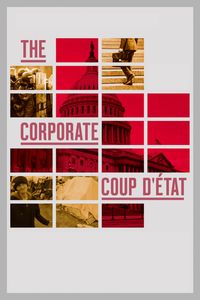
The Corporate Coup d’État (2019)
(On Cable TV, August 2019) There’s some precious irony in having some of the best documentaries about the sorry state of (North-) American society being financed by Canadian tax dollars. But after All Governments Lie and now The Corporate Coup d’État, Fred Peabody is clearly establishing himself as a clear-eyed chronicler of the many forces making things worse in today’s world. The central thesis of the film, as per its title, is in describing how politics are increasingly subordinate to corporate interests in setting policy, especially with laws that demonstrably benefit no one but a few corporations. But it’s impossible to present such a thesis without plenty of tangential topics to support the main argument, and that’s how we find ourselves discussing the opioid epidemic as evidence of generalized despair, excessive imprisonment used as social control mechanism more than individual punishment (let alone rehabilitation), and state violence not being used except overseas and in the inner city, as per police brutality riots. Much of the film’s thesis is not new nor all that revolutionary—Canadians will note that it, and the film’s title, comes from a 1995 book by John Ralston Saul, whose achievement since then include being the husband of the country’s Governor General. Much of the film uses a mixture of on-screen titles, news footage (sometimes used ironically—The CBC comes in for a few shots), on-the-ground reporting (not as intellectually heady but viscerally illustrative of the thesis—the foreclosure sequence is particularly poignant) and interviews with notables such as Ralston Saul, Cornel West, Matt Taibbi and quite a bit of Chris Hedges. Much of the film is quite convincing, showing that the 1995 thesis has been fully realized and illustrated by the past twenty-five years. Still, I can’t help but poke at a few moments of the film. One idea worth exploring would have been the centralization of wealth in the Internet age, for instance. I also wanted to hear more about the idea that Obama’s election caused an increase in corporate messaging to undermine his political support. Perhaps more crucially, I’m really not all that happy about the “both sides” rhetoric that finds its way in the text: it’s demonstrably not true, and it feeds into hopelessness rather than activism. (As that other noted Canadian intellectual Rick Mercer once ranted, choosing the lesser evil is really important.) Still, it’s quite an interesting documentary: It guns for big ideas, and finds plenty of material to illustrate its argument. It’s also far more entertaining than you’d expect: Perhaps the biggest treat in The Corporate Coup d’État is seeing West and Ralston Raul have a tea and chat about how to save the world. Considering this and a rather good envoi, the film doesn’t end quite as bleakly as you could expect from its glum subject matter.
