Fredrick March

  • Susan and God (1940)

    Susan and God (1940)

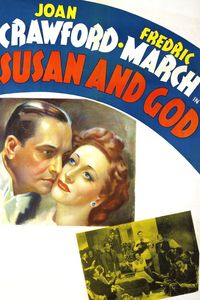
    (On Cable TV, March 2021) Try as I might, I just couldn’t get interested in Susan and God. Watching it because it’s directed by George Cukor, I was reminded that, having seen the best of his filmography, I’m now seeing the rest. As a comedy, it’s limp, and as a drama, it’s insubstantial. I’m not Joan Crawford’s biggest fan, and Fredrick March leaves me unmoved most of the time. There’s some promise in the premise (bored socialite claims to have found religion, then proceeds to blow up friendships and relationships by exposing everyone’s sins) but the execution is bland and featureless. I can sort-of-see the echo of the end of prohibition in how the film tackles self-righteousness and piety-as-tourism, but it’s really not enough to elevate the entire film from the doldrums. Too bad, really, because reading reviews of Susan and God has me thinking that this is the kind of material that appeals to me… but what I saw on-screen was simply not enough to stay interested.

  • I Married a Witch (1942)

    I Married a Witch (1942)

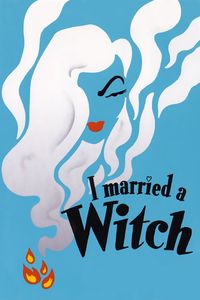
    (On Cable TV, November 2020) There are a few wonderful surprises buried in Hollywood film history, and I Married a Witch certainly feels like it. A fun blend of comedy and witchcraft, it features a father-and-daughter pair of sorcerers burnt at the stake in early New England and imprisoned in a tree until the 1940s, when they are freed by a lightning strike and eager to wreak vengeance on the descendants of the man responsible for their immolation. That doesn’t quite sound so much fun (and some of the dialogue from the historical antagonist is downright psychopathic), but I Married a Witch is very much presented as a comedy, and everything is in the execution. The daughter is played by Veronica Lake, and while Lake is extraordinarily beautiful to begin with, she also gets to play her characters with impish humour that adds much to her sex-appeal. Meanwhile, Fredrick March is the straight man of the story, bewildered at all the right moments and indignant at the others—he’s meant to be outshined by Cecil Kellaway as the warlock who’s not held back by anything like romantic love. The modern witchcraft angle is rare in classic Hollywood (feel free to pair it with Bell, Book and Candle fifteen years later), and the special effects are still decently effective. Still, it’s the great mixture of humour, romance and political satire that works much better than anything you may imagine from reading I Married a Witch’s plot summary. Don’t miss it!

  • Executive Suite (1954)

    Executive Suite (1954)

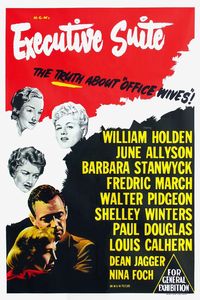
    (On Cable TV, October 2020) I am fascinated by tales of boardroom intrigue, a fascination that comes from my background as a white-collar office drone, constantly aware and at the mercy of senior management shenanigans. I also suspect that such high-level executive machinations are perhaps the closest modern equivalent to palace intrigue, what with the king having to deal with his scheming courtiers in modern attire. No matter the reason, I found myself very quickly drawn into Executive Suite’s steely-eyed depiction of the feeding frenzy that follows the death of a furniture magnate, as two visions of the company battle it out in a succession drama played in voting shares and personal grudges. The film’s opening moments are remarkable, as a first-person point of view of someone sending a telegram and going out to take a taxi turns tragic when the person dies and his wallet is stolen. It turns out that we’ve just seen the death of a company president, and the wallet theft means that no one (except for one executive using this knowledge for insider trading) will realize what happened for another day. The film settles down a bit after this fantastic opening sequence, but the sides are steadily described, what with a quality-conscious designer going up against a penny-pinching financial officer for control of the company. There are many similarities here with 1956’s Patterns, but Executive Suite is a solid drama of moves and counter-moves (with a seriousness underscored by, well, the lack of a score), with a likable hero played by William Holden and decent supporting roles for Barbara Stanwyck, Fredrick March and Shelley Winters. Director Robert Wise’s approach to the material is decidedly close to the ground, but there’s a decent understated flourish to the script, as it quickly sketches characters, and sometimes catches them in compromising positions. I don’t expect everyone to be as enthralled by Executive Suite as I was, but there’s something carefully balanced about its dramatic plotting and its almost realistic approach to the material.
  • Anna Karenina (1935)

    Anna Karenina (1935)

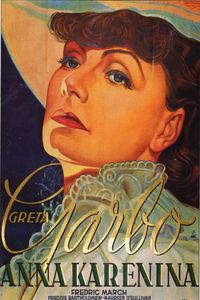
    (On Cable TV, March 2020) Another one in a long list of 1930s Hollywood literary adaptations, the 1935 version of Leo Tolstoy’s much-adapted Anna Karenina does have Greta Garbo, Fredrick March, and David O. Selznick as a producer—the three of them as close to Hollywood royalty as it was possible to get in the mid-1930s, which should give you an idea of the pedigree and importance of this Anna Karenina production. It goes without saying that Garbo is the main reason to see this version—it was a familiar role (she also played in a 1927 version), but this time she could use her voice. Although handsomely shot with big-budget production means most visible in sets and costumes, this production doesn’t quite have the technical polish nor expansive cinematography of later versions—but it does focus on the nuts and bolts of the story with good costume drama instincts (which includes a thorough culling of the novel to its most dramatic elements to fit within 90 minutes), so it’s still quite watchable today. I still prefer later versions, though.