Gene Krupa

  • The Big Broadcast of 1937 (1936)

    (On Cable TV, September 2022) With a title as blunt as The Big Broadcast of 1937, you know exactly what to expect: a variety show with a loose framing device having to do with Broadway and radio broadcasts circa mid-1930s. It certainly delivers: Even as part of a series, it’s watchable by itself, not only as an illustration of how radio operated back then, but also as a sampler of some celebrities of the time. It’s not that good of a musical: the rhythm is slack, the acts aren’t all as compelling, and the film frankly gets lazy with the framing device (or, rather, lack of) by the time the third act hits and it’s one diegetic number after another. But on the other hand, here’s another chance to catch Jack Benny, or the legendary George Burns and Gracie Allen couple closer to their vaudeville prime, or bandleader Benny Goodman with Gene Krupa on the drums. There’s also a short animation piece, at a time when those weren’t plentiful, and a little bit of visual style to make the musical numbers stand out. The plot itself? Largely forgettable, with its mixture of business concerns and light romantic comedy. But the point here isn’t the narrative—it’s capturing the performances of people who were, at the time, among the nation’s best-known entertainers. I wouldn’t necessarily recommend The Big Broadcast of 1937 to just about anyone, especially if they are completely unfamiliar with the period of its production. But for anyone looking to dig deeper into the era, it’s got a few fun bits and pieces.
  • The Gene Krupa Story (1959)

    The Gene Krupa Story (1959)

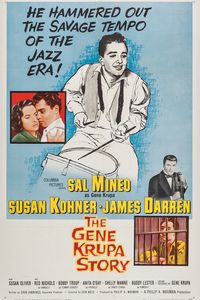
    (On Cable TV, January 2021) It’s often fascinating to realize how we come to know some things. In explaining why I deliberately set out to watch The Gene Krupa Story, for instance, I would have to explain how I was introduced to the American drummer through the music of electronica band Apollo 440 and some swing-house tracks, then add how Krupa often popped up in classic Hollywood movies such as Ball of Fire, The Glenn Miller Story and The Benny Goodman Story. Even today, nearly everyone has heard Krupa at one time or another—his drum work on Benny Goodman’s “Sing, Sing, Sing” is regularly sampled as shorthand for “old-time swing music” in contexts as various as The Simpsons or Woody Allen movies. Alas, always be wary of discovering more about half-familiar names: As documented here in a biographical film already sympathetic to its subject, the real Gene Krupa was a brilliant drummer that came bundled with a difficult human being. Drug abuse, unstable relationships, adultery and ostentatious lifestyle come with his success, and while this is all predictable to modern audiences raised on generations of musical biographies, The Gene Krupa Story did it in 1959. The film is perhaps most noteworthy for Sal Mineo’s energetic performance as Krupa—while Krupa himself provides the film’s music, it takes some talent to mimic his live-wire act, and despite other flaws, the film can at least claim to have a solid lead performance. Where the film doesn’t do as well is in flattening its historical component—coming from 1959 (and unfortunately shot in black-and-white). The Gene Krupa Story doesn’t portray much of a difference between the decades of its narrative: Everything feels like the 1950s, even when it heads to the heydays of 1930s Manhattan jazz. A wasted opportunity—but the drum work makes the film worth a look even when other aspects of the production falter. Listen to the film even if you don’t watch it—but have a glance at Mineo’s high-energy act from time to time.

  • Ball of Fire (1941)

    Ball of Fire (1941)

    (On Cable TV, January 2020) I’ll watch anything directed by Howard Hawks, but even I got a bigger surprise than expected with Ball of Fire, a romantic comedy with a few unexpected treats. Gary Cooper stars in his own solid way as an encyclopedist who steps out of his reclusive existence to study contemporary slang… and ends up paired with a lounge singer who needs to lay low after her mobster boyfriend comes under scrutiny. Barbara Stanwyck is at the top of her game as the female lead invading the sanctity of the encyclopedia writers’ refuge, teaching them much and falling for one of them in return. The plot, in typical screwball fashion, makes little logical sense but impeccable comic sense. Before long, we’re in a clash in which bookish old men take on gangsters holding them hostage through science—and win. Along the way, we get a performance out of the legendary drummer Gene Krupa playing the original Drum Boogie (a welcome surprise, given that I was familiar with Swing Republic’s electro house remix), first with his big band and then minimally with two matchsticks (with the expected final flourish). The rapid-fire dialogue is a Hawks trademark (working from a script written by a young Billy Wilder), and having Stanwyck as a typical Hawksian heroine only bonifies the result. I’m not as happy with the film’s clear anti-intellectual skepticism, but much of it simply powers the plot—by the end brawl between Cooper and a mobster, there’s no doubt as to who will triumph. It all makes for a very likable film working from a Snow White and the Seven Dwarves template, with two lead actors at their most sympathetic, and a writer-director combo who clearly knew what they were going for.