George Burns

  • The Big Broadcast of 1937 (1936)

    (On Cable TV, September 2022) With a title as blunt as The Big Broadcast of 1937, you know exactly what to expect: a variety show with a loose framing device having to do with Broadway and radio broadcasts circa mid-1930s. It certainly delivers: Even as part of a series, it’s watchable by itself, not only as an illustration of how radio operated back then, but also as a sampler of some celebrities of the time. It’s not that good of a musical: the rhythm is slack, the acts aren’t all as compelling, and the film frankly gets lazy with the framing device (or, rather, lack of) by the time the third act hits and it’s one diegetic number after another. But on the other hand, here’s another chance to catch Jack Benny, or the legendary George Burns and Gracie Allen couple closer to their vaudeville prime, or bandleader Benny Goodman with Gene Krupa on the drums. There’s also a short animation piece, at a time when those weren’t plentiful, and a little bit of visual style to make the musical numbers stand out. The plot itself? Largely forgettable, with its mixture of business concerns and light romantic comedy. But the point here isn’t the narrative—it’s capturing the performances of people who were, at the time, among the nation’s best-known entertainers. I wouldn’t necessarily recommend The Big Broadcast of 1937 to just about anyone, especially if they are completely unfamiliar with the period of its production. But for anyone looking to dig deeper into the era, it’s got a few fun bits and pieces.

  • Oh, God! (1977)

    Oh, God! (1977)

    (On Cable TV, March 2021) If you’re reading this review in the hope of learning a reason to see Oh, God!, it’s not that complicated: George Burns as God. That’s your reason. The story may be a circa-1977 take on how a divine message would be perceived by humanity, but the film’s big draw is Burns playing (a representation of) God, talking to a most unlikely messenger and trying to get him to spread his gospel. It’s sacrilegious and surprisingly faithful at once, tweaking traditional doctrine but reinforcing moral values at once, and reserving its biggest criticism for hypocritical televangelists. Director Carl Reiner does justice to a script that’s not specifically comic nor all that profound, remaining to the gentle amiability of the proceedings. John Denver is not bad in the lead role and Terry Garr is her usual self in a supporting role, but Burns steals the show — he’s the most remarkable character, gets all of the best lines (including some great ad-libs, we’re told) and plays the role with impeccable comic timing. I dimly remembered at least the concept for the film from childhood trips to the video store, but I’m not sure I saw more than the courtroom scene. In any case, the result is pleasant without being hilarious — but the result does feel smarter than the average Hollywood comedy, so there’s that. Plus Burns as God, obviously.

  • A Damsel in Distress (1937)

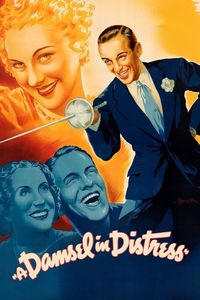
    A Damsel in Distress (1937)

    (On Cable TV, October 2020) One of the lesser Fred Astaire musicals of the 1930s, A Damsel in Distress takes us to England, where Astaire plays (as usual) a renowned entertainer trying to find love. He eventually finds it in the character of an English lady, although not without the complications that usually follow such narratives. The cast does offer some interest, with Joan Fontaine at the female lead, and comic characters played by none other than George Burns and Gracie Allen, the later being progressively funnier as a squeaky-voiced airhead. There’s the usual number and variety of dance numbers from Astaire, and while there’s nothing truly anthology-worthy here, two or three sequences still work really well: “Stiff Upper Lip” leads to a showpiece funhouse dance number, while “Nice Work If You Can Get It” leads to an Astaire drum solo played with a variety of appendages. Nearly everything about the film is perfunctory by Astaire’s high standards—Fontaine is not a particularly good dancer, the comedy is slight (aside from Burns and Allen) and the premise is a bit dull compared to other movies of the era. Those who keep a wearied eye on Astaire’s romantic persona (boiled down to “no means try again later”) will note an explicit statement of the persistence credo late in the film, where a character calls out Astaire for being too passive and to Go Get It. Modern audiences will groan at that moment—what works for Astaire would mean a restraining order and social media denunciations in real life twenty-first century. Still, A Damsel in Distress itself is not too bad, even though it is frankly one of the more easily disposable of Astaire’s black-and-white films.