George Kennedy

  • Airport ’77 (1977)

    (In French, On TV, November 2021) By 1977, both the Airport series and the disaster-movie subgenre had evolved to make the existence of a ludicrous film like Airport ’77 inevitable. While the first Airport was an ensemble melodrama enlivened with some techno-thriller elements, the success of its imitators focused on the thrills and by the time the follow-ups came around, the drama was clearly an accessory to the spectacle, although it allowed some Classic Hollywood superstars one last go at box-office gold. So it is that one of the two most engaging elements of Airport ’77 is James Stewart, with a relatively small role as the owner of an airline—so proud of his newest plane that he loads it up with invaluable treasures right before it’s set to travel from New York to the Caribbean, with none other than Jack Lemmon playing the plane’s pilot. But this wouldn’t be a disaster without a disaster, and so thieves drug the passengers, steal the valuables and make a dumb mistake that sends the plane crashing into the ocean and settling down a few metres down the surface. The other asset of the film kicks in at that point — a relatively credible description of how such a disaster would be tackled by the US Navy (with some assistance from series mascot George Kennedy), slipping large balloons underneath the wings of the plan to raise it up to the surface so that passengers can be rescued. (Let’s all agree to ignore the extremely high likelihood of the plane breaking up upon hitting the ocean in the first place.)  Stewart, Lemmon and the US Navy don’t quite add up to a completely enjoyable film, but they do help rescue it from disaster. I don’t necessarily count the unlikeliness of the plotting against Airport ’77 — it’s a disaster film, after all. But there’s still too much dead weight, too many bog-standard subplots, and too little of a climax to cap things off. It fits with the other films of the series… even if the steady drop-off in quality becomes more and more obvious.
  • Fools’ Parade (1971)

    (On Cable TV, October 2021) A surprisingly older James Stewart anchors Fools’ Parade, a Depression-era comic thriller in which a just-released ex-con with a sizeable check in his pocket gets involved in a number of adventures to protect his hard-earned money. Playing with his usual drawl, good-natured persona and exaggerated squint (the character is missing a glass eye), Stewart does have some company in the cast: It’s a shock to recognize a young Kurt Russell in a supporting role (meaning that you can jump from 2021’s The Fast and the Furious 9 to 1936’s Rose-Marie with this one degree of separation), or have George Kennedy play the heavy. It’s billed as a comedy for obvious reasons—it ends well, for one thing, and there’s one sequence that ends with a surprising bang—but the tone is not always jolly. Clearly shot in the muddy 1970s, it’s a film drowning in browns and blacks, which does take away from a comic atmosphere. Still, it’s reasonably entertaining: Where else can you watch Stewart with sticks of dynamite strapped to his body, genially threatening to blow up the bank if his reasonable demands aren’t met? As you may guess, Fools’ Parade doesn’t quite fit together: a bit too sombre for pure comedy, and too comic for pure thrills. But it does work, largely thanks to Stewart being so effortlessly watchable.

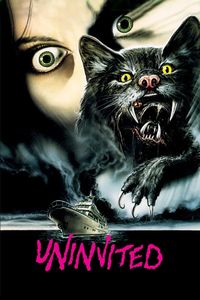
  • Uninvited (1987)

    Uninvited (1987)

    (In French, On Cable TV, July 2020) A strong contender in the so-bad-it’s-strangely-compelling category, Uninvited is significantly worse than your usual horror film, but in ways that have you looking forward to the next inanity. The stupidity starts early on with the idea of an adorable orange tabby cat somehow transforming back and forth in a horrifying puppet creature that murders people. Writer-director-producer Greydon Clark means to evoke a sense of claustrophobia by setting almost all of the film aboard a yacht with fewer than ten characters, but the limited competence of everyone associated with the film soon sabotages anything beyond mild comedy. The special effects are almost uniformly terrible, only to be outdone by, well, everything else from costumes to acting to staging to dialogues (even in dubbed French). Uninvited’s only marginal success is overall directing and pacing because as terrible as the elements of the film can be, it does move briskly from one set-piece to another, and it becomes a game to spot the next Truly Dumb Thing on the menu. Even the snarky Wikipedia plot summary can’t help itself, as it mentions how the characters somehow use a sextant to perform blood analysis, or how the different cat at the end of the film undermines the sense of cyclical doom that it means to invoke. George Kennedy somehow ends up stuck in the middle of this—although he checks out midway through, having completed his job of attaching a recognizable name to the marquee. The other actors are much worse than him, which is saying something. The result is a truly bad film, but one that does have a certain constant interest to it—I’m probably going to remember Uninvited much longer than most of the other movies I’ve seen this week.

  • The Delta Force (1986)

    The Delta Force (1986)

    (In French, On Cable TV, July 2019) I’ve come to be grateful for the “time-travel effect” of watching older movies that take us to a past time and place, but that appreciation has its limits, especially when it takes us to a time and place that should remain distant. Part of The Delta Force’s anti-charm is that it takes us to a radicalized version of the mid-1980s where terrorists were everywhere and the only possible solution was violent action taken against them. To be fair, I can imagine a number of good scripts in which this idea is discussed. But none of them happen to feature Chuck Norris as a former Delta Force operative taking on the terrorist almost single-handedly. And few of them go for the cheap theatrics and hyper-manipulative tactics used here. On the other hand, if you really want a taste of how American foreign policy was perceived in America circa 1986ish, then this is the film to watch: it’s not good and it’s not refined and it tells you everything you need to know in as blatant a way as possible. The stereotypes are as blunt as they can be, with Palestinian hijackers, Jewish hostages, American muscle and ineffective Middle Eastern help—is it even useful to note that The Delta Force was produced, written and directed by the very Israeli Menahem Golan and Yoram Globus? Calling it a piece of propaganda doesn’t quite capture it—considering that the villain’s plot was based on two early-eighties real-life events, it’s perhaps fairer to call it a fantasy of excessive retribution. It’s not fair to say that the film rests on a lot of unexamined assumptions about terrorism and violent response—it’s more accurate to say that the film stakes itself on not revisiting those assumptions. There are a few interesting things about The Delta Force. Chuck Norris may or may not be to anyone’s liking, but he is surrounded by an astonishing number of grade-A actors in big-to-minor roles, from Lee Marvin to George Kennedy to Shelley Winters to Robert Vaughn, to Robert Foster. For all of its emotional manipulation, the film does stumble into a few effective scenes (usually sandwiched between far less effective material). Finally, there’s a violent wish fulfillment of seeing terrorists getting their comeuppance, which works even when you’re not a far-right-winger. Any history of 1980s Hollywood movies and their relationship with American foreign policy can talk about Top Gun and Rambo, but it has to include a chapter on The Delta Force: It’s so blunt, with all subtext being presented as text, that it pretty much spells out what other films hesitantly allude to.

  • Airport 1975 (1974)

    Airport 1975 (1974)

    (In French, On Cable TV, November 2018) The original Airport may have been meant as a workplace drama made even more thrilling by the possibility of airplane crashes, but it launched the 1970s disaster movie craze and by the time its own Airport 1975 follow-up came around, the series refocused on a profitable niche: airborne disasters, in this case what would happen if a small plane crashed in a jumbo airliner? The premise doesn’t make a lot of sense the closer you look at it (or rather: it doesn’t make sense that there would be something to do after such a collision), but no matter: it’s up to George Kennedy and Charlton Heston to play the heroes, be lowered in the gaping open cockpit, and bring everyone back down to safety. That should be enough in itself, but contemporary viewers will get quite a kick out of this Airport 1975 because it’s one of the main sources of inspiration for the classic spoof Airplane! That’s right: the nun, the sick kid and other gags all find their origin here, lending an unintentional hilarity to something meant to be deadly serious. Otherwise, well, some of the airborne footage is impressive, while some of the special effects have not survived well at all. Karen Black is not bad as the heroine, despite her character bearing the brunt of the film’s unconscious sexism. Still, for all its faults, there’s a bit of a magnificence to the results—this is not meant to be a good movie, but it seems to know what it’s made for. As a result, Airport 1975 withstands an admittedly ironic contemporary look better than many of its contemporaries.

  • Charade (1963)

    Charade (1963)

    (On Cable TV, March 2018) It does take a while before Charade comes into focus. It begins strangely, with a contrived meet-cute at a ski resort in the Alps that turns into an even stranger succession of events once the heroine comes back to Paris to find out that her husband has died, a large amount of money is missing, and three strangers really hated her ex-husband. The artificiality of the setup is almost overpowering, and even the comforting presences of Audrey Hepburn as the widow and Cary Grant as a mysterious free agent aren’t quite enough to unpack the heavy-handed setup. But as the deaths and double-crosses being to pile up, Charade does acquire a nice velocity, and even answers the questions raised in the first act. Hepburn is adorable as the endangered heroine, despite being too young for the role. Meanwhile, Grant is terrific as someone who may or may not be friendly—he’s occasionally very funny (ha, that shower scene!), and his last grimace of self-revelation at the very end is like seeing a split-second callback to the classic comedies early in his career. Also noteworthy as supporting roles for Walter Matthau, George Kennedy and James Coburn. Great scores and visual design by Henry Mancini and Saul Bass round up an impressive crew. Surprisingly not directed by Alfred Hitchcock, Charade is increasingly endearing the longer it goes on, and satisfyingly blends romance, comedy and suspense. It’s well worth watching. Just make sure to give it more than thirty minutes to make sense.

  • The Dirty Dozen (1967)

    The Dirty Dozen (1967)

    (On Cable TV, March 2018) Frankly, I thought that I would have enjoyed The Dirty Dozen quite a bit more than I did. Part of it may have been shaped by modern expectations—in modern Hollywood, movies based on the premise of bringing together hardened criminals for a suicide mission are meticulously polished to ensure that the criminals aren’t too bad, or that they meet a morally suitable comeuppance. Our heroes have been unjustly convicted, or operate according to a sympathetic code of honour that may not meet official approval. Their adventures, first in training and then in combat, are calculated to meet focus group approval. But The Dirty Dozen, having been forged in the years following the breakdown of the chaste Hayes Code, is significantly rougher and grittier than the modern ideal. The dirty dozen members are in for reprehensible conduct, not pseudo-criminal malfeasance. The attitude of the film, as Hollywood was pushing the limits of what was acceptable in terms of violence, also permeates everything. While tame by contemporary standards of gore, The Dirty Dozen nonetheless feels … dirty. There are a lot of characters, and they’re often short-changed by the film’s juggling of roles. This being said, The Dirty Dozen is also a showcase of actors: In between Lee Marvin, Ernest Borgnine, Charles Bronson, John Cassavetes, George Kennedy and an impossibly young Donald Sutherland (among many others), there are a lot of familiar faces here, and that has its own appeal. If you can go along with the film’s disreputable atmosphere, it remains a competent war film … but it may be difficult to do so.

  • Cool Hand Luke (1967)

    Cool Hand Luke (1967)

    (On Cable TV, November 2017) A cliché isn’t necessarily a cliché if it’s in the film that came up with it in the first place. So it is that pointing at Cool Hand Luke as a big bunch of familiar prison-movie moments is useless, given that it made up half of them and competently executed the others. It’s not subtle, though: first-time director Stuart Rosenberg doesn’t miss an opportunity to go for Christ symbolism whenever possible, and the mirror-glasses thing also gets a lot of play. Otherwise a paean to resisting authority, Cool Hand Luke is notable mostly for Paul Newman’s performance (echoed at the end of the film) as a rebellious inmate unable to quietly do his time. It evolves in a fairly standard prison picture, although the chain-gang aspect gives it a slightly different flavour. It’s not a cheery film, although individual moments may appear more encouraging. George Kennedy appears in a dramatic performance that got him an Oscar but may surprise viewers familiar with his more light-hearted roles. One of the film’s standout sequence has to do with a woman lasciviously washing her car in full view of a convict gang—it’s so over-the-top that it gets a laugh or two. Otherwise, Cool Hand Luke is memorable for the bluntness of its execution, and for depending on Newman as its narrative anchor. It doesn’t quite feel as fresh as it must have been at the time, but keep in mind that 1967 was at the cusp of two very different eras…