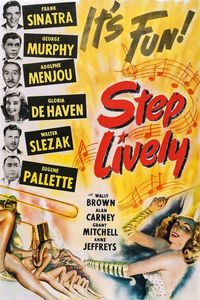
Step Lively (1944)
(On Cable TV, May 2021) As a remake to the Marx-Brothers 1938 comedy Room Service, the 1944 Frank Sinatra vehicle Step Lively was not necessarily doomed to failure. Absent the Marxes, it’s clear that the remake will not be the same kind of comedy — and Sinatra’s ability to do verbal humour isn’t the same as Groucho Marx. (Ironically, those two would later co-star in Double Dynamite seven years later.) Fortunately, the script was heavily retooled, largely reverting to its Broadway theatrical roots, absent the specific Marx flourishes. And it works rather well — the base story is something that can more effectively be told as a low-octane charming comedy rather than an out-and-out vaudeville special, and it’s in that vein that Step Lively can best exploit the talents of pre-icon Sinatra. There is a bit of a mismatch between young Sinatra and the world-weary fast-talking role he’s meant to play, but this is tempered by modern viewers’ knowledge that Sinatra would eventually become (as “Chairman of the Board”), the kind of character he was portraying here. Some of the supporting players (notably George Murphy, Wally Brown and Alan Carney) are meant to be funnier and usually are, leaving the straight man reacting and the straightforward singing to the lead. While Step Lively won’t rock anyone’s world (well, other than Sinatra fans), it’s a pleasant enough watch and an interesting point of comparison with the zaniness of Marx-style Room Service.