Gert Fröbe

  • Monte Carlo or Bust! aka Those Daring Young Men in Their Jaunty Jalopies (1969)

    Monte Carlo or Bust! aka Those Daring Young Men in Their Jaunty Jalopies (1969)

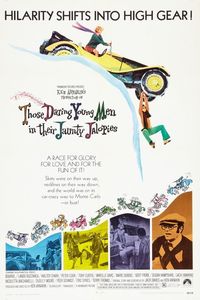
    (On TV, June 2021) If you’re noticing a slight titling resemblance between Those Daring Young Men in Their Jaunty Jalopies and the better known Those Magnificent Men in Their Flying Machines, well, that’s not an accident: Monte Carlo or Bust! was made as a sequel to the earlier flying film, and the American release simply retitled the result to make it even more clearly related to its 1965 predecessor. The premise is a ground-bound variant, the characters are similar but not meant to be related (even if some of the cast is the same, no character is meant to carry from one to the other), and the style is very similar: Random comic mayhem across a large ensemble cast, structured around a race that’s never as simple as it would appear in the first place. Terry-Thomas plays a large part in this film, but the ensemble cast includes such notables as Tony Curtis (who, for extra bonus points, also played a racer in the similarly-themed but funnier The Great Race), Dudley Moore, and Gert Fröbe. The 1920s setting means that we’re back in a somewhat heroic era for racing, with many mishaps along the way that would do not exist in a more modern age. Monte Carlo or Bust is decently amusing, but it is not snappy: at slightly more than two hours, it’s very much an epic comedy that favours large-scale practical gags rather than tight dialogue or fast pacing. There’s a little bit of romance to make it sweeter, but the overall impression remains of an amiable, often spectacular sort of comedy. It hasn’t aged as well as it should, but it keeps some of its period charm.

  • Ein Unbekannter rechnet ab [Ten Little Indians aka And Then There Were None] (1974)

    Ein Unbekannter rechnet ab [Ten Little Indians aka And Then There Were None] (1974)

    (In French, On Cable TV, November 2019) As murder mysteries go, And Then There Were None is one of the darkest ones and it remains one of Agatha Christie’s best-known novels. I first read it in high school, so it keeps that timeless aura that, paradoxically, makes its various film adaptations more interesting. In the case of this 1974 version (a multinational collaboration, but shot in English), the appeal here is in a very specific 1970s take on the material, not particularly faithful to the original text but interesting in its casting and audience-friendly choices. It’s obvious from the first few frames that it’s going to be a very 1970s kind of film—the fuzzy colour cinematography, the fashions of the day played up and the actors being a multinational bunch of then-celebrities. Take a look at that cast: Charles Aznavour, Elke Sommer, Gert Fröbe, Oliver Reed, Richard Attenborough and Orson Welles. But it’s in the changes to the story (many of them reprised from the 1965 version by the same producer) that the film ends up being most interesting. Dispensing with the traditional island location, this one ends up in the Iranian desert prior to the revolution—the impact still being isolation in the middle of nowhere. Thus transplanted in a sand ocean, the story largely goes about the same way until it hits its third act, at which point the plot is rejigged in most Hollywoodian fashion to allow for foiling the book’s entire plot and allowing some characters to survive the events of the film. As a Christie enthusiast, I suppose I should be aghast at the way the entire harsh point of the novel is softened into crow-pleasing pablum. But in the end, I’m not particularly bothered by the changes—I find them interesting in the way they alter the premise, and I’m never totally opposed to happy endings anyway. The original novel remains available for all to read if you want the real deal—and considering its enduring popularity either now or in the 1960s–1970s, there’s a fair case to be made that the filmmakers were able to give something new to audiences expecting a straight-up retelling of the book. Add to that the now-delicious patina of 1970s style and the 1974 version of Then There Were None remains worth a look.

  • Goldfinger (1964)

    Goldfinger (1964)

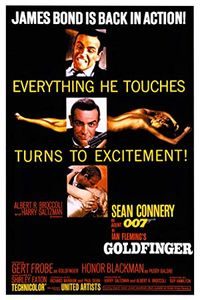
    (Second viewing, On Blu Ray, September 2018) The James Bond series really caught fire on its third outing, with Goldfinger hitting upon the mixture of overblown villainy, hot dames and cool secret agent. From the table-cutting laser to the modified Aston Martin, from the cheekily named Pussy Galore to the ludicrously exotic (and fictional) way of being killed with gold paint, from the stocky henchman to the final 007 timer count, you can finally feel the series tweak the formula that it would follow from then on. It helps that the film is above average in several aspects: Gert Fröbe makes for an oddly compelling villain, the evil plot is actually cleverer than usual, and if you pay attention, there is an interesting subversion of Bond’s role in having him being a bystander for much of the film. The already-established fundamentals of the series are there in good form: the globetrotting romp through a handful of countries, Q’s gadgets, and, of course, Sean Connery’s imitable yet unsurpassed charisma. In most technical aspects, Goldfinger has aged remarkably well: the gadgets feel contemporary, the period detail is fascinating (ah, that look at a mid-sixties American commercial strip!), the editing is more modern than contemporary standards, and the pacing holds up thanks to Bond’s early introduction compared to previous instalments. Alas, it’s not all great: the film’s sexism is often unbearable, whether you’re talking about the “man talk” slappy dismissal of a minor female character, or the plot hinging on a reluctant seduction with echoes of “Bond can turn any woman straight.” There are other annoyances (hey, Bond doesn’t like the Beatles!), but they don’t feel quite as unforgivable as the film’s clearly retrograde ideas about women. Oh well; at least we’ve got “No, Mister Bond, I expect you to DIE!” to fall back on.