Gina Lollobrigida

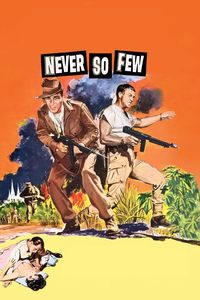
  • Never so Few (1959)

    Never so Few (1959)

    (On Cable TV, April 2021) The 1950s were a victory lap when it came to Hollywood movies and World War II. Even absent the propagandist imperative of the war years, studios kept revisiting the conflict in generally heroic tones, praising the American soldier and considering the war as a series of adventures. You can see that tone at work in Never so Few, which explores an understudied facets of war (the Burmese theatre) in a way that evolves from slight comedy to revenge thriller. It is, at the very least, heavy on stars with Frank Sinatra and Gina Lollobrigida in the lead roles, and notables such as Steve McQueen, Charles Bronson and Paul Heinred in supporting roles. In an attempt to throw everything in its expansive two-hour running length, there’s a depiction of troops in wartime and a mission behind enemy lines, but also a shoehorned romance and a travelogue as well. It works, but just — Never so Few isn’t some kind of forgotten classic or anything: it’s worth a look if you like the cast, or if you want another illustration of another corner of WW2, but it’s not always as compelling nor as consistent as similar films from the era.

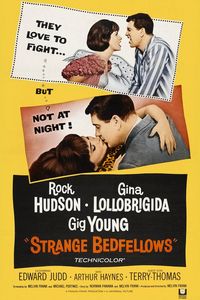
  • Strange Bedfellows (1965)

    Strange Bedfellows (1965)

    (On Cable TV, March 2021) As I may have mentioned before, there’s a specific tone to 1960s sex comedies that hasn’t, can’t and won’t be successfully replicated. A mixture of naughtiness but no explicitness, mid-period Technicolor cinematography, slightly more permissive audience expectations, stars moulded in the waning studio system and the optimistic exhilaration of the decade as everything was changing. Strange Bedfellows may not be a classic, but it is an illustration of that specific subgenre and the fun it can have. Rock Hudson and Gina Lollobrigida star — Lollobrigida is a good fit for the part of a flighty artist who gets married to Hudson’s suave account executive. Hudson himself is not bad, although the more I see of his performances, the more I can’t help but compare them to what Cary Grant would have done better — both, after all, looked the part of handsome leading men, but Grant had a self-deprecating streak that made his comic performances almost perfect. Hudson doesn’t quite have that, so while his performance is enjoyable, it doesn’t quite have that extra spark necessary for this kind of comedy. (To face the obvious question whenever we have a Hudson romantic comedy: Strange Bedfellows does have a surprising number of very ironic moments knowing that Hudson was gay — clearly the filmmakers knew what they were doing.)  There’s some jet-setting charm to the way the film goes from London to New York. The tone of the film shifts a bit too much toward absurdity in its last act — not that I don’t like zany humour, but it could have been zanier from the start. There are better 1960s comedies out there, but even an imperfect vehicle, such as Strange Bedfellows, is worth a few chuckles. If you like that style, you’ll like the film.

  • Solomon and Sheba (1959)

    Solomon and Sheba (1959)

    (On TV, November 2020) A film can do everything according to the rules and still fall flat, and that’s the way I feel about King Vidor’s Solomon and Sheba, a historical epic that clearly plays by all of the rules of 1950s epic movies yet fails to make a strong impression. Oh, it does have its qualities—Yul Brynner with hair (as Solomon), George Sanders in a minor role, and the incomparably named Gina Lollobrigida (as the queen of Sheba), huge armies clashing in the desert, and a scene with the well-known judgment of Solomon, and the rest of what audiences expected from movie epics over what they could see on household TVs. But compared to other epics, Solomon and Sheba feels somewhat generic—compressing decades of filmmaking in one all-available present, this film appears without much distinction nor grandeur beyond Brynner playing a king. Things get somewhat more interesting once you start reading about the film’s production—the newness of shooting a historical epic in Spain (rather than the more common choice of Italy at the time) pales in comparison to the behind-the-scenes drama that surrounded Tyrone Power‘s sudden death two-third of the way through, and his replacement by Brynner. Very little (if any) of this backstage turmoil shows up on the screen, though, and the result, unfortunately enough, is Yet Another Epic rather than something distinctive in its own right.

  • Beat the Devil (1953)

    Beat the Devil (1953)

    (On TV, September 2020) I’m a bit surprised at how Beat the Devil doesn’t work as well as I was expecting. On paper, it looks like a slam-dunk: a comic adventure starring Humphrey Bogart (plus Jennifer Jones, Gina Lollobrigida and Peter Lorre!), directed by John Huston and co-written by Truman Capote, all taking place in exotic British East Africa. It’s explicitly made as a parody of earlier films, and concerns swindlers trying to claim uranium-rich lands. I mean, how can this fail to deliver? But it does—the herky-jerky script struggles with consistent tone (a likely artifact from having been reportedly rewritten on a daily basis), the comedy is weighted down by bland direction and the visual flourish of the film is nothing worth reporting on. Some of the film’s production history suggests that it was almost treated as a vacation by Huston, Bogart and others, and this lack of discipline clearly shows—it’s also unclear if Huston had a sense for comedy, as demonstrated by what Beat the Devil tries to pass off as funny. This being said, I’m putting an asterisk (*) here to revisit this film in a while, just to see if I either understand more about what it’s reputedly trying to parody, or if I’m in a potentially better mood to accept what’s going on here.

    (Second Viewing, On TV, December 2021) This is my second go-around on Beat the Devil, and I’m still as dumbfounded (or disappointed) as during the first. At another glance, this still feels like a can’t-miss film: A group of shady characters; striking actors such a Humphrey Bogart, Peter Lorre, Gina Lollobrigida and Jennifer Jones; directing by John Huston; and a script by Truman Capote. Better yet – the film is often presented as comedy, spoofing the kind of character-based adventure films that Hollywood was churning out at the time. The problem is that none of these things quite add up. It’s clearly not serious, but it’s not all that funny either, and the florid dialogue doesn’t add up to a compelling storyline. Some of this weirdness can be explained by taking a look at Beat the Devil’s production history – with the director ripping up the script on the first day of shooting and Capote churning out material as the shoot went on. The disjointed aspect of the film isn’t helped by actors goofing off when the goofing off doesn’t have a point. I gave the film a second look hoping that it would make more sense a second time around, but merely found my interest wandering again for what I feel are the same reasons. Oh, the occasional bon mot perked up my interest from time to time, but it’s not enough, not sustained into a coherent narrative nor a coherent comic tone. Maybe I’ll give it a third try. Maybe I’ll just ignore Beat the Devil as something that simply doesn’t work on me.