Godzilla series

  • Gojira tai Megaro [Godzilla vs. Megalon] (1973)

    (On TV, October 2021) Oops—I may be overdoing my Godzilla series marathon. The recent cable release of King Kong vs. Godzilla has led Canadian cable TV channels to show as many Godzilla movies as they had rights for, and that meant that I’ve been seeing one of them every week for the past few weeks. Considering the formulaic nature of the series, I’m feeling burnt out now—and seeing them in scattered chronological order is not helping, as the technical and narrative polish of the film keeps changing. Godzilla vs. Megalon is a late-ish Showa era entry, meaning that the stylistic elements of the series were well established (with Godzilla now firmly a hero), but the series was also trying to find ways to stretch the formula as wide as it could. This means that, in addition to the monsters and aliens introduced in previous instalments, we also get an undersea, underground civilization attacking humanity for its damaging nuclear tests, and Godzilla racing to the rescue in his googly-eyed glory. This is the one with the humanoid robot fighting Godzilla if you’re looking for a shortcut. Godzilla vs. Megalon works in the same ways the Godzilla series knew how to work by that time—but taking a kids-friendly approach, making Big G the hero and having the convoluted plotting leading to a big kaiju-fighting finale. I don’t think I’m the target audience any more for this kind of material, but it’s still effective in bits and pieces. I’ll be the first one to admit that the series will probably make far more sense if ever I sit down to watch the entire thing chronologically. In the meantime, though, I’m seeing what falls on the DVR schedule… but I think I’ll take a break for the next while.

  • Mosura tai Gojira [Mothra vs. Godzilla] (1964)

    Mosura tai Gojira [Mothra vs. Godzilla] (1964)

    (On Cable TV, September 2021) I’m slowly dipping my toes into the Godzilla-Toho catalogue, and while Mothra vs. Godzilla does have the advantage of featuring the iconic moth, it’s very much an early-period Godzilla film: It’s still weird to see Godzilla portrayed as a pure antagonist (rather than the sympathetic but uncontrollable force for good of later films) and the entire menagerie of creatures and aliens isn’t quite there the enliven things up. Not that the result isn’t weird enough, what with Godzilla running amok over Japan, a mysterious egg, a nuclear-devastated island of fairy-like creatures, rapacious theme park developers and the scientists trying to find a solution. It’s thankfully in colour, features just enough rubber-suit rampaging (although I’ll never get over Godzilla’s ping-pong eyes) and the obvious miniature sequences add to the charm. Historically, this is the fourth-in-the-series film that marked the shift of the series to a kid-friendly style and, in doing so, cemented its style. It doesn’t quite stand alone, but that’s something true of the rest of the series as well. Still, Mothra vs. Godzilla remains reasonably fun as a kaiju film.

  • Kaijû sôshingeki [Destroy all Monsters] (1968)

    Kaijû sôshingeki [Destroy all Monsters] (1968)

    (On Cable TV, February 2021) As someone who’s sympathetic to the Godzilla movies but hasn’t seen all that many of them, I’m half-entertained, half-puzzled by Destroy all Monsters. This late entry in the original Godzilla chronology does have the distinction of moving things along to a near-future of space travel, a “Monster Island” hosting the kaijus and bright colour cinematography. (I obviously missed a few films in-between the original Gojira and this.)  It all gets wilder once our human protagonists discover an alien plan to mind-control people and monsters alike to destroy the world or some such nonsense. The script is promising but ultimately unsatisfying, as good ideas are not executed particularly well, and as the pacing of the film varies considerably. Even the highlights, such as the film’s sole urban-stomping monster fight, are seemingly inserted without much impact on the plot. Much of the ending has various monsters curb-stomping an evil alien monster in a one-sided fight that would probably mean more if I knew more about that alien monster. (I also suspect that I would hate mini-Godzilla —sorry, “Minilla”—even more if I’d watched more of the series.)  Still, much of Destroy all Monsters is endearing to a surprising degree. Adding goofy eyes to Godzilla helps a lot, but even the now-obvious miniature work doesn’t fail to be impressive. The film has a charming quality to its goofiness, even (or especially) when all-female aliens looking like a K-pop band are trying to destroy earth. In the Godzilla chronology, this may represent the best of what the original series has to offer, and the monster team-up, colourful cinematography, quaint special effects and near-future imagination do a lot to make Destroy all Monsters still fun.

  • Godzilla, King of the Monsters! (1956)

    Godzilla, King of the Monsters! (1956)

    (Second viewing, On Cable TV, July 2019) Blame my failing memory, but I assumed that Godzilla, King of the Monsters! was a sequel to the original Gojira, and nearly put off its viewing to another day after watching the original. But I didn’t, and was pleasantly surprised to find out that in its cinephile goodness, TCM had played both the Japanese original and its Americanization back-to-back. Godzilla, King of the Monsters! takes Gojira and reshapes its footage around new sequences featuring Raymond Burr as an American journalist who gets to experience the events of the film as part of his reporting. Extra sequences with Japanese actors talking with Burr are inserted in the previous film’s footage, providing a snappier rhythm (the film begins with catastrophic devastation, then flashes back in time to explain how we got there) and an accessible way for 1950s audiences to appreciate an unapologetically Japanese movie. Tall-and-wide Burr towers awkwardly over Asian extras as he describes the events unfolding, and even sort-of-interacts with some of the original characters through tricky editing. Despite the repetitiousness, it’s a far better movie if you’ve just seen the original as I did, as you can really appreciate the efforts that the American filmmakers went through in order to adapt the material to their target audiences. (History, hilariously enough, shows that this Americanization was more popular than the original in many markets, and even found its way back to Japan a few years later where it made a substantial amount of money.)  Some of Gojira’s most explicitly political (read; anti-nuclear) material did not survive the recut, but some of the best lines of dialogue remain. For today’s far more cosmopolitan audience, the idea of re-cutting a foreign movie with American content is tantamount to heresy, and it’s easy to laugh at the clumsiness of the attempts. But that’s missing the historical context: Without Godzilla, King of the Monsters!, there wouldn’t be much of a Godzilla cultural imprint in American society, and perhaps even less of an inroad from other Japanese filmmakers (including Kurosawa) in 1960s American film culture. It did the job at the time, and it does feel reasonably respectful even today: Burr interacts humbly with his Japanese hosts, and even if the spotlight is on him, he does not diminish the heroism of the Asian characters. The result is fascinating, especially if you can pair it with the original.

  • Gojira [Godzilla] (1954)

    Gojira [Godzilla] (1954)

    (On Cable TV, July 2019) I first saw the Americanized version of Gojira (the one with Raymond Burr) a few decades ago, but had clearly forgotten most of it given that a look at the original Japanese version kept most of its power to surprise me. [July 2019: Having seen the Americanized Godzilla, King of the Monsters right after this one, I can understand the reaction—the American version feels like a highlight reel of the original that cuts away much of the gradual buildup.]  Given that this is the original kaiju movie that spawned it all, it’s no surprise to find out that this Gojira feels very different from all the other ones. Made at a time when the conventions of monster movies did not exist, its first half-hour is a mystery that only gradually reveals the existence and then the shape of the monster, with much of the destruction occurring two thirds of the way through in order to provide a climactic ending that defeats the monster but feels much smaller than the citywide destruction that precedes it. There’s more human material than you’d expect, what with a romantic triangle and a tortured scientist reluctant to kill the monster. The special effects are rough and obvious, but they still have an effective earnestness that bests a lot of expensive CGI—the point being that the scenes where Godzilla goes to town, complete with atomic breath, are still effective enough to be worth a watch. It’s not possible to talk about this original Japanese Gojira without mentioning the social subtext that comes with it, released nine years after Hiroshima/Nagasaki and explicitly presenting the monster as a product of atomic blasts with the promise of more to come.

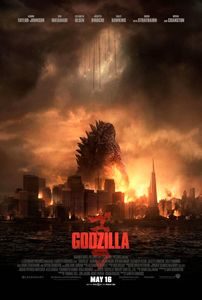
  • Godzilla (2014)

    Godzilla (2014)

    (On Cable TV, February 2015) The American 1998 Godzilla film may be nearly two decades old, it’s still enough of a cautionary tale to lower expectations about the 2014 version.  Fortunately, this latest iteration of the character doesn’t need lowered expectations:  Ably helmed by director Gareth Edwards (making the jump to multi-million moviemaking right from the clever low-budget Monsters), Godzilla is an imperfect but satisfying take on the classic character, updated to the latest expectations but old-fashioned in its willingness to deliver the basics of a monster movie.  One of the best demonstrations of this film’s understanding of the Godzilla mythos is its explicit willingness to treat Godzilla as a force of nature, an anti-hero to be used against bigger threats rather than a threat in itself.  Relatively daring is the decision to keep Godzilla half-seen until late in the film, occasional glimpses of his bulk being enough to keep us satisfied until the climax.  Coming in late in the monster-movie game, Godzilla can also afford to skip over the expected parts, showing us the resulting destruction as a highlight news reel rather than the main sequence itself.  The way the mythology is explained is quite successful, instantly raising the credibility of the film with some entertaining confabulations.  The Japanese origins of the character are treated with respect (who better than Ken Watanabe to be the voice of reason?), and there are a number of small mythos winks (from 1954 to Mothra) to keep even casual fans entertained.  Where the film doesn’t do as well is with its human characters: While Aaron Taylor-Johnson isn’t bad as the protagonist (showing a far more respectable image than in the Kick-Ass films or Anna Karenina), he’s a bit underwritten, and that also goes for the other characters.  The fast-moving nature of the film offers few opportunities for credible character involvement, and some of the plot tricks get far-fetched after a while.  Still, let’s not be overly critical: This Godzilla is a pretty good treatment of the character, and it offers a steady succession of small thrills along the way.  Not bad at all.

  • Godzilla (1998)

    Godzilla (1998)

    (In theaters, May 1998) First things first: Godzilla stinks. The dialogue is beyond horrendous and well into inanity, the story has gaping holes, the pacing could -should!- have been improved, the characters aren’t very interesting and the attempts at “humor” are embarrassing to watch. (Especially the awful “Siskel and Ebert” bits.) In retrospect, Godzilla stands as a particularly irresponsible waste of good money and even better talent on a more than sub-standard script. If only someone with any storytelling sense had rewritten this script in the vein of Moby Dick, then we could have had a killer movie to watch. Alas… But, to paraphrase Spice World, it was quite entertaining without actually being any good. The setup is intriguing. Some of the set-pieces are a lot of fun to watch. Jean Reno is a delight (but then again, he speaks French most of the movie, which is huge plus for my French-Canadian ears.) The ending car chase is pretty spiffy and the final battle against Godzilla is spectacular. In the meantime, most of New York’s landmarks get trashed quite thoroughly and we get to see some pretty special effects. (It’s a shame that they had to use darkness and rain to cut CGI corners, but we’ll see about that in the sequel.) In the realm of the usually-stinky monster movies, Godzilla stands as a more polished (if not necessarily better) species. Trashy B-movies adapted to contemporary standards. Whether or not you’ll like it still depends on your tolerance for trash…

    (Second viewing, On VHS, August 2000) I stand by my original review: Godzilla as made by the “American” team of Emmerich and Devlin definitely has its moments, but they’re constantly dogged by uneven pacing, a script that should be taken out and burnt, below-average acting and too-expensive CGI effects. Compare and contrast with the Japanese-made Godzilla 2000 to see a film made with a lower budget, but whose willingness to trade perfection in effects shot allows for more exciting directing and more storytelling possibilities. Still; the set-pieces here are exciting and if you’re willing to gloss over the pacing in-between Godzilla’s presence on the screen, it’s a pretty good monster movie. Vicki Lewis is absolutely delicious -not to mention underused- as a flirtatious scientist. And Jean Reno is cooler than the sum of the rest of the film.