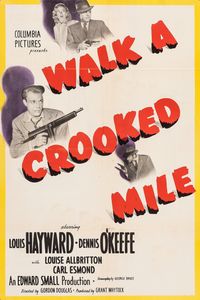
Walk a Crooked Mile (1948)
(On Cable TV, June 2021) It would be a stretch to call Walk a Crooked Mile a good film, but as a cauldron in which the late 1940s poured their insecurities, stylistic quirks, social prejudices, technological developments and vision of authority, it almost becomes fascinating. Often presented as noir thriller, it’s a film that’s perhaps best described as an espionage procedural with a heavy dash of two-fisted action. Mainly concerned about tracking down anti-American communist spies sniffing around the edges of the nuclear program, it’s a thriller with a heavy narrative voice to reassure viewers on what to think, clearly highlighting the new techniques that the homeland has at its disposal to identify and catch those who would threaten the nascent American hegemony. If this sounds heavy-handed… you haven’t seen the way director Gordon Douglas goes about it. The heroes (all males) fit within the very specific Anglo-Saxon ethnic mould that the FBI and Scotland Yard identified for its agents, while our villain (Raymond Burr in an early-career role) is conveniently labelled as not-like-us with a conspicuous goatee. There’s a sequence in which scientists are introduced with their career accomplishments, immediately followed by something along the lines of “and this brilliant woman, speaking five languages, is their secretary.” (While not uncommon for films of this era, this systemic marginalization of a female character is more infuriating here because it’s sandwiched in the middle of an authoritative tone that clearly tells viewers what is right and correct.) While Walk a Crooked Mile’s style is a blend of realism and noir flair, its attempts to stick to reality are not always helped by bombastic, dramatic scenes — such as the torture sequence in which the beaten-down immigrant American (a woman) spits in the faces of her torturers by telling them that she knows what dictatorship is like and she won’t help them. There is some interest in the breathless description of new gadgets that the all-virtuous never-wrong police services are starting to use. While I do have some innate fondness for that kind of nascent techno-thriller and the clean, straightforward style that the film takes on, I did have a bigger problem than usual going along with Walk a Crooked Mile’s unexamined ideological assumptions — I suspect that much of my reluctance comes from its daddy-knows-best tone, coupled with the knowledge that it supported a worldview that led to minority oppression, HUAC witch-hunting and rampant abuse of power. Classic Hollywood was a white man’s power fantasy, and Walk a Crooked Mile clearly fits the mould. Fascinating, but not necessarily good, nor a good thing.
