Graham Greene

  • The Comedians (1967)

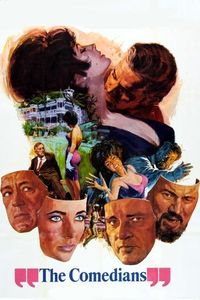
    The Comedians (1967)

    (On Cable TV, August 2021) To answer an obvious question: No, The Comedians is not a comedy. It’s really at the other end of the scale, since it’s a brutally convincing portrayal of Haiti under the murderous Duvalier regime, with its unrestrained tonton macoutes enabling a reign of terror over the island. Like many French Canadians, I have an above-average awareness and affection for Haiti, and wasn’t expecting a 1960s American film to be so effective into portraying a regime of terror that endured well into the 1980s, overlapping with my childhood memories of then-current events. Much of the darkness of the film clearly comes from Graham Greene’s original novel, writing squarely in his usual “white man goes to a poorer country; terrible things happen” mode. This time, the white man is portrayed by Richard Burton, with then-wife Elizabeth Taylor playing his married mistress. The plot is a downbeat mixture of British operatives, American businessmen, Haitian oppressors, diplomatic personnel and homegrown resistance. It really, truly, definitely does not end well. Still, there’s quite a bit to like here: Burton plays world-weariness like few others and he shares a few good sequences with Taylor. Alec Guinness brings some dark comedy to the cast, with Peter Ustinov also contributing some flair to a supporting role. Some black American actors of the time, such as James Earl Jones and Cicely Tyson, also get supporting parts due to the setting of the film. Downbeat tone aside, The Comedians suffers most in its pacing — at a punishing 160 minutes, it’s too scattered, too leisurely and too inconsistent as well to be truly effective. Probably too faithfully to its source (Green adapted his own novel without concision), its lack of concision does its topic matter no favours. I still found it interesting, largely for Burton and the portrayal of Haiti (even if filmed in now-Benin), but I can think of several ways in which the result could have been better.

  • The End of the Affair (1999)

    The End of the Affair (1999)

    (On Cable TV, April 2021) I was surprised to realize that I’d never seen The End of the Affair — as a multiple Academy Awards nominee during the period where I was actively chronicling the films I saw, I probably gave it a miss considering how little I cared about sordid affair dramas. I still don’t, but at least I can now go half a review without snidely dismissing the film as mushy claptrap. Or, um, maybe not. Directed by Neil Jordan from a Graham Greene novel and featuring no less than Ralph Fiennes and Julianne Moore, it’s not as if you can’t figure out from those four names what kind of film you’re going to get — something well-mannered, languidly paced, well-written but never energetic and almost hermetically consumed with the navel-gazing of two adults behaving badly. The End of the Affair is romantic drama given maximalist treatment with plenty of pauses, delays, torpid pacing and moments meant to evoke erotic tension. It does sort-of-work — There’s a lot more nudity than you’d expect from Moore or Fiennes, and it’s actually quite tasteful in its specific way. It does feel like an inheritor to the doomed-romance British tradition of films like Brief Encounter, and there’s never any doubt that it’s not going to end well. (Especially when the film begins with “This is a diary of hate” from someone who’s not an emo teenager.)  One of the reasons why I’m happier seeing the film now rather than in 1999 is that I’ve grown more sympathetic to the result: it may not be my cup of (intensely simmering) tea, but I can appreciate the maturity of the results, many of the good lines, quite a bit of the restraint in which it’s executed and the overall atmosphere of doomed lovers. The End of the Affair is a very specific kind of film, but it’s not badly executed as those go.

  • Through Black Spruce (2018)

    Through Black Spruce (2018)

    (On Cable TV, June 2020) There’s something deliberately unsatisfying in Through Black Spruce that makes it hard to like, no matter how much any reviewer would like to support First Nations filmmaking. I suspect that much of this has something to do with adapting a novel to the big screen—the storytelling flaws of the source seem built into the unfocused result. Part of the plot is about a young Cree woman investigating the disappearance of her twin sister in Toronto; the other part is a tale of harassment and revenge on a reserve. Alas, the Toronto segments never lead anywhere (why raise a mystery if it’s not going to be resolved?) and the reserve subplots are both hazily motivated and arbitrarily developed. The raw look at the relationship between the reserve and the big city is promising but leads nowhere—ultimately, the admirable effort and provocative details don’t amount to a compelling story. While handsomely directed by Don McKellar, one of the crown princes of Canadian cinema, and benefiting from a compelling lead performance by Tanaya Beatty (plus Graham Greene in a supporting role), Through Black Spruce seems determined to make itself hard to appreciate, by insisting on a markedly less interesting subplot and scrupulously avoiding any kind of resolution.

  • The Human Factor (1979)

    The Human Factor (1979)

    (On Cable TV, April 2020) Maybe you want to watch director Otto Preminger’s last film. Maybe you’re interested in a quasi-domestic British film about the mundanity of espionage. Maybe you want to gawk as a young Iman (and who wouldn’t?) In any case, your path has led you to The Human Factor. It starts on a surprisingly dull note, with subtle British spycraft jargon, side glances, cryptic language, elliptical dialogue and a dark outlook on national betrayal—everything is beige and boring even during the colourful strip club sequence in which Preminger gets to show nudity after spending so many films wishing he could. It all feels like substandard Le Carré, his cerebral style being unusually susceptible to bad adaptations. At least there’s Iman: She looks terrific, of course, and while she’s not a gifted actress, this is probably the best performance she’s ever given. The Human Factor, as it develops and improves, belongs to the subtle low-key school of murky British counterespionage, which may not be to everyone’s taste—certainly, when compared to much better examples of the form, this one feels lifeless and far too long for its own good despite being adapted by Tom Stoppard from a Graham Greene novel. Non-Iman actors are quite good, though, what with David Attenborough, Nicol Williamson and Derek Jacobi. The third act gets slightly better as it heads to Africa via flashbacks, to tackle issues of apartheid and interracial relationships in a more vital fashion. After idling for most of its duration, The Human Factor eventually, finally, builds up to a decent conclusion. It’s a bit too late, you’ll say, and I’ll agree—Some serious retooling would be required to make this a more interesting film, but Preminger did not succeed with this one.

  • Thunderheart (1992)

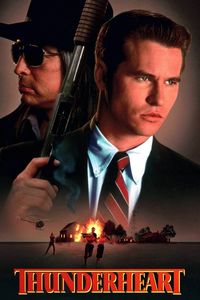
    Thunderheart (1992)

    (In French, On Cable TV, January 2020) On the one hand, there’s something admirable in seeing Thunderheart tackle the deplorable state of native reserves in the United States by setting a murder mystery within its borders. Our way into this setting is done through the dispatch of an FBI agent of mixed ethnicity (Val Kilmer, who is also of mixed ethnicity) but no cultural affiliation to native causes. As he gradually investigates the murder, he also gains an appreciation for his own origins. Standard Hollywood character development, but handled well, especially within the context of an unvarnished depiction of reserve living in the early 1990s—not that things have changed very much since then. Director Michael Apted makes effective use of helicopter-mounted cameras to give a good sense of space, action and the neighbouring landscapes—an essential when setting a film in the Badlands. While Kilmer ably headlines, the highlight here is once again Graham Greene as a local agent. Still, this could have been a better film: Thunderheart remains very much the story of a non-native protagonist exploring “the other,” and not a story told from within the native community. As revelatory as it could be in the early 1990s, it does feel limited today at a time when movies increasingly reflect diverse voices from their own perspectives. I liked it, but I can see how we’ve gone a bit beyond that.

  • Wind River (2017)

    Wind River (2017)

    (Netflix Streaming, August 2018) Harsh, uncompromising but satisfying, Wind River is another success for writer/director Taylor Sheridan, who tackles the difficult subject of violence against native women in a thriller that pulls no punches. Jeremy Renner stars as a man with specific skills that become very useful once a murder is reported on a reserve—being a skilled tracker/hunter turns out to be essential when the FBI can’t be bothered to send more than a token junior agent. Directed soberly, Wind River does tackle difficult topics in discussing the way violence can strike “even the good kids” and the devastating legacy that such deaths can cause. At the same time, it’s a bit of a macho revenge tale in which the unknown assailants of a revolting crime and tracked, caught and made to suffer. I’m not overly bothered by the premise that sees a white man bring justice on native land—the film clearly shows the protagonist’s pre-existing sympathies for his native ex-in-laws, and the film does leave plenty of development for its native characters. Renner makes the most of his existing action persona, while Graham Greene is up to his usual high standards. Elizabeth Olsen feels-out of place, but that’s the point of the film. Kelsey Chow has a short but striking role. With Sicario and Hell and High Water, actor-turned-screenwriter Sheridan fast established himself as a writer to watch for mature character-driven thrillers of the sorts we’ve grown to miss in a fantasy-saturated cinema marketplace. With his directorial debut Wind River, he takes it to the next level—now let’s see what next he has in store.

  • Dances with Wolves (1990)

    Dances with Wolves (1990)

    (On TV, August 2016) In an age of CGI-fuelled extravagant spectacles, you’d think that a special-effect-free western Dances with Wolves would be underwhelming … but it’s not. A sweeping western epic, this is a movie that still feels great today largely because it so grounded. You can compare the film’s standout buffalo hunting sequence to the SFX-heavy stampede in Abraham Lincoln: Vampire Hunter (as sacrilegious it may be to even mention both movies in the same paragraph) and there’s no comparison: the best special effect remains reality. It helps that the film itself is solidly put together: Dances with Wolves remains director/star Kevin Costner’s most notable achievement, and still one of his best roles to date. (Contrarily to his other career-best The Bodyguard, his stoic persona hadn’t fully solidified by then, and he seems more adept in the various facets of his role.) There are also notable roles for Graham Greene, and the lovely Mary McConnell. While Dances with Wolves’ pacing can be maddening throughout its three hours, it does help create the sense of scale that the story requires: As shown by the film’s title, it’s very much a character-driven piece set against the immensity of the frontier, as a white man comes to adopt the native way of life. As such, I think that it has weathered the past quarter-century better than other similar pieces. From my limited white-guy privilege, interrogating the story through a white-saviour perspective doesn’t lead to a full-blown condemnation, since the protagonist doesn’t do all that much to save “the others” (arguably, he only creates trouble for them along the way), and “the others” are portrayed with some nuance. While I’m not a natural audience for westerns (nor assimilation narratives, and especially not three-hour films), Dances With Wolves flows better than I expected, and remains just as respectable today as it was back in 1990. It’s still an impressive achievement, even without computer-generated hordes of buffalos.