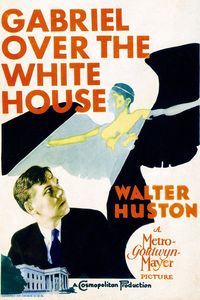
(On Cable TV, March 2021) Considering that I’ll watch almost any movie dealing with the American presidency, having a look at a film called Gabriel Over the White House was a given (or would have been had my DVR properly recorded it the first two times I tried). But it’s fair to say that I really didn’t know what I was getting into with the film. The first half-hour is interesting enough — we’re first shown the presidency in the middle of the Great Depression (itself a drastic change from the trappings of the presidency introduced over the years), with a shockingly cynical president (played by Walter Huston) clearly enjoying his corruption of the office. But one car accident later, the president finds himself between life and death. Visual clues hint at divine intervention in his recovery, especially when, overnight, he becomes a presidential scholar and righteous moral crusader. So far so good if you’re looking for a comforting fantasy of moral redemption in the White House. It’s also a film notable for confronting the issues of the Great Depression at a time when Hollywood tried to avoid the entire issue — we’re reminded of the employment crisis, the prevalence of racketeering, starving farmers, the prohibition and foreclosures. But then—whew—, the film takes a huge right turn into benevolent dictatorship, with armed police forces conducting deadly military raids on racketeers (although that happens after racketeers machine-gun the White House). The film is absolutely supportive of this fascist takeover of the United States, showing how the divinely inspired president’s good ideas (including familiar things such as a federal police or an air force, neither of which existed at the time) lead the world toward utopia, with the villains being summarily executed and the Washington Covenant showing enlightenment to humanity. As director Gregory La Cava’s film ends with a paean to the fascist protagonist, calling him “the greatest man who ever lived,” we’re left blinking in amazement. The relevance of the film today couldn’t be clearer, with Gabriel Over the White House being an amazing demonstration of the traditionally thin line between American politics and Christian crusading. It’s a weird, weird fantasy, the likes of which would now be dead on arrival from any major American studio. It’s frighteningly revelatory about the state of American political thinking in the 1930s, as the United States was not that far away from the overall European slide into authoritarianism that eventually led to World War II — the gulf between this film’s third act and Triumph of the Will is not that large. It does make Gabriel Over the White House a borderline-reprehensible film, but a fascinating object of study even now. As the old misattributed saw goes: “When Fascism comes to America, it will be wrapped in the flag and carrying a cross.”