Guy A. Lepage

  • L’Empire Bo$$é (2012)

    L’Empire Bo$$é (2012)

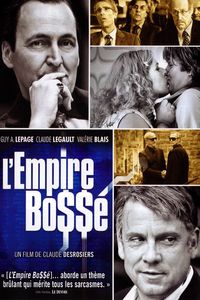
    (On Cable TV, June 2021) It’s not a bad thing when filmmakers get ambitious and start aiming at well-deserving targets. But when the result can only be described as “perplexing,” then maybe that’s a hint that something got lost during execution. In a way, it’s not that surprising that a French-Canadian film would use comedy to take aim at institutional corruption — after all, French-Canadian society loves its comedians (they’re arguably more popular than singers) and the way to French-Canadian box-office success is paved with broad comedies. So, when L’Empire Bo$$é tracks the career of a Québécois businessman from humble origins to international success, there should be a built-in comfort level to the entire thing. Even more so given that noted comedian/celebrity Guy A. Lepage plays the lead character throughout the decades covered by the film. Some of the material is quite good — by the time the film draws a summarized but troubling portrait of the ways corruption has been built into the Canadian political system (explicitly parodying elements of the sponsorship scandal a few years earlier), it’s hard not to be impressed by the film’s willingness to go there. But the portrait isn’t as convincing when you get down to the execution—in its hurry to get to the end, L’Empire Bo$$é often diminishes itself—there’s a lack of focus, an inconsistent comic tone and a willingness to overuse cheap laughs even as it aspires to a more cerebral comic register. Director Claude Desrosiers’ intention to fit everything in a mockumentary format isn’t as savvy a decision as it could have been, considering how the format flattens the comedy. I still liked the result, but I can see why others wouldn’t — it would take a major overhaul of the film, at the script level, for it to achieve its full potential.

  • L’appât [The bait] (2010)

    L’appât [The bait] (2010)

    (On Cable TV, September 2020) Crime comedies are very close to being the platonic ideal of French-Canadian summer blockbusters, and it’s not that surprising to see the producers of the film look for a transatlantic crossover in L’appât by asking noted French-Canadian superstar Guy A. Lepage to star alongside French comedian Rachid Badouri. Clearly aiming for a large audience, writer-director-producer Yves Simoneau (in a surprising return to cinema screens after decades working in television) bets everything on accessible action-comedy. But does he succeed? That depends on your tolerance for broad, almost intentionally stupid execution. The narrative hook of pairing a dumb gaffe-prone municipal cop (Lepage) with a near-flawless special agent (Badouri) is promising, but Simoneau makes the French-Canadian character an exasperating grade of weapons-grade stupid with few redeeming traits, and the film has to carry that on its shoulders for the entire running time. It doesn’t help that Lepage plays the character like in a sketch comedy which doesn’t fit into the world of the film. Badouri comparatively does better, but the script is at the other character’s level. (At least we get to see striking Montréal-area actress Ayisha Issa in a small role.) It all feels like a waste of talent and resources, especially given how the film’s technical credentials shine whenever there’s a bit of action on-screen. But in the end, L’appât is not an action movie: it’s a broad-spectrum comedy, and it doesn’t quite succeed all that well at it. Sure, there are a few laughs… but they’re either accidental or guilty ones.

  • Camping sauvage (2004)

    Camping sauvage (2004)

    (In French, On TV, July 2020) French-Canadian cinema has a decent tradition of going for big crowd-pleasing comedies, and Camping Sauvage is clearly set in this tradition, helped along by input from a number of the defunct but not forgotten Rock et Belles Oreilles comedy troupe—Yves Pelletier and Guy A. Lepage showing up in key roles, André Ducharme helping write the script and fan-favourite Sylvie Moreau playing the lead female role. The premise isn’t meant to be high art, as a Montréal financial high-flyer witnesses a criminal act by a mob figure and is immediately sent packing in a witness protection program until the trial. Which means being given a new lowest-of-the-low identity working in a camping establishment, with a biker gang headquarters right across the street and a policeman contact more interested in romantic jealousy than professionalism. Camping sauvage is slickly directed by most standards, although the humour is very French-Canadian in patois and cultural reference. Still, it’s a pretty good time—pair it with De Père en Fils (either the original or the sequel) for similar material.