Howard Hawks

  • Bringing up Baby (1938)

    Bringing up Baby (1938)

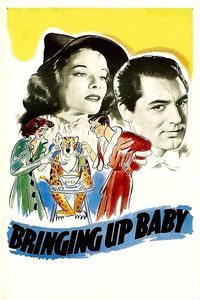
    (On Cable TV, January 2018) All right. This is it. I am a contended cinephile. When I embarked on a conscious program to watch older movies, I did so supposing that sooner or later, I’d watch a movie that I’d fall in love with. While I’ve been really happy to revisit some old favourites and see them hold up (2001: A Space Odyssey, for instance), or to confirm that some beloved classics are beloved for a reason (Singin’ in the Rain, anyone?), I started watching Bringing up Baby without any expectations other than crossing off a popular title from 1938. Within minutes (specifically the torn dress sequence), however, I was squarely identifying with Cary Grant’s proto-nerd protagonist, falling in love with Katharine Hepburn’s drop-dead gorgeous romantic interest and gasping at the speed and precision of director Howard Hawks’ movie. To put it simply: Bringing Up Baby is as funny, witty and fast as any contemporary romantic comedy, and the 1938 year of release is irrelevant. The plot is a big ball of nonsense that has something to do with a paleontologist, an heiress and a tame leopard. But never mind the plot, as the real strength of the film is in its witty fast-paced dialogue. Hepburn is an instant favourite as a character too crazy to be true … but the entire film is like that, and it plays beautifully even eighty years (!) later. Those who complain that “old” movies are dull and slow clearly haven’t seen Bringing up Baby. It’s raucously funny even today—while contemporary comedic theory holds that chicken and monkeys are the funniest animals, the film makes a strong case that leopards may be a comic engine of their own, as several of the film’s funniest sequences hinge on the eponymous “Baby.”  (To be fair, one scene also involves chicken. Being eaten by the leopard.)  Considering that the film is often upheld as a representative example of screwball comedies, I have a feeling that I’ve just discovered an untapped vein of pure cinematic bliss. At the pace at which I see movies, I often see them and move on, never to re-watch again. In Bringing up Baby’s case, however, I ended up ordering it on DVD (along with three other similar Hepburn comedies) within days of seeing it. I have a feeling I’ll be extolling its virtues and often lending the DVD in the next few years.

  • The Big Sleep (1946)

    The Big Sleep (1946)

    (In theaters, August 2000) Truly great movies are never outdated, which is why we’re still able to look at The Big Sleep nearly fifty years later and wonder why they don’t make’em like this any more. Crunchy dialogue (you could pull quotes from this one forever), wonderful characters, a Byzantine plot, constant reversals (not much suspense, but plenty of surprises!) and several of the world’s loveliest women soft-shot in glorious black and white, including one librarian (Dorothy Malone) that has definitely not gone out of style. Add to that a great, unashamedly-macho performance by Humphrey Bogart, and you’ve got yourself a classic. You will want to watch it again, if only to understand the plot.

    (Second viewing, On Cable TV, November 2020) I first saw The Big Sleep in a repertory theatre roughly twenty years ago, well before I started being interested in Humphrey Bogart, Howard Hawks, noir or even the classic film period. So, I was curious to see it again and see if my perspective had changed in any way. There are a few things I remembered from my first viewing that I revisited with as much joy this time around: Dorothy Malone’s super-sexy one-scene wonder as a librarian, for instance, is even better a second time around knowing the direction that Malone’s career would take later on. Something that I was definitely anticipating this second time around was the sheer scene-to-scene narrative appeal of director Hawks’ approach. Among other things, his ideal of “the Hawksian woman” leads to three very strong female roles—beyond Malone’s character, we also get two very confident sisters, each playing the events on their own terms. For modern viewers, the Hawksian women always feel more interesting than other female roles at the time, even in the notoriously female-empowered noir subgenre. This being said, I suspect that the marquee appeal of The Big Sleep will remain elsewhere—namely, one of Bogart’s most striking performances as private detective Philip Marlowe, the trenchcoat and overdone narration exemplifying the core of his screen persona. Considering this assortment of riches almost entirely unrelated to the plot, it’s no surprise to realize, once again, that The Big Sleep is best appreciated as a mood scene: the plot is so infamously complex that even the filmmakers had trouble keeping it straight, which means that viewers are advised to soak in the film’s atmosphere, even enjoy individual self-contained scenes, and not worry too much about whether it all makes sense. Fortunately, there’s enough atmosphere, bon mots and acting moments to reward viewers throughout even after they’ve stopped worrying about keeping the entire story in their heads at once. Given the twenty-year gap between both of my viewings, I’m nearly sure that the version I’ve seen in theatres was the 1997 re-release of the 1945 original cut and so was this Turner Classic Movies broadcast… but I can’t be too sure, and I don’t care all that much: If you ask me, The Big Sleep is about Bogey looking frumpy and talking tough, Malone and her glasses, Hawks making sure that the female characters were interesting, and the pure encapsulated iconography of noir on full display.