Ida Lupino

  • Thank Your Lucky Stars (1943)

    Thank Your Lucky Stars (1943)

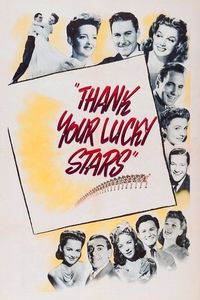
    (On Cable TV, July 2021) The more you learn about Hollywood history, the more you discover sub-sub-genres with maybe a handful of titles. Sometimes, they even prove to be a lot of fun… for the right audience. Thank Your Lucky Stars can be loosely included in the “wartime musical revue” subgenre, pleasantly overlapping with the “studio self-satire” one. In other words, here we have Warner Bros putting together a loose collection of sketches featuring their own stars, loosely connected with a slight and amusing plot. There’s one important caveat for twenty-first century audiences, though: This kind of satire, heavily based on screen personas, is completely dependent on audiences knowing quite a bit about what is being parodied. So it is that Thank Your Lucky Stars largely depends on audience knowledge of Eddie Cantor, as Cantor sends up his screen persona by playing a dual role as his self-obsessed self and a humbler look-alike. Much of the humour in the narrative is in the mistaken identities, but far more of the film’s laughs come from the various sketches and musical numbers scattered in-between — especially when they feature performers not known for singing, such as Ida Lupino (!) and Betty Davis (!!). Other highlights have S.Z. Sakall intimidating Humphrey Bogart, and Erroll Flynn as a blowhard soldier. Thank Your Lucky Stars served as a fundraiser for the Hollywood Canteen, which also spawned another film of the same name that is very much in the same genre. Cantor himself is fearless in sending himself up (and has a few good comic moments, such as when he finds himself on an operating table), while the sight of Davis crooning about the lack of eligible men is a sight upon itself. The caveat is that the comic revue is only a fraction as enjoyable if you’re not familiar with the names that are featured in it — but if you are, it’s a lot of fun. Like most movies of that subgenre, Thank Your Lucky Stars is worth revisiting regularly as you learn more about Hollywood History.

  • The Trouble with Angels (1966)

    The Trouble with Angels (1966)

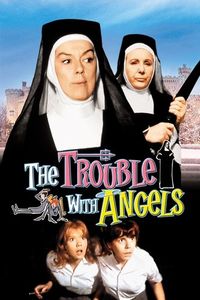
    (On Cable TV, July 2021) At first glance, The Trouble with Angels feels like a silly comedy featuring two teenagers taking on their nun-run Catholic school. Child star Hailey Mills (fresh from the end of her contract with Disney) pairs up with June Harding to butt wills against a Mother Superior portrayed by Rosalind Russell. Mills’s character isn’t always likable in the opening minutes of the film, multiplying trivial hijinks out of what sounds like sheer boredom and dragging her new friend along. The highlight does remain Russell, almost ideal as the reasonable voice of reason keeping the girls in line. As it happens, though, this is indicative of where the film wants to go — away from anti-establishment comedy, and into a coming-of-age drama where The Girl Learns better. I still don’t quite buy the revelation-for-the-sake-of-drama that dominates the film’s last ten minutes (you’d think that such a shift would be more gradual, and that the best friend would be aware of it), but I don’t think the film is meant to be assessed on strictly realistic terms. You can recognize in The Trouble with Angels the kind of heartwarming film meant to reaffirm traditional values, right on time for family night viewing.   It’s not bad as such — a bit conventional in the end, but clearly engineered by director Ida Lupino to be innocuous and likable.

  • Ladies in Retirement (1941)

    Ladies in Retirement (1941)

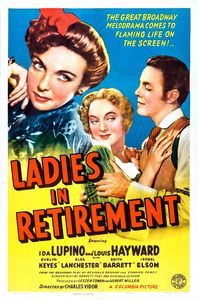
    (On Cable TV, April 2021) It took me some time to warm up to Ida Lupino — she’s wasn’t always a flashy actress and she didn’t go for a strong unified screen persona. (She’s arguably more interesting now as one of the rare female directors of the 1950s than as an actress, but that severely underplays her best and most captivating performances.) But as with many non-superstar actors, sooner or later there’s a film that makes people click with her, after which it any film featuring her gets an “Oh, It’s Ida Lupino!”  So it is that Ladies in Retirement is a good honest thriller that would be interesting in its own right as a natural blend of Victorian setting and noir aesthetics only one step removed from Gothic. But it does have an added dimension with Lupino as a 22-year-old playing a fortysomething protagonist who goes murderously crazy. She also plays against her then-husband Louis Hayward — he as a schemer, she as a housekeeper with a big secret. The almost-comic opening soon turns grim, and while the film (adapted from the stage) is much better in its atmosphere and development than its underwhelming conclusion, there’s a gender-bent domestic thriller here that stands adjacent to material in the vein of the not-much-later Gaslight.

  • The Food of the Gods (1976)

    The Food of the Gods (1976)

    (On Cable TV, February 2021) The badness of some movies transcends space and time, and so The Food of the Gods can still, in 2021, be showcased along the worst of the worst, an infamous Golden Turkey that combines the downbeat apocalyptic leanings of 1970s Science Fiction films with the most ill-conceived special effects imaginable. The premise is as simple as it is moronic, as a mysterious substance causes animals to grow several times larger than usual. Our “hero” discovers the development on a farm on an isolated island where it’s being used to grow chicken to human dimensions… and where, yuck, grubs are big enough to put up a fight. The hysterically funny stuff begins once the rats also grow to gigantic size, and the “special effects” are shots of regular rats hanging around a miniature house. Awful doesn’t begin to describe it, so in-between the awful script trying for an ecological lesson and the terrible special effects, the film has at least two strikes against it. It’s all the most dismaying to see the legendary Ida Lupino as a supporting player in what would end up being the penultimate movie of her career. The drawn-out coda is meant to be terrifying but feels silly, which reinforces the impression left by the entire film. See The Food of the Gods only if you dare — it’s the kind of film that Mystery Science Theater 3000 was designed to mock.

  • They Drive by Night (1940)

    They Drive by Night (1940)

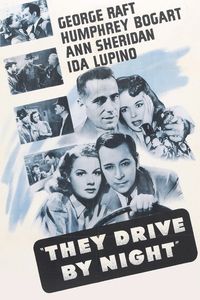
    (On Cable TV, January 2021) If you’re lured to They Dive by Night by Humphrey Bogart’s name, be warned that this is a film from his ascending stardom era—not the Bogart of pop-culture legend, but the rough-hewn character actor he was before his trench-coat fame. The story definitely has him as a supporting player to a lead duo played by George Raft and Ida Lupino as, respectively, a truck driver trying to make ends meet, and the scheming seductive wife of a trucking company owner. This being on the edge of a film noir, she kills her husband and promotes Raft’s character in a bid to get closer to him, but he’s already smitten with a far more wholesome girl. Bogart plays Raft’s brother/trucking partner, while Ann Sheridan plays the good girl. The thriller elements are solid enough (although the ending clearly belongs to a more reasonable, less spectacular age), but the look at circa-1940 trucking can be fascinating—my favourite sequence in the film details how the brothers take a load of produce across the state and negotiate themselves a nice windfall. Bogart remains interesting in one of his last supporting roles, while the normally compelling Lupino is even more captivating as a lust-crazy murderess. While a minor film by most standards, They Drive by Night remains a solid early noir with a few compelling performances.

  • On Dangerous Ground (1951)

    On Dangerous Ground (1951)

    (On Cable TV, December 2020) Film nor takes a trip to the country for crime and romance in director Nicholas Ray’s On Dangerous Ground. Robert Ryan stars as a burnt out suspect-punching New York City cop who, in the film’s opening segment, gets reprimanded by being sent upstate to cool off and help an ongoing murder investigation. The second portion of the film is a contrast in more ways than one, as the rainy nighttime visuals are replaced by the serene beauty of snowy farmlands and our policeman anti-hero gets to interact with people who aren’t necessarily the scum of the Earth. This is where he meets a beautiful blind woman (the ever-striking Ida Lupino), for whom he falls despite her brother being his prime suspect. It all escalates into a climax that’s both predictable and satisfying within the confines of the film’s sense of right and wrong – romance gradually creeping up on the criminal arc and acting as the true resolution of the film. It’s quite an unusual blend despite its familiarity – noir in the snow and eventually replaced by romantic redemption. But that’s the magic of Ray as a director – make us believe in dubious material, and somehow wrapping it up in a coherent package.

  • While the City Sleeps (1956)

    While the City Sleeps (1956)

    (On Cable TV, December 2020) The more I discover lesser-known movies from the 1950s, the more I realize that, despite the conformist fairytale that many would like to make you believe about the decade, it was filled with social criticism, technological doubts and satires about the post-WW2 order. While the City Sleeps benefits from the outsider’s gaze of director Fritz Lang: it is at its core a crime drama that becomes an excuse to examine the growing power of media in American society. When a media magnate dies as a serial killer terrifies the city, the directors of the three divisions of his empire (newswire, newspaper and television) are encouraged to find the killer first in order to secure a prestigious new job. As an excuse to study the tensions between personal gain and news ethics, While the City Sleeps exploits its plotting for all it’s worth: the directors scheme and draw audacious plans that directly put others in danger in an attempt to seize the headlines (and accessorily catch the killer). A great cast complements the story – Dana Andrews at the protagonist, a suitably slimy Vincent Price as an underestimated heir, George Sanders as one of the competing directors and a great-looking Ida Lupino as a clever writer. It all amounts to an absorbing film, clearly going beyond film-noir clichés to attempt an ambitious study of how personal greed can corrupt institutions meant to be trusted by the public. It’s suitably cynical at a high level, but can rely on a likable protagonist to anchor the film. Lang’s Hollywood career was not perfect, but I don’t recall truly disliking any of his films during that period. While the City Sleeps is no exception.

  • The Sea Wolf (1941)

    The Sea Wolf (1941)

    (On Cable TV, October 2020) Let’s see: A Jack London maritime adventure novel brought to the big screen by director Michael Curtiz, and starring no less than Edward G. Robinson as a sadistic sea captain, John Garfield as a hero protagonist and a beautiful Ida Lupino as the love interest? Oh yes, there’s ample reason to have a look at the 1941 adaptation of The Sea Wolf. Reportedly the best of the numerous film version of the novel, this one does get a crucial element right: Robinson as the antagonist, a formidable presence for an equally fearsome character. Lupino is certainly an asset as well, but the film’s execution through a foggy studio set means that the atmosphere of the seagoing ship is appropriately claustrophobic and oppressive. The plot goes a bit further than an already-interesting adventure story to become a small-scale illustration of the dangers of fascism, which adds quite a bit to the result. Good special effects (for the time) and tons of atmosphere complete the portrait. While it has the clunkiness of the technical means available to studio-bound 1940s filmmakers, The Sea Wolf is nonetheless a good adaptation and a fair adventure story in its own right.

  • The Devil’s Rain (1975)

    The Devil’s Rain (1975)

    (In French, On Cable TV, September 2020) All movie reviewers love to think that their bon mots are the best, that no one else will ever best them in describing a film, and that they certainly don’t need to do anything so vulgar as quoting some other critic. But sometimes, even the most egocentric of reviewers can admit defeat when a quote so perfectly formed comes to their attention. In The Devil’s Rain’s case, I bow down to Michael Adams, who in his book Showgirls came up with “the ultimate cult movie… It’s about a cult, has a cult following, was devised with input from a cult leader, and saw a future superstar indoctrinated into a cult he’d help popularize.” Whew—it’s so good a quote that it headlines the film’s Wikipedia entry. It’s a lot to unpack, but it says it all—The Devil’s Rain is a very 1970s satanic cult movie describing how a cult leader enslaves descendants of his cult centuries after being burnt alive. It’s absolutely not a good movie, but it has a bit of corny charm, and features such notables as William Shatner, Ernest Borgnine (with horns!), Ida Lupino (in a typical Golden-hollywood-star-slumming-in-1970s-horror-film role) and John Travolta in a supporting role. With a cast like that, you can see how and why the film developed a cult following—especially considering that the result, affected by production problems, isn’t particularly coherent on any level. To complete unlocking the quote, it’s worth noting that Church of Satan founder Anton LaVey was a technical advisor on the film, and that John Travolta first encountered Scientology on the set of the film. Whew. The final eight minutes of melting cultists is a lot, though. It would be professional malpractice to suggest watching The Devil’s Rain for its own intrinsic qualities, but as a budding film historian I’d be equally negligent if I didn’t single out the ways in which this movie has made a mark, as tiny as it was, on the grand film tapestry. [November 2024: As I edit this review for publication, years after seeing this wholly unremarkable film, I’m stuck at how I vividly remember at least one element of it—The repeated, “get me out of here!” lament heard over the Bosch-style opening credits. You never know what will stick!]

  • The Big Knife (1955)

    The Big Knife (1955)

    (On TV, September 2020) Considering my fondness for Hollywood stories about Hollywood, I’m surprised that I don’t like The Big Knife as much as I probably should. The story of an actor negotiating a new contract with his studio while blackmailed due to a few sordid stories (both past and current) sounds like something right up my alley. It’s not as if the film doesn’t have other qualities either: Ida Lupino is wonderful as usual, Rod Steiger chews a lot of scenery, and Jack Palance is sort-of interesting. But in the end, it’s the entire film that fails to impress—perhaps too bleak for esoteric reasons (blame playwriter Clifford Odet, who wrote the theatrical play from which this is adapted), perhaps too stuck to the florid dialogue of the original, perhaps a bit too sedate and stage-bound as the theatrical play itself. I’m not sure there’s a crowd-pleasing movie to be made about an actor declining a wealth-making studio contract, and certainly not in the way the film ends. Too bad, because there are flashes of wit in the dialogue, and some fun performances—just not the kind of material that transforms a film into something compelling. In the end, I just could not make myself believe in The Big Knife.

  • High Sierra (1941)

    High Sierra (1941)

    (On Cable TV, August 2020) According to many film historians, High Sierra is the film that put Humphrey Bogart on the map: He was already a steadily working, well-regarded actor for Warner Brothers, and his fame would be consecrated within the next year with The Maltese Falcon and Casablanca, but High Sierra is the film that made people stand up and take notice of him as a star. Watching it, it also strikes me as a strong early noir film, what with the dark forces of fatality stopping even a well-meaning character from a happy ending. Bogart here plays a character recently released from prison, but already planning a big heist. The film describes his own dramatic arc along the way from prison to recidivism, made more interesting by the character being tempted by the righteous path. This being an early noir, you can expect that it’s not going to end well… but it’s the journey that counts, and seeing Bogart ruminate on the choices his character is making. This may be the transition point between Warner’s 1930s gangster films and true honest noir as we’d know it later on – you can point to The Public Enemy one way, and Detour the other. It’s also quite entertaining to watch – Bogart looks terrific with a very severe haircut, torn between Ida Lupino as a fantastic bad girl, and Joan Leslie as the flip side of his morality. The result is impressive even today, and not merely as a precursor to Casablanca-era Bogart.

  • Hollywood Canteen (1944)

    Hollywood Canteen (1944)

    (On Cable TV, May 2019) Here’s what you need to know about Hollywood Canteen: During WW2, Hollywood celebrities got together and paid for a club in Los Angeles exclusively reserved for servicemen on leave where they could get free drinks and meals. Adding to the appeal, glamorous movie stars donated their time by actually bartending and waitressing for patrons of the place. This is all true—although accounts of the place usually underplay the considerable Pro-Hollywood publicity value in this arrangement. Further adding to the mystique is this film, not a great one but a fascinating time capsule of propagandist wish fulfillment that shows WW2 soldiers enjoying a few days in Los Angeles and spending time at the Hollywood Canteen where they get a chance to rub shoulders with movie stars. (Lost to twenty-first century audiences is the idea that when this film was shown to servicemen overseas, they could have been these guys.)  The film itself, once past the bare-bones setup, is a series of performances by Hollywood then-stars at the Canteen, effectively turning the film is a series of variety show sketches while the film’s protagonists kiss Hollywood starlets, empty sandwich trays or watch the acts with mouth agape. If some scenes make you somewhat queasy at the way the actresses are offered to soldiers for kisses, then you do have a good grasp at the hierarchy of values presented here, elevating the fighting soldier on a special pedestal. Hollywood Canteen remains both a wartime propaganda film, and a revue of who was who in Hollywood at the time—some of them featured in the movie, others referenced through dialogue. Many of the jokes are obscure now that the stars are gone—Jack Benny gets a laugh from the characters just by showing up, for instance, leaving twenty-first century audiences puzzled for a few moments. It’s fun to see some Hollywood stars in a far more relaxed environment, though—especially Bette Davis in a more comic role. The Canteen acts as a pretext, as the characters have adventures around town, our protagonist gets to romance a movie star and we tour the Warner Bros studios of the time. It’s actually quite a fun movie even with the propaganda material … but it works far better as a reminder of a bygone era.

    (Second viewing, On Cable TV, February 2021) I first saw Hollywood Canteen barely two years ago, but since I’ve spent much of the intervening time deepening my knowledge of classic Hollywood, revisiting it felt like a different experience. This is true of most films if you’re interested in the vast meta-narrative of Hollywood, but it’s particularly relevant in discussing Hollywood Canteen, as it’s a film that relies a lot on celebrity cameos for effect. The plot of the film remains the same from a first viewing to a second: it’s a fictionalized homage to the real “Hollywood Canteen” that, during WW2, offered free meals, refreshments and entertainment to servicemen on leave in the Los Angeles area. Thanks to the effort of notables such as Bette Davis, Hollywood studios pooled their resources and stars for the upkeep of the place, and it wasn’t rare to see a screen legend serving tables at the Canteen. The result was a propaganda victory for Hollywood, and fuel for fantasies involving soldiers and starlets. Alas, this aspect makes it intact in the film, as there’s a truly uncomfortable amount of time and attention lavished on named stars granting kisses and weekend getaways to the film’s fictional soldier characters, each of them over the moon to get some personal attention from their screen favourites. The film is at its worst when focusing on Joan Leslie playing “Joan Leslie,” an object of lust for many but luckily snagged by our protagonist as the millionth G.I. to enter the Canteen. Blech. But plot is the least of Hollywood Canteen’s worries when there’s a stream of musical numbers and comic cameos to act as a revue musical. That’s when a second viewing comes in: Cameos can be more mystifying than satisfying if you’re not familiar with the actors making a winking walk-on appearance, but they pay off the more you’re familiar with the comic point being made. 1944 audiences had no trouble catching the various jokes, allusions and parodies in Hollywood Canteen, but modern audiences will be tested on their knowledge of early-1940s pop culture — and specifically the Warner Brothers roster of stars. Having brushed up on my classic Hollywood in two years, I now knew who was Joe E. Brown and now could appreciate the donut gag as intended. The more you know about the character actors at the time, the more you can appreciate the bit with S. Z. Sakall and his cheeks, or Sydney Greenstreet hamming it up menacingly with Peter Lorre. My growing appreciation of Ida Lupino went up with every word of French she spoke (a gag made even funnier by Victor Francen’s follow-up), and so did my slow-burn liking of Bette Davis as she came onstage to explain the genesis of the Canteen. I’m not as up to speed when it comes to musical stars, but even I could appreciate the Andrew Sisters, Roy Rogers and his horse Trigger, the rather funny “You Can Always Tell a Yank” (which eerily sounds like a Disney song for reasons I can’t quite figure out), duelling violins and the background music by Jimmy Dorsey and his orchestra. Even the second time around, I maintain that Hollywood Canteen is somewhat distasteful as a narrative, but I grew much fonder of the remaining three-quarter of the film, as a comic musical revue.