Irwin Allen

  • A Girl in Every Port (1952)

    A Girl in Every Port (1952)

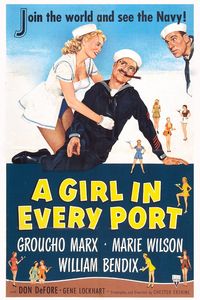
    (On Cable TV, October 2020) My answer to “Which Marx Brother do you find the funniest?” is immediate, constant and definitive: Groucho, always Groucho. His typical verbal wit is my kind of humour, and he was, to me, always the highlight of any of the Brothers’ movies. A Girl in Every Port is something slightly different, as we have Groucho without his brothers playing a sailor who gets embroiled in racehorse schemes while his ship is stationed in town. At no less than sixty-two at the film of the film’s release, Groucho is easily a few decades older than his character, but those (along with the painted-on moustache) are the conventions we have to play with if the film is to make any sense. The script is willing to complicate and overcomplicate its own fraudulent schemes until even the characters comment on easier ways of doing things. (But the gag of a horse being helped on a warship is worth it.) The result isn’t all that funny, but it’s amusing enough, and a welcome opportunity to have Groucho go for one of his last starring movie roles. Groucho himself may not hit any peaks of verbal humour, but he breaks the fourth wall quite a bit, and he gets his laughs. Don DeFore anchors the film as the henpecked victim of the scams, while Marie Wilson provides the romantic interest. Notably an early Irwin Allen production, A Girl in Every Port is probably best suited for Groucho fans and those who have the patience for an average comedy. But it’s fun all right, and who can resist Groucho commenting to the audience on the unlikeliness of his own movie’s plot?
  • The Story of Mankind (1957)

    The Story of Mankind (1957)

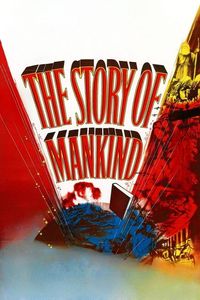
    (On Cable TV, August 2020) Oh, what a mess. Any movie that punches so hard through my suspension of disbelief that I start asking why it exists has already lost. In the case of The Story of Mankind, here we have a science-fictional “alien judgment” framing device looking at the history of humanity as an excuse to have small historical sketches conveniently casting as many known actors as possible. It’s hard to resist a film that had Hedy Lamarr, three of the Marx brothers, Vincent Price, Peter Lorre, Dennis Hopper (!) and Cesar Romero, but just wait until it begins and you’re served sketches that are neither funny nor profound, skipping ahead history to serve the usual bromides, with stunt casting that doesn’t really use the actors to their fullest extent – even the Marx Brothers appear in different scenes, and don’t play to their strengths. (I was waiting for the Groucho scene… I should have skipped it.) The film being directed by Irwin Allen, I half-suspect that the idea was for a grandiose statement with state-of-the-art special effects. Instead, we get sketches comparable to a high-school production, and a constant back-and-forth between trying to make a statement and trying to make jokes. The Story of Mankind is almost fascinating in its hideousness, but I really can’t recommend it as anything but a curio.

  • The Swarm (1978)

    The Swarm (1978)

    (On Cable TV, March 2020) Killer-bee movies were a surprisingly robust trend in the late 1970s, with at least three of them on the record—clearly a case of Hollywood taking a new striking idea and then beating it into pulp. None of the killer bee movies are acknowledged as being any good, but big-budget The Swarm actively pushes into ridiculousness at times. Masterminded by master-of-disaster producer-director Irwin Allen, The Swarm follows the then-much-anticipated deadly bees as they make their way north to Texas, and proceed to outwit all humans. To be fair, and this is part of the film’s unique “charm,” the human characters are all singularly stupid here—up to and including panicking hard enough to (somehow) a blow up a nuclear power plant. Who needs killer bees when kids think it’s a good idea to set bees on fire, when train drivers cause derailments at the slightest sign of panic, when military officers think it’s a good idea to torch Houston? In keeping with other 1970s disaster movies, the cast is a remarkable mixture of new faces like Michael Caine (struggling helplessly against the material), and Classic Hollywood veterans, such as José Ferrer, Slim Pickens, Henry Fonda, Fred MacMurray, Richard Chamberlain and Olivia de Havilland. Such an undignified mark on their resumés… although they, too, must have hoped that the film would be as successful as Allen’s previous disaster movies. Alas, it wasn’t so: Audiences were indifferent to The Swarm, and critics were savage in their appreciation — although the film has since gained a bit of a cult status due to its risible nature. (It was, in many ways, the end of Allen’s career: he never as big of a budget nor recaptured the popular imagination after that.) The Swarm may be a bad movie, but it does remain quite a bit of fun to watch—you can’t help but blink at the inanity on screen and wonder how it got made with such expansive means. It doesn’t end once the credits roll: Just as you start to relax, thinking that you’re over the worst of it, the film hits you with the dumbest, most offensive disclaimer imaginable under the context: “The African killer bee portrayed in this film bears absolutely no relationship to the industrious, hardworking American honey bee to which we are indebted for pollinating vital crops that feed our nation.” Ooof! I watched the film with a friend, and at the end of it said, “I’m glad you were with me through this, because later I will be able to ask you if this really happened.”