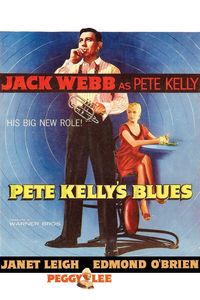
Jack Webb

  • Pete Kelly’s Blues (1955)

    Pete Kelly’s Blues (1955)

    (On Cable TV, April 2021) There’s a quirky mixture of musical comedy and gangster film at play in Pete Kelly’s Blues, which uses 1927 Kansas City as a backdrop for a tale of speakeasies, mob bosses, and a jazz house band trying to maintain its independence—and keep its cut of the earnings. The film itself is a bit bland and misguided — in setting up the band leader as this person going toe-to-toe with organized crime, the film can’t find an appropriate tone between comedy or thriller. Mechanically, people get murdered, the band leader fights back, the boss is brought down but the film never quite narratively sparks to life. The setting itself is intriguing but never more than perfunctorily rendered — a rather common problem in 1950s movies trying to portray earlier decades, almost as if Hollywood couldn’t shake the stylistic weight of that era. Fortunately, plotting isn’t the entire film — there’s quite a bit of music, and that’s when the film hits its stride. A highlight includes a performance from none other than Ella Fitzgerald, and other musical numbers (including a really good opening sequence) briefly revive interest in the film. As directed by (and starring) Jack Webb, Pete Kelly’s Blues is a bit of a missed opportunity and, frankly, not much of a movie for most audiences. But its odd mixture of sensibilities may be just effective enough for jazz fans or gangster movie buffs.
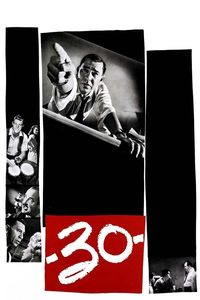
  • -30- (1959)

    -30- (1959)

    (On Cable TV, March 2020) At this point in my exploration of Classic Hollywood, I almost live for those hidden gems in the margins of the official canon we remember from past decades. Something very much like -30-, a thoroughly satisfying newsroom thriller that nonetheless feels practically unknown these days. I think that some of this may be due to a title (Dash three zero dash, newspaper shorthand for “end of story”) that’s nearly impossible to search online; some of it to a less-than-stellar box-office performance; and maybe also because it’s a somewhat average film that just happens to hit a lot of my buttons. I mourn, for instance, the disappearance of newsroom dramas—I like that subgenre a lot, and anything even feeling like one automatically gets a few points from me. I’m also a sucker for time-compressed films, and this film barely fits within a single nighttime shift with a cavalcade of subplots to fill the running time. Jack Webb stars, directs and produces the film in a very efficient fashion: despite the fast pacing of the film, there are few stylistic flourishes even if the script crackles with pretty good repartee. Looking at some of the film’s contemporary reviews, I see that many critics dismissed the film’s outdated throwback to 1930s newsroom tropes despite taking place in the late 1950s. That kind of criticism is virtually irrelevant today, as one period blurs into another and we don’t really care as much as to whether it’s twenty years out of date or just an entertaining-enough script. The soundtrack isn’t bad, and the entire narrative has enough energy to make it to the morning. It reminded me a lot of 1994’s The Paper, and that’s another plus-for-me aspect of the film that may not work as well on others. But who cares about the others? -30- is my TCM discovery of the week, and one more reason to keep watching even if I think I’ve seen most of the classics.