Jacques Demy

  • Les demoiselles ont eu 25 ans [The Young Girls Turn 25] (1993)

    Les demoiselles ont eu 25 ans [The Young Girls Turn 25] (1993)

    (On Cable TV, April 2021) While other people praise Les parapluies de Cherbourg, my favourite Jacques Demy musical is, without a doubt, Les demoiselles de Rochefort, one of the rare pastiches of American musicals that actually work as a great movie on its own. I’m far from being the only one to think highly of the film, as Les demoiselles ont eu 25 ans goes back to Rochefort in order to celebrate the film’s twenty-fifth anniversary. Amazingly enough, this documentary was directed by none other than French cinema legend Agnès Varda, Demy’s widow who was present during the celebrations to receive the homages in lieu of her husband (who died in 1990). While short at 63 minutes, the film blends footage of the original film and the celebrations with interviews from various players in the film, including Catherine Deneuve. We also get a look, through archival footage and recollections, at the making of the film. It’s clear from the footage that by 1993, Rochefort had immensely benefited from the film’s enduring reputation — various local officials speak fondly of the impact the film had on tourism. While the result is more utilitarian than inspiring, it’s not a bad way to revisit the impact of Les demoiselles de Rochefort and to refresh your brain with the terrific earworm of its best-known song. Clearly made for fans of the film, it delivers everything we can ask of a twenty-fifth anniversary celebration.
  • Model Shop (1969)

    Model Shop (1969)

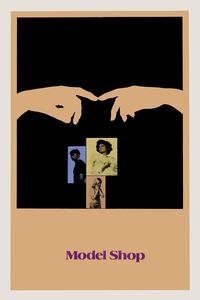
    (On Cable TV, February 2021) I got interested in Model Shop simply because I was curious to see more of Jacques Demy’s work after The Parapluies de Cherbourg and Les Demoiselles de Rochefort. I was curious to see his take on late-1960s Los Angeles, whether he’d carry his stylistic quirks over, and whether it would feel more like New Hollywood, Nouvelle Vague or the kind of Old-School Hollywood that Demy pastiches in his best-known movies. As it turns out, Model Shop feels like pure undiluted New Hollywood in its downer ending, small-scale character study and obsession with satisfying the filmmaker’s artistic intentions rather than providing entertainment to audiences. The story, as slight as it is, follows an unemployed Los Angeles man whose life is spiralling out of control — his girlfriend is about to leave, his draft notice has come in and (horrors!) his car is about to be repossessed, a sure sign of failure in car-centric L.A. As a film it’s not much: your liking for it will depend on how you feel about New Hollywood’s artistic aims in general. I still have moments of affection for the result, or rather specifically how its naturalistic approach credibly portrays 1969 Los Angeles without artifice, as the protagonist drives through the city and we take in the sights of an utterly generic city street. Otherwise, Model Shop is a very specific kind of film, somewhat undistinguishable from so many other similar movies if it wasn’t for its specific setting.

  • Lola (1961)

    Lola (1961)

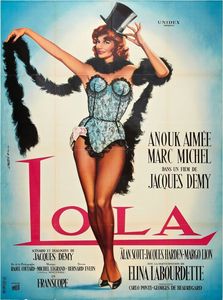
    (On Cable TV, August 2020) I’m not a big fan of writer-director Jacques Demy, and going back to have a look at his first feature Lola doesn’t endear me any further to him. A characteristically unfulfilling romance with a twisted cast of characters, it’s about a young man falling in love with his ex-girlfriend, except that she pines for her own ex, and another man also pines for her. At least, with Anouk Aimée in the lead, we can understand how that character can have three lovelorn men revolving around her. The rest of the film is considerably fuzzier, which should not be a surprise to anyone with a good knowledge of Demy’s filmography. It’s quite French Nouvelle Vague, except without much of the playfulness found in other comparable films. Romantic, for sure, but not comforting at all.

  • Les demoiselles de Rochefort [The Young Girls of Rochefort] (1967)

    Les demoiselles de Rochefort [The Young Girls of Rochefort] (1967)

    (In French, On TV, December 2018) Just as I was tempted to dismiss writer/director Jacques Demy on the basis of the unbearable Les parapluies de Cherbourg, here comes the much better Les demoiselles de Rochefort to redeem it all. This far improved follow-up fixes my two biggest annoyances with the previous film: Much of the dialogue is spoken rather than sung, and it does feature a happy ending (even though it’s by mere seconds—the film does toy with its audience toward the end, perhaps keenly aware that those having seen Les parapluies de Cherbourg almost expected an unhappy ending.) That alone could have been enough to make it a good movie, but then it goes the extra mile. Not only does it feature a young gorgeous Catherine Deneuve and her sister Françoise Dorléac, but here is no less than Gene Kelly (visibly older, but still capable) walking in for a few scenes and a dance number. Very, very colourful, Les demoiselles de Rochefort makes the best of its coastal-town setting, starting with an elevated bridge dance sequence, then spending much of its time in a public square with a fantastically glassed-in café set. There’s a little bit of atonal weirdness when it turns out that there’s an axe murderer (!) hanging around, but otherwise the film is far more successful than its predecessor. “Chanson des Jumelles” is a great, memorable number, but it’s really the cheerful colourful atmosphere of the film that wins audiences over. I happened upon the movie by chance, playing as it was in the middle of the night on an unlikely TV channel, and almost gave it a pass. Only Gene Kelly’s name drew me in, and I’m glad it did—Les demoiselles de Rochefort is now one of my favourite French films of the 1960s, which is saying something considering the strengths of the decade for French cinema.

  • Les parapluies de Cherbourg [The Umbrellas of Cherbourg] (1964)

    Les parapluies de Cherbourg [The Umbrellas of Cherbourg] (1964)

    (Kanopy Streaming, October 2018) You would think that I, being a francophone fan of musicals, would be a natural audience for Les parapluies de Cherbourg, perhaps the best-known musical to emerge from 1960s France and a major influence over films such as Damien Chazelle La-La Land. But I reserve the right to have idiosyncratic reactions, and as it turns out I’m this close to loathing writer/director Jacques Demy’s Les parapluies de Cherbourg. For one thing, it’s a downer musical. For another, it’s a wall-to-wall musical: The characters can’t stop singing even in dialogue scenes when there is no song, no rhymes, no arrangement, no accompanying choreography, no reason to sing. The effect is profoundly irritating. It sounds like incessant meowing for no reason and if I don’t like it from my cat at six o’clock (well, at least she’s hungry—it’s for a reason), I don’t necessarily like it from my TV screen for an hour and a half. Les parapluies de Cherbourg drove me crazy in a way that most musicals don’t, seemingly magnifying everything that usually annoys people about musicals. The reason why I can’t quite bring myself to kick this movie in the trashcan is that it does have some charm once past the meowing. The story is simple and while it ends in a not-so-happy way (well, the guy is happy and the woman isn’t so much and the audience least of all), it does feel rather endearing during its first act, especially before the unrelenting singing becomes unbearable. It’s also immensely colourful, with a portrayal of late-1950s small-town northern France that is affectionate and stylized at once. The ending sequence, as melancholic as it can be, is beautifully shot and doesn’t forget, through a signed “Cherbourgeoisie,” to put its class message front and centre. Given that I followed Les parapluies de Cherbourg by the absurdly ridiculous Au hazard Balthazar, it’s even far from being the worst movie I’ve seen that day. Maybe I’ll revisit it eventually. But maybe I’ll wear earmuffs. [January 2019: I’m happy to report that Les demoiselles de Rochefort, Jacques Demy’s follow-up musical to Les parapluies de Cherbourg, is a far more enjoyable film.]