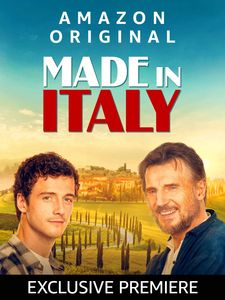
Made in Italy (2020)
(On Cable TV, February 2021) There is a well-worn quality to Made in Italy’s narrative that both helps it feel comfortably familiar, and makes entire sequences feel redundant. It starts as a young British man convinces his painter father to go back to their family house in Italy, with the intention of selling it so that he can buy an art gallery. Once over there, our young protagonist discovers that the house is nearly dilapidated, that heroic efforts will be required to make it sellable, and that there are plenty of unresolved issues between himself, his father and his dead mother. Much of the film is very, very familiar — to the point where we’re just waiting for a cute Italian girl to show up so that the protagonist can realize the folly of his current goal and start planning to stay and grow as a person. (Spoiler alert: this is exactly what happens.) On one hand, this does help the film reach part of its objective as comfort viewing — the thrill of the house renovation arc is familiar, and so are the gradual romances that involve the main characters. Part of the point of Made in Italy is to enjoy the luminous Tuscan scenery, the way the house gradually becomes a terrific place to live in, and the copious references to great food. (Would it be surprising to learn that the Italian love interest is a cook? Not really.) On the other hand, the same familiarity also requires the two male leads to work out their tragic repressed trauma in a series of conventional sequences that everyone must suffer through in order to get to the next charming bit. Writer-director James d’Arcy errs in putting too much emphasis on the melodrama at the expense of the stronger romantic/rustic qualities of the film, although it’s easy to see on the page that the dramatic material would be required to give enough substance to the result. The casting of the film is uncanny, though: Liam Neeson is up to his usual high standards as an aging artist afraid to go back over the biggest trauma of his life, but the magic happens once you realize that his son is played by his real-life son Micheál Richardson, their characters echoing the real-life grief of Natasha Richardson’s death. Knowing this, their big confrontation at the end of the film adds a bit of oomph to otherwise familiar scenes but also feels a bit voyeuristic. Still, Made in Italy does have enough going for it to be mostly charming most of the time — the third act is a bit drawn out, and you can see the pieces fall into place well before it happens, but there’s comfort in anticipating how it’s all going to come out.
