James Garner

  • Dead Silence (1997)

    (On TV, November 2021) As far as low-budget made-for-TV thrillers go, there’s something halfway interesting in Dead Silence. After all, this is about psychopathic criminals taking a busload of deaf children hostage in a farm, as the police surround the area and negotiations begin. The disability angle adds interest to what would otherwise be a rather run-of-the-mill thriller. Casting adds some more as well, with veteran James Garner playing the lead hostage negotiator and Marlee Matlin as a schoolteacher. The low-budget imperatives of the film create a nicely restrained setting around the farm. The last element of note is a wild third-act swerve that creates more questions than it answers, but makes for a sudden late burst of energy in a film that needed it. The result is still not all that good, but it is not quite as bland as it could have been — the proof being that Dead Silence is still playing on TV twenty-five years later, even if on a Canadian channel focused on accessibility issues.

  • Hour of the Gun (1967)

    (On Cable TV, September 2021) Hollywood’s determination to make an endless number of movies about the O.K. Corral gunfight is no match for my determination to not care about any of them (well, maybe except for Tombstone). In Hour of the Gun, we find ourselves once again at the Corral — but taking a slightly different direction, the film begins with the shootout, then follows the aftermath of the events as the Clanton gang is run down. Much of the films’ interest comes from featuring James Garner as Wyatt Earp and Jason Robards as Doc Holliday — as a capable duo of actors, they can hold our interest longer than the script. Otherwise, much of Hour of the Gun feels like a feature-film length epilogue to another story, and one that’s powered more by American West mythology than intrinsic storytelling qualities. I’m sure that within a few decades, machine learning will be good enough that we’ll be able to point a moviemaking engine to the dozen O.K. Corral movies and generate a mash-up combining the best elements of all. That will probably be more interesting than watching the source movies themselves.

  • The Thrill of It All (1963)

    The Thrill of It All (1963)

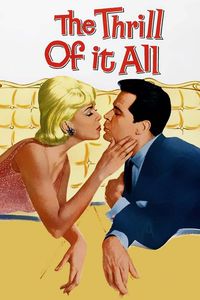
    (On Cable TV, February 2021) The life of a cinephile can be unpredictable: A few weeks ago, I was surprised to learn that no less serious filmmaker as director Norman Jewison had, early in his career, directed a romantic comedy like Send Me No Flowers. But it wasn’t the only Jewison romcom! Now here we are, taking in its immediate predecessor, the Doris Day/James Garner romantic comedy The Thrill of It All. Curiously enough, it’s a film with some clear social relevance today, as the satirical script (by Carl Reiner) is focused on a housewife who comes to be offered a lucrative contract lending her authenticity to a series of advertisements for a national brand… much to the dismay of her husband. There’s only one small step from there to the influencer lifestyle of today, with tensions within couples where the influencer suddenly becomes more famous than the other partner. While Day and Garner are terrific and often very funny in their roles, the film’s worst moments have to do with the male character demonstrating a mile-wide raw streak of fragile masculinity in the face of a more successful partner, intentionally putting her down in a twisted-logic kind of attention-seeking. This behaviour does make the third quarter of the film more difficult to get through than expected — if you want to skip from the car plunging into the pool to another car getting stuck in traffic, that may be best to avoid the whole unpleasantness. Still, it’s hard to resist Garner’s early-1960s squared-jawed charm, and Day is, as usual, the leading partner when it comes to comic timing. The film’s best satirical material is in wrestling with the nature of television advertisements, while Day proves game to do just about any indignity asked of her. For Jewison, The Thrill of It all is yet another example of his incredible variety as a director in a career that spanned five decades. The result is not entirely likable, but it’s well worth a look.

  • Boys’ Night Out (1962)

    Boys’ Night Out (1962)

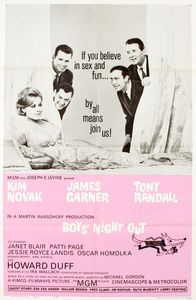
    (On Cable TV, January 2021) What I like about 1960s sex comedies is the very specific tone that they have, sufficiently freed from the Hays Code to tackle more salacious topics such as the ongoing sexual revolution, but still unwilling to be vulgar about it—it’s naughty without being upsetting and while I wouldn’t want to see that tone everywhere, it’s a welcome change of pace. The premise of Boys’ Night Out is simple, what with four men pooling their money to rent an apartment in Manhattan. If you want to compare eras and tone, keep in mind that there’s a 2014 “erotic thriller” called The Loft (itself a remake of a 2008 Dutch film) that shares that exact same premise—but the later R-rated film goes all-in on graphic content and murder. Boys’ Night Out is arguably funnier to modern-day audiences, as we can clearly picture where the film could but chooses not to go—because while our four men (three married, one divorced) may tell the others that they’re in for the young blonde “housekeeper” inhabiting the apartment, things are very different (and much funnier) once the married men get their night out: One simply wants to eat more than the health food prepared by his wife; another wants to talk without constantly being interrupted; the third simply wants to repair things around the apartment. Meanwhile, our divorced protagonist (the very likable James Garner) falls for the housekeeper and gets jealous of the achievements made up by his three friends. It’s all slightly naughty but not really, and the film does hit a good rhythm during its second third, especially when the “housekeeper” is revealed to be doing field research on a sociology thesis exemplified by the three married men. Boys’ Night Out offers a comic take on the Mad Men-ish era of henpecked husbands living the commuter train lifestyle, blunt gendered stereotypes and all. It does become less effective during its third act, as the comedy wears out while the film desperately tries to wrap up everything in a way that leaves everyone happy, wives included—the pace slows down considerably, and by the time the last fifteen minutes roll by, there aren’t any surprises left—just a drawn-out execution of something entirely predictable. Tighten that third act and it would be a much better film—but it serves well as a time capsule comedy, as a showcase for Kim Novak playing broad comedy, or another very similar film featuring Tony Randall in a very familiar role. Boys’ Night Out is fun and practically plays as family-friendly entertainment despite the subject matter, so innocuous is it in presenting its then-risqué subject matter.
  • Support Your Local Sheriff! (1969)

    Support Your Local Sheriff! (1969)

    (On Cable TV, October 2020) I don’t, as a rule, like westerns very much—the combination of overly familiar elements with an overall might-makes-right attitude has never sat very well with me, and you can make a fair argument that much of it boils down to basic differences between Americans and Canadians. It takes a lot to get me sympathetic to a Western, but Support Your Local Sheriff! manage to do so through a mildly comic treatment of the good old stranger-comes-to-town idea. Here, we have James Garner playing a confident gunsmith who takes up the sheriff’s job in a gold-rush town while he’s on his way to Australia—taming a rowdy town with little support from the town’s leaders. Perhaps the most interesting thing about Support Your Local Sheriff! is how it manages to be amusing without going to comedic extremes—this is tame material compared to Blazing Saddles, for instance, but the payoff is the ability to make compelling comic characters without turning them into absurdist caricatures. The film succeeds quickly at making us care for the characters, and once you have that, you can keep the same gently comic tone going until the end, as the film doesn’t necessarily rely on gags to keep going. Garner cuts quite a figure as the hero in a role tailored for him (he produced the film) — most modern comedies would have been tempted to make him incompetent, but here the laughs are better in following how he outsmarts the town. Meanwhile, Joan Hackett makes for a lovely romantic foil, with director Burt Kennedy being able to create a convincing small-town western atmosphere out of a meagre budget. I quite liked the result—it treats western with a lack of irreverence but not quite contempt, and it leaves viewers with smiles on their faces.

  • My Fellow Americans (1996)

    My Fellow Americans (1996)

    (In French, On TV, October 2019) There isn’t anything particularly sophisticated in My Fellow Americans, which features two bickering American ex-presidents going on the run after being exposed to malfeasance from the current administration. But it’s one great late-period opportunity for Jack Lemmon and James Garner to shine in comic performance as elder statesmen. The film eventually becomes a buddy road movie (complete with the mandatory shot of the two characters screaming, “Aaah!” while driving), taking them (mostly) undercover through America in an effort to get back to Washington and expose the plot before they’re killed. There’s an effective mixture of the high and the low here, with two revered figures often acting out like schoolboys. Despite the warring presidents from different parties, don’t expect much political relevance from a film that would rather settle for silliness rather than barbed satire. (It’s also from an era where you could actually respect [ex-] presidents no matter their affiliation, but we’re long past that point now.) Still, Lemmon and Garner make for a good comic pair, even when the rest of the film around them is trite and obvious. I half-enjoyed My Fellow Americans, which is more than I can say from most similar movies.

  • Grand Prix (1966)

    Grand Prix (1966)

    (On Cable TV, March 2019) As I continue my exploration of classic Hollywood cinema, I have a growing fondness for those movies that manage to capture something that existed then and doesn’t now. Movies with a big enough budget to fulfill their goals of immersing us in a world unlike our own. Movies such as Grand Prix, which takes us right in the middle of mid-1960s Formula 1 racing. Hop in the cockpit of a fast car, because we’re going for a ride! Director John Frankenheimer here manages the stunning feat of presenting an entire F1 season through distinct races, augmented by some stunning cinematography designed by none other than Saul Bass. Several sequences have an authentic feeling of speed and danger as we sit next to the driver, fly in helicopters, or witness impressively staged accidents. Even today, the racing sequences impress—and it’s amazing to realize that this was shot for real without CGI trickery—it would be almost impossible to restage Grand Prix with its period feel today (although Rush did come close), making it something that can never be surpassed even with today’s means.   It may not come as a surprise to find out that the narrative connective tissue between the races is far more conventional. There are only so many permutations of classic racing subplots, after all, and Grand Prix only has to put up enough connective tissue to get the next race with a bit of dramatic context. There is some serious acting talent on display here. Yves Montand is quite cool in a leading role, as is a young James Garner. None other than Toshiro Mifune makes a cameo as a Japanese racing team owner. Meanwhile, Jessica Walter is jaw-dropping beautiful as the romantic lead. Movies with intermissions usually have me wishing they were shorter, but not Grand Prix: this one is worth the near-three-hour running time. What an incredible film, even half a century later.