Jason Clarke

  • Silk Road (2021)

    Silk Road (2021)

    (On Cable TV, November 2021) As someone whose experience of the Internet goes back to the very early 1990s, I’ve had the chance to change my mind about it as it evolved. My early quasi-libertarian enthusiasm for the utter freedom of speech (and significant freedom of action) of the Internet’s early days has been tempered by some unpleasant realizations about social dynamics, epistemological tribalism and the need to behave as members of communities. As such, I have an axe and a half to grind about the spectacularly dumb idea of cryptocurrencies, the abuse of technology for illicit pursuits and communities that don’t incorporate at least some kind of moderation. All of which to say — I enjoyed Silk Road’s depiction of the eponymous dark web site’s foundation, but never so much as when it showed how the result blew up in its creator’s face. As it happens, I was at least semi-familiar with the broad outlines of the plot, having read the original article on which the film is based. As it sets up both a technological whiz-kid and a grizzled veteran cop as antagonists, I kept waiting for the unusual twist I remembered from the article. Still, the film doesn’t too badly as an Internet procedural, detailing in bite-sized doses what made Silk Road so special and why it evaded consequences for a while. Nick Robinson is suitably irritating as a young man with lofty misguided ideals who ends up realizing he’s not better than a common hoodlum, while Jason Clarke does get a nice turn as a traditional policeman who keeps up with the latest in online crime. (Meanwhile, Alexandra Shipp is eye-catching as the somewhat ineffectual voice of morality trying to get through to the tech-obsessed protagonist.)  There’s a steady forward rhythm and some darkly amusing sequences on the way to the third act… which is where it all comes down uncontrollably. Perhaps hampered by an overly slavish adhesion to the facts of the case, the climax of Silk Road seems to run out of steam rather than build to a dramatic climax. (It’s made even worse by a framing device that tells you where it’s going and doesn’t add too much to the initial impression.)  There doesn’t seem to be much made of the lead characters’ relationship, and you can almost sense the missed opportunities for a far more aggressive approach in handling the material, not to mention engaging in a confrontation between naïve ideals and real-world consequences. But maybe I’m asking too much of a film built as a run-of-the-mill cyber-thriller: Silk Road is too afraid to go beyond the facts of the case and start asking questions that we need to discuss.

  • Pet Sematary (2019)

    Pet Sematary (2019)

    (Amazon Streaming, September 2021) Stephen King’s Pet Semetary is often called his scariest novel and while there’s a bit of marketing in that moniker, it’s not completely undeserved. Part of its appeal is how it completely engages with some extreme, universal terrors: the death of a child, for one, and then the temptation to cheat nature and somehow reverse death. While the novel is a bit of a slow build, emotions eventually run high at a level that readers can understand: what parent, after all, wouldn’t go to extremes to bring back their child? It’s an incredibly strong concept, and it led to a first, perfectly serviceable movie adaptation in 1989. Nobody was really asking for a remake, but Hollywood has a logic of its own and that’s why we got one anyway thirty years later. Surprisingly, this Pet Sematary makes a few unusual but calculated bets that expect viewers to have seen the previous version. The slow build of the original is gone — the directors have crammed as many jump scares as possible in order to keep audiences from getting antsy. More significantly, the film is replete with foreshadowing, ominous portents and thematic call-forwards, suggesting to viewers familiar with the first film that the film expects them to hang on for the ride. Even better: this Pet Sematary makes a few changes that don’t deviate from the central atmosphere of the original, but keep viewers on their toes. The cat brought back from death is overly (almost ridiculously) evil; the kid that dies is not the same; the ending makes explicit the suggested bleakness of the original finale. In other words, if you’ve read the novel or seen the first film, you will have a sense that this version is in constant dialogue with the original works, and those who experienced all of them. It doesn’t necessarily make for a particularly better movie — at times, this Pet Sematary becomes irritating with its refusal to let the tension build naturally, not to mention its more formulaic nature—but it does add a bit more interest to what could have been a mediocre result. Jason Clarke’s not bad here in the lead, but it’s a bearded John Lithgow who gets some attention as the crusty old guy warning them (not very efficiently) about meddling with forces they don’t understand. But, of course, we know what is going to happen — it’s in the nature of the genre. In the end, this Pet Sematary ends up neither better nor worse than from the original, most visibly exemplifying the differences in approaches between the late 1980s and the late 2010s.

  • Everest (2015)

    Everest (2015)

    (On Cable TV, June 2016) This may sound ungrateful, but I’d expect a disaster movie about climbing the Earth’s tallest mountain to be a bit more … impressive. It’s not as if Everest is entirely missing in thrills: After reading a lot about Himalayan mountain-climbing, it’s fascinating to see a big-budget production head over to Nepal (even if only for a small portion of the shoot) and show us how it’s done. The capable group of actors assembled for the film is impressive, starting with the ever-impressive Jason Clarke and Jake Gyllenhaal as duelling climbers/entrepreneurs. Part of the film’s middle-of-the-road impression may be due to its insistence on sticking to a true story, the disastrous 1996 Mount Everest disaster spectacularly chronicled in Jon Krakauer’s Into Thin Air. Interestingly enough, Everest is not based on Into Thin Air, while Krakauer shows up as a non-heroic character. There’s a limit to the amount of drama (or, perhaps more accurately, audience-friendly dramatic structure) that can be generated from a film intent on sticking to facts, and Everest finds itself limited to the real story. Direction-wise, Baltasar Kormákur has fun with some set pieces, even though the story itself treads familiar ground. What’s often missing, though, is a sense of scale: For such a big mountain, Everest is too often glimpsed from too close and the film rarely delivers on the awe of the mountain-climbing experience. Regrettably, Everest’s strengths only highlight its limits: While it’s a decent travelogue, it should have been a more absorbing experience. I may, however, revisit this film in a few years to see if I’m being too picky.

  • White House Down (2013)

    White House Down (2013)

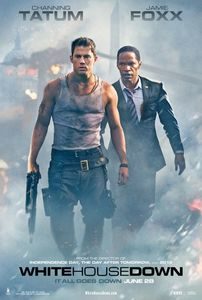
    (Video on Demand, January 2014) Director Roland Emmerich is a consummate entertainer, and showing White House Down alongside Olympus Has Fallen, the other great White-House-siege film of 2013, only serves to list why he’s so good at what he does: Good balance between action and humor, clean editing, just-enough character development and a willingness to go insane at appropriate moments… along with self-acknowledgement of outlandish material. The numerous points of comparison between both films only serve to highlight what White House Down does best: Channing Tatum is credible enough as the accidental hero (he’s got confidence without swagger, making him relatable), Jamie Foxx is just fine as a “47th president” clearly modeled after the 44th one, the “threat matrix” idea for the antagonist is ingeniously-executed, the action sequences are vivid without being gory, and the film manages to navigate a tricky line between national symbolism and overblown jingoism. White House Down‘s crowd-pleasing dynamism means that the film as a whole feels like one big competently-executed formula and that’s just fine: the film is easy to watch and enjoy, the only sour note coming late in the conclusion as another wholly-unnecessary antagonist is revealed with a Scooby-Doo-level lack of subtlety. The film is possibly never better than when it acknowledges its own presidential-lawn car chase absurdity with a well-placed “Well, that’s not something you see every day.” –although the “just like in Independence Day” quote comes close. Good turns by numerous supporting players (Maggie Gyllenhaal, Richard Jenkins, James Woods and a remarkable Jason Clarke whose character is best imagined as being exactly “that guy” from Zero Dark Thirty) add just enough to make the film even more enjoyable. While White House Down comes with the usual action-blockbuster caveats (formula all the way, and don’t think too much about it), it’s a remarkably successful example of what it tries to do, and it’s hard to give a better recommendation for this kind of film.

  • Zero Dark Thirty (2012)

    Zero Dark Thirty (2012)

    (On Cable TV, November 2013) Given the acclaim that Zero Dark Thirty received upon release (all the way up to Oscar nominations) and the interest in its premise, I frankly expected more than I got from the film.  Telling the story of the hunt for Osama bin Laden seemed essential given his decade-long bogeyman stature in the American psyche… but who expected a film about such a gripping subject to be, well, so dull?  Clocking in at a near-oppressive two-and-a-half-hour, Zero Dark Thirty takes forever to tell its story, underplaying some moments (such as the strike against CIA employees at Camp Chapman) while letting others take place in near-real time.  The pacing is tepid, and the basic tools of the film (cinematography, dialogue, direction) aren’t all that compelling either: For all the good that I think of her films up to and including The Hurt Locker, director Kathryn Bigelow’s work here seems more average than anything else, and does little to fight against the heaviness of the rest of the film. Fortunately, the performances are quite good: Jessica Chastain is splendid as the personification of the “Sisterhood” of CIA analysts that doggedly pursued bin Laden for more than a decade, while Jason Clarke is curiously compelling as a CIA interrogator.  As far as the gulf between fiction and reality is concerned, a look at the HBO documentary Manhunt should help clear up the historical liberties taken by Zero Dark Thirty –although viewers should be forewarned that Manhunt is considerably crisper and more compelling than its fictional counterpart.