Jean Arthur

  • The Silver Horde (1930)

    The Silver Horde (1930)

    (On Cable TV, June 2021) As much as I like the 1930s a lot as a filmmaking decade, it gets rougher the older you go, and The Silver Horde is perhaps most remarkable for reminding us of the awkward period during which silent cinema transitioned to sound. Among other obvious artefacts, we have title cards being used to simplify narrative development (why show when you can tell?), a sound mixing that often goes completely silent in between dialogue (without background noises or music), and a rigidity of camera work that betrays those early loud boxed-in cameras. This is all the more remarkable in that The Silver Horde takes on grand ambitions for its backdrop, heading to Alaska for some great outdoor sequences. The initial excitement at setting an adventure story way up north soon fades as the film heads for the interiors of Seattle and the familiar machinations of a romantic comedy in which women vie for lead actor Joel McCrae’s attention. There are a few highlights (including an action scene set aboard a fishing boat, nicely handled), but otherwise the film soon turns unremarkable, except when its technical limitations become apparent. While The Silver Horde technically qualifies as a Pre-Code film, it does not really feature any of the characteristics that film fans have come to associate with the era — there’s little in here that couldn’t have been executed in the same way a few years later. As such, The Silver Horde is a bit of a snore even at 75 minutes — it’s only mildly interesting in its plotting and is perhaps most notable for being one of McCrae’s earliest starring roles, and the first of his three on-screen pairings with Jean Arthur, also in an early role. The look at salmon fishing, however, does have a quasi-documentary interest.
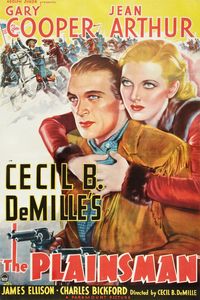
  • The Plainsman (1936)

    The Plainsman (1936)

    (On TV, January 2021) While I can appreciate individual westerns, I am not a genre western fan and a quick look at The Plainsman demonstrates why. Now best known as an amalgamation of historical mistakes and simplifications (so much so that there’s even an academic article cleverly arguing for its less-than-terrible authenticity) by notoriously loose director Cecil B. DeMille, The Plainsman plays like a who’s who of historical western figures even if they never significantly interacted or if the chronology doesn’t make sense (such as having Lincoln in the opening scene of a post-Civil War film). The film does score points for featuring big 1930s stars such as Gary Cooper and Jean Arthur, but the impact of the result is underwhelming. Part of it is having Western as a spectacle of American expansionism, which gets less effective one centimetre past the American frontier. It probably doesn’t help that The Plainsman is as plain as Westerns got at the time—let’s remember that the big revolution in western-as-a-deeper-genre came years later with Stagecoach. Until then, The Plainsman is still a western about the western, since it cares so little about the facts to make any impact as historical fiction. Both Cooper and Arthur were bland stars at their best, and this film doesn’t do much to make them look any better. (Although Arthur with a bullwhip is definitely something special.)  I strongly suspect that I’d like The Plainsman if I had more interest in western history, or even in westerns as genre. As such, it simply looks average—although the glut of much better westerns to come in later decades may work against even the best of what the 1930s had to offer.

  • The Talk of the Town (1942)

    The Talk of the Town (1942)

    (On Cable TV, February 2020) Heavier on the romance and lighter on the comedy, The Talk of the Town nonetheless remains a Cary Grant all-spectacular. The premise is archetypical enough, with an escape criminal finding refuge in the same cottage as a lawyer and the woman they both lust over. With Grant, Jean Arthur and Ronald Colman as the three points of the triangle, things quickly heat up. Grant remains utterly charming in the film’s mixture of laughs, suspense and romance—you would think that Colman would have trouble keeping up, but he does quite well in his inglorious role as the romantic rival. Worth noting: the jazzy opening sequence that crams a first act’s worth of exposition in a few minutes’ worth of spinning newspaper montages. Amazingly enough, the ending wasn’t decided until test screenings picked one romantic winner over the other. There are a few pacing issues, as well as some rough transitions from one tone to another, but The Talk of the Town remains a very satisfying blend of different things, with Grand, Colman and Arthur being equally enjoyable throughout it all.

  • The More the Merrier (1943)

    The More the Merrier (1943)

    (On Cable TV, November 2019) Sure, yes, you can watch WW2 military dramas all day long, but there was plenty going on at home during that time, and The More the Merrier takes as pretext the comparatively little-known wartime housing shortage in Washington, DC, during the war, as government needs rapidly expanded past the housing supply. While, in real life, this led to tension, overcrowding and bed-sharing, this romantic comedy uses the situation as a pretext to some silly shenanigans. Jean Arthur plays a woman subletting her apartment, while Charles Coburn is all scene-stealing twinkles as an older rich man subletting his half of her apartment to a suitable soldier played by the ever-affable Joel McCrea. Sparks fly in many different directions in a plot set in a very specific situation where eligible men are scarce and privacy is in even shorter supply. Arthur and McCrea make for a fine pair, but it’s Coburn who gets the best role here as an independently rich retiree who engineers their romance. (When the film was remade in the mid-1960s as Walk, Don’t Run, that role ended up being Cary Grant’s final turn.) While The More the Merrier isn’t particularly ambitious, it’s quite successful at managing the little bit of chaos it has created for itself. The ending doesn’t quite pull all of the threads together as tightly as it should, but don’t worry: Romance triumphs and everyone finds a place of their own. You can see why the film earned a Best Picture Academy Award nomination.

  • Only Angels have Wings (1939)

    Only Angels have Wings (1939)

    (On Cable TV, March 2019) There are a few Howard Hawks movies that I like better than Only Angels have Wings, but it does bring together a lot of what made Hawks such a compelling director. It’s a rip-roaring adventure featuring tough guys, as it focuses on a South American airmail company featuring intrepid pilots and dangerous planes. Cary Grant headlines the cast as the head pilot and manager of the small, almost bankrupt company. There’s some hope in the form of a new contract, but achieving it will mean death-defying mountain flying. As if that wasn’t enough, there’s romantic tension thanks to a newly arrived singer (Jean Arthur) and the protagonist’s ex-flame (Rita Hayworth). The mountain passes are treacherous and the planes are underpowered, but the mail must go through no matter how many special-effect crash sequences this means. Directed and partially written by Hawks, Only Angels have Wings clearly shows him working in his element, with a group of tough men and equally tough women working at the frontier of human ingenuity. The dialogue is smart, the pacing is fast, and there’s enough humour and romance to enliven what remains a manly adventure story. The special effects are surprisingly good and impressive for the time. The result is liable to fascinate early aviation fans, even despite the limited means of the time. Grant is his usual charismatic self, with good support from Arthur and a short but eye-catching role for Hayworth (in what is often considered her breakout film). An essential part of the Hawks filmography, Only Angels have Wings still has enough thrills and charm to be worth a look by twenty-first century audiences … like much of Hawk’s filmography.

  • Mr. Smith Goes to Washington (1939)

    Mr. Smith Goes to Washington (1939)

    (On Cable TV, February 2018) It’s practically impossible to be an American political junkie and not know about Mr. Smith Goes to Washington, given the film’s stature as a statement about the American political system and its iconic representation of James Stewart as a filibusterer. Curiously enough, though, I had never seen the film. Not so curiously enough, I had seen enough of James Stewart to be an unqualified fan of the actor even before watching Mr. Smith Goes to Washington. That may explain why I spent most of the film in a buoyant joy, watching one of my all-time favourite actor in a film that, perhaps now more than ever, still resonates as an eloquent paean to the ideals of American-style democracy despite the messiness of its practice. It wasn’t necessarily perceived as such, though—If I believe the contemporary snippets quoted on the film’s Wikipedia page, the film was initially condemned for its cynical take on the corruption of the system, and the idealistic nature of its protagonist’s struggles. But while such an approach may have shocked well-meaning commentators then, it may strike contemporary viewers as healthy informed idealism today. Corruption is a natural enemy of governance at all times (now more than ever, considering a current presidential administration that spins off a new scandal every three days) but a healthy government has ways to fight back, and it sometimes takes just one person with the right ideals to make things happen. I still think that the film ends without a satisfying coda, that Stewart’s character is initially presented as too much of a simpleton, and that we don’t see nearly enough of Jean Arthur. On the other hand, Frank Capra’s film remains just as sharp and compelling today as it was—even the climactic filibuster sequence, with its near-real-time popular manipulation and reaction, still plays exceptionally well in this age of constant news cycle. Mr. Smith Goes to Washington is an acknowledged classic for a reason, and you don’t have to be a political junkie nor a James Stewart devotee to understand why.