Jean Gabin

  • Le jour se lève [Daybreak] (1939)

    (On Cable TV, November 2022) I don’t particularly care for Le Jour se lève, but I can certainly admire its craft and chosen genre—anyone who loves film noir can’t help but be fascinated by the French poetic realism subgenre that shares so much of its DNA. The premise is admirably tight: After killing a man, the protagonist locks himself in this apartment and flashes back to the romantic relationship worth killing over even as the police surround the apartment and plan on breaking through. With Marcel Carné directing, Jacques Prévert writing and Jean Gabin in the lead role, this is one of the big French films of the 1930s. The combination between romance and crime is still effective, and brings to mind many later films. Amazingly enough, Le jour se lève was long thought lost—a combination of the Nazi regime and RKO’s efforts to destroy all copies of the film as so not to compete with the American remake The Long Night ensured that the film disappeared for a few years, only to re-emerge in the 1950s. It would have been quite a loss.
  • La bête humaine [The Human Beast] (1938)

    (On Cable TV, September 2022) For Hollywood film noir fans, La bête humaine’s main attraction is that it’s the film that inspired Human Desire, a pretty good 1954 Fritz Lang effort. As such, the original film is part of that group of French movies that led to film noir, the rough romantic crime poetry filtered through later post-war American sensibilities. Of course, compared to the slick cinematography of latter-day Hollywood, La bête humaine is coarser and blander. But writer-director Jean Renoir turns in a perfectly enjoyable effort, inspired but not beholden to the source Émile Zola novel—the biggest change being the focus of the film on a genre thriller narrative blended with romantic fatalism. It’s really not a feel-good film—and when you combine the film’s sentimental but merciless ending with Jean Gabin’s lead performance, you end up with something that would make a splendid double-feature with Pepe le Moko. That, or pair it with Human Desire—both are well worth watching together, if only to appreciate the subtle shifts in tone and atmosphere.

  • Pépé le Moko (1937)

    Pépé le Moko (1937)

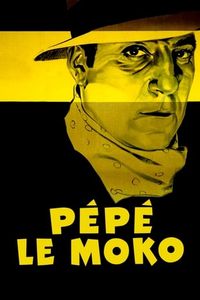
    (On Cable TV, October 2012) Often presented as part of the proto-film noir corpus, Pépé le Moko has a surprising aura of modernity about it—almost as if it was a 1950s film sent back twenty years earlier. In many ways, it prefigures the French Nouvelle Vague and its preoccupation with crime stories as a framework for character-driven moments. Here, we spend the film in Algiers, specifically in the labyrinthine Casbah where our titular character hides from the authorities. Pepe is an underworld prince—a master thief commanding respect and the attention of authorities seeking to flush him out. As the film begins, our protagonist gets stir-crazy from being confined in the same surroundings with the same woman for nearly two years. At the same time, another attractive woman passing through Algiers makes his acquaintance and the attraction is immediate. This obviously won’t end well (Pépé le Moko intentionally pushes things to poetic tragedy), but the way to get there is filled with a fascinating environment, intriguing characters, some good set-pieces and an approach that still feels compelling three-quarter of a century later. Writer-director Julien Duvivier makes a few good choices along the way, starting with casting Jean Gabin in the lead role. I was fascinated by some of the supporting characters—particularly the unusual beauty of Line Noro, and Lucas Gridoux as a cleverly shifty inspector. The ending shifts from crime thriller to romantic tragedy, but it does make sense—Duvivier is working in the French poetic realism tradition, and you can see in Pépé le Moko a springboard from that to the Nouvelle Vague. But even if you’re not quite up to speed in historical film movements, Pépé le Moko has enough to keep you interested from beginning to end.