Jean-Luc Godard

  • La chinoise [The Chinese] (1967)

    (On TV, July 2021) When I say that La chinoise reeks of the sixties, I’m being literal. I’m not paying a compliment to its atmosphere — I mean that thanks to its naturalistic portrayal of left-wing revolutionaries, you can actually imagine what they smelled like: a mixture of body odour, cigarettes and unrealistic expectations. Much of the film’s first section consists in having characters lecture the audience about the coming Marxist revolution, the evils of American foreign policy and what the Chinese are up to. It’s not quite as tedious as it sounds thanks to Godard’s hyperactive editing illustrating the monologues with jump cuts, skits, stock illustration and one rather catchy novelty song. Many scholars agree that La chinoise is when writer-director Jean-Luc Godard shifted gears from a semi-traditional form of filmmaking to a more politically charged career path. It also illustrated the preoccupations of the French left-wing just as the protests of May 1968 got underway, marking an unerring flair for current events. So, there’s some documentary value in having Godard chronicle (albeit not as a disinterested observer) the mood of the time and the tenor of the discourse. Of course, there’s a limit to how much of it is tolerable — the first section of the film is so basic in its filmmaking that it’s not hard to recall amateur YouTube video showing more talent in putting something similar together. The real film begins a bit later, as the characters (having spoken enough to the audience) get to speak to each other and carry bloodthirsty measures. Saying that I hated the characters by the end of the film would be incorrect, as I started loathing them well before then. What saves La chinoise from pure disgust (especially at the part where violence is proposed) is a thin veneer of humour that carries throughout — it’s not much, but at least it’s something. But as a deterrent against replicating the excesses of the French far left of the 1960s, it’s hard to think of a better example than La chinoise.

  • Une femme mariée: Suite de fragments d’un film tourné en 1964 [A Married woman] (1964)

    Une femme mariée: Suite de fragments d’un film tourné en 1964 [A Married woman] (1964)

    (On TV, July 2021) I’ve mentioned this a few times, but it still amazes me how often the French nouvelle vague can feel like a parody of itself. Ask any North American cinephile about their worst preconception of French cinema, and they’ll almost immediately reach for the clichés of a black-and-white dialogue fest in which the characters keep talking about life, love and sex. But many nouvelle vague films did correspond almost exactly to this cliché, and Une femme mariée is certainly one of them. The very slight plot has a married woman finally breaking off her affair with another man. But narrative is the least of writer-director Jean-Luc Godard’s concerns here — much of the film is a very typical blend of flat voiceovers, extended riffs, intertitles, semi-related images and conversations about various topics with a slight philosophical bent. I’m relatively lucky in that, while I don’t exactly hate that kind of filmmaking, I can listen to it without too much trouble. (I’m also understanding it in the original French, which helps — the translated subtitles, as competent as they are, flatten some of the dialogue.)  On the other hand, there isn’t much left once the film ends — it’s 94 solid minutes of meandering dialogue without much of a narrative point, and I suppose I’ll get to enjoy the film all over again if ever I get to see it again. Behind the scenes, there’s some interest in how the film was produced (in less than three months to meet a deadline) or the controversy that it attracted, even in France, for its then-racy dialogue and character behaviour. Still, Une femme mariée doesn’t do much to change my opinion of Godard or la nouvelle vague in general — it’s very much the kind of film that makes people wary of them both.

  • Le Redoutable [Godard Mon Amour] (2017)

    Le Redoutable [Godard Mon Amour] (2017)

    (On TV, June 2021) The French student protests of May 1968 in Paris still echo in the Francosphere’s cultural heritage, and there have been no dearth of movies portraying it, helped along by the considerable participation and sympathy of the filmmakers of La Nouvelle Vague to the cause. One of the newest entries in the subgenre is Le redoutable, a Jean-Luc Godard biopic that covers a few years in the filmmaker’s life, through his wedding and breakup with Anne Wiazemsky (who wrote the autobiography from which the film is adapted). As a portrait of Godard, writer-director Michel Hazanavicius (continuing his meta-cinematic obsession that led to the Oscar-winning The Artist) offers a portrait that’s both detailed and uncompromising: intellectually self-obsessed, lisping, not particularly communicative nor warm with his girlfriend and devastated by the events of May 68 that leave him politically unmoored, Godard is not a hero here. Louis Garrel takes on a titan of cinema as Godard, and the result is a treat for anyone, fan or foe, who knows about the Nouvelle Vague and wants another look at the events of May 68. While I’m not overly amazed by Le redoutable, I’m happy to have seen it and even happier that it exists at all — as a contribution to the corpus of cinema about cinema, it’s not a bad entry at all, and it resists the temptation to paint its subject as saint or villain. (I still like Truffaut a lot more.)

  • Vivre sa vie: Film en douze tableaux [My Life to Live aka It’s My Life] (1962)

    Vivre sa vie: Film en douze tableaux [My Life to Live aka It’s My Life] (1962)

    (Criterion Streaming, April 2021) At this point in my exploration of Nouvelle Vague cinema, I’m content to just let the movies wash over me, not trying too hard to find meaning or satisfaction in my film education. In Jean-Luc Godard’s halfway experimental Vivre sa Vie, we’re stuck with a young woman as her dreams of stardom as she leaves her husband and child to become an actress and, when that doesn’t pan out, gradually turn toward prostitution. Even before its gratuitously violent ending, Vivre sa vie is not meant to be an uplifting film — the protagonist’s descent through desperation is portrayed clinically, as she methodically has to abandon her dreams and, even then, has trouble surviving. Anna Karina (then Godard’s wife) is often impassible, as much of the film plays in her head. As a narrative, it doesn’t do much hand-holding — we’re left to infer much of the plot from clues and one showpiece sequence after another. There are intertitles, unconventional editing, jump cuts, deliberately artificial sets, an explicit shout-out to Jules et Jim, and what I’d call cinematic humour so dry as to be undistinguishable from style. This is a film of moments more than sustained storytelling: One montage scene tells us more than we’ve ever wanted to know about the legalities and practices of early-1960s prostitution in Paris. Another has Karina dancing around a pool table to the delight of viewers and disinterest of the characters sharing the room with her. One last highlight is a lengthy conversation between the protagonist and an older man on philosophical topics. Then there’s the hilariously violent scene that takes the film and (not without a bit of earlier foreshadowing, mind you) shoves it brutally into the crime genre, sparing no one. It’s going to linger in memory for sure, and it clearly shows Godard’s preoccupations in between other career landmarks, such as À bout de souffle and Le Mépris. Good? Bad? Who cares — it’s Godard.

  • Hélas pour moi (1993)

    Hélas pour moi (1993)

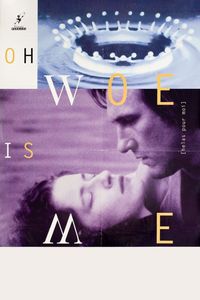
    (On Cable TV, February 2021) I had a surprisingly good time watching Hélas pour moi, but that came from an early decision to declare narrative bankruptcy on the film. Anything billed as a “poetic drama” in its log-line is usually a lost cause anyway — the only reason why I had a look at the result was because it was a late effort by writer/director Jean-Luc Godard. It only takes a few minutes into the film to realize that it’s not going to be understandable in any kind of conventional sense: it’s a film that plays on emotions, impressions, visual flourishes and allusions to philosophy and classical literature. Title cards separating the film in chapters or offering odd bits of narration only make the entire film feel even more hermetic if you’re not the director. Over time, I’ve come to make peace with the idea of film as an artistic expression of individual filmmakers (although the inherent elitism of film production costs leading to a class of film gatekeepers still rankles me), even if that does not mean that I’ll like the result. As the languid, pretentious, consciously self-absorbed nature of Hélas pour moi became obvious, I stopped trying to make sense of the film and let it wash over me. To be fair, there’s plenty to look at even if you’re not attempting to make sense of it — a young and trim Gérard Depardieu is the film’s headliner, but Laurence Masliah looks absolutely terrific here at times (the sequence in which she is introduced, off-focus to better feature her wild red mane is just… wow) and Aude Amiot looks nice as well. Are watching French girls a substitute for a strong narrative? Yes, if that’s all the film has. Still, Hélas pour moi does have a few good moments: thanks to Godard’s veteran eye, parts of the film can be appreciated even if you refuse to try to make sense of it. (I was tempted at times to see the film as a parody of a pretentious arthouse film, but it wasn’t worth the effort.)  I’m far, far from recommending the result, but it’s possible to find something to appreciate in nearly anything if you’re creative enough.

  • Bande à part [Band of Outsiders] (1964)

    Bande à part [Band of Outsiders] (1964)

    (Youtube Streaming, August 2020) When I think French Nouvelle Vague, I picture a vague mix of black-and-white cinematography, characters in a romantic triangle, the streets of Paris, references to Hollywood, and seemingly improvised philosophical discussions sometimes interrupted by the elements of a criminal subplot. In other words, I’m just about ready to designate Bande à part as the most new-wavish of the French New Wave movies. In writer-director Jean-Luc Godard’s hands, it features one woman and two men plotting a robbery in-between dancing at Parisian cafés, running through the Louvre and discussing Hollywood. It may feature budding criminals, but Bande à part qualifies as a genre-heavy crime film only by the loosest of definitions—it’s far more interested in the relationships and rambling discussions between the trio than the crime they’re planning to commit. As befit such an archetypical film, it has spawned numerous imitators from Tarantino (who practically worships the film and features a striking homage to its dance sequence in Pulp Fiction) to Bertolucci’s The Dreamers. For a cinephile, it’s interesting to see an influential film after its imitators and feel the mental click of puzzle pieces fitting together—it does help that Bande à part fully plays into nearly all of the clichés of its specific era of filmmaking: it’s an archetypical film, and perhaps best of all it’s curiously enjoyable as such—but then again most of Godard’s early movies are a charm to listen to once the characters get talking about such any subject. In the end, I’m not that overly enthusiastic about Bande à part… but I can see what the fuss is about.

  • Le mépris [Contempt] (1963)

    Le mépris [Contempt] (1963)

    (On Cable TV, July 2019) There are a few things colliding in Le Mépris. Writer-director Jean-Luc Godard shows us what happens when a marriage crashes into a film production, comparing the nitty-gritty of making a movie and the heightened melodrama of a suddenly disintegrating relationship. The film stars Brigitte Bardot in of her most dramatically challenging roles, as her picture-perfect sex-appeal bolsters her role as a woman who realizes that her husband is trying to sell her to a film producer in an attempt to get more money. Cue the titular but no less furious contempt. The anti-romantic plot thread is perhaps best exemplified by a very long sequence midway through the film in which the married couple argues in measured terms throughout their apartment—the kind of sequence that makes film students think about the use of space and character separation. The other subplot, about the multilingual production of a movie based on The Odyssey, is far droller: Featuring no less than Fritz Lang in an amusing role as the film director, it also stars a young Jack Palance as a hard-driving film producer who may or may not be interested in Bardot’s character. The banter here is far funnier than expected, what with a poor translator trying her best efforts to bring together a cast and crew speaking four languages, Lang arguing about the meaning of The Odyssey, and metatextual glimpses at a movie production. The blend of two tones and styles is provocative, especially when they literally involve a car crash at the climax, resolving a few plot threads in far too convenient a manner. Much of Le mépris is interesting; much of it is long—ultimately, it’s up to the viewer to pick and choose their favourite parts.

  • Pierrot le fou (1965)

    Pierrot le fou (1965)

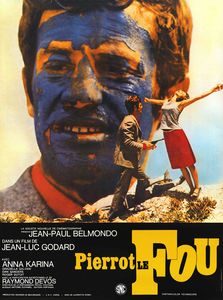
    (In French, On Cable TV, October 2018) I’m not working with the largest of reference pools when it comes to writer/director Jean-Luc Godard’s work, and so watching Pierrot le fou so soon after À bout de Souffle is a bit like going over much of the same terrain. Once again, we have a man (played by Jean-Paul Belmondo) on the run, pursued by violent forces, followed cinéma-vérité-style with a romantic relationship complicating everything, all leading to a tragic end. This is an overly reductive plot summary, but it does encapsulate my own similar reaction to the work. Except that Pierrot le fou isn’t quite as accomplished, as vital, as interesting as À bout de souffle. This being said, it’s Godard’s first colour film and clearly a more expensive production, which does have qualities of its own, slick and colourful. The presence of women and guns ensures that it’s not uninteresting, but it does have its annoyances, from free-flowing improvisational dialogue that doesn’t have the concision best suited to those kinds of films. I’m still glad I’ve seen it, but it’s one step shy of essential.

  • À bout de souffle [Breathless] (1960)

    À bout de souffle [Breathless] (1960)

    (Kanopy streaming, September 2018) I’m watching a lot of older movies these days, but it’s hard to predict how I’m going to react to them. I like the Old Hollywood style but I don’t like neo-realism, and I can be frustratingly inconsistent on my reactions to the French New Wave—speaking the language definitely helps, although not as much as you’d think given the Atlantic gap between French dialects. Still, I had a better time than expected watching À bout de souffle for a few reasons. The biggest one, I think is a combination between a then-experimental style and a now-familiar genre story: As our no-good anti-hero kills a cop and spends the rest of the film escaping his inevitable retribution, the film plays with editing in ways rarely seen outside Russia until the late 1960s—jump cuts shorten conversations, speed up the rhythm of the movie and introduce an element of nervousness for a protagonist on the run. (And yet, in a film renowned for its frenetic editing, the most impressive shot is an unbroken sequence in which the camera slowly rotates around a room, showing the introduction of two characters. This tends to support the assertion from some of the filmmakers that the editing was really something that came up during the post-production phase of the film.) Jean-Paul Belmondo is, inevitably, incredibly compelling as the murderous lead character, channelling Bogart cool but transforming it into charisma of his own. Writer/director Jean-Luc Godard’s abilities far outstrip his meagre budget, with the film feeling like a complete artistic vision rather than being hampered by budgetary compromises and guerilla-style filmmaking. Not all of À bout de souffle is good (some of the more philosophical or romantic interludes can feel as incredibly pretentious as some of the worst of the New Wave) but the high points are high, and there’s enough of a plot to sustain the attention of more conventionally driven viewers.

  • Alphaville, une étrange aventure de Lemmy Caution (1965)

    Alphaville, une étrange aventure de Lemmy Caution (1965)

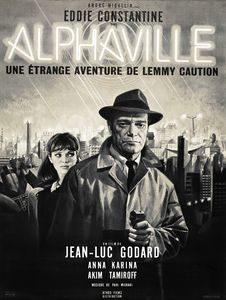
    (On DVD, August 2010) For a moment, I nearly hated this film.  Keep in mind that it’s a pure product of the French new Wave, which set out to challenge viewers’ expectations about the nature of films.  Here, writer/director Jean-Luc Godard takes the usual SF/thriller formula (ie; a secret agent sent to a foreign city to rescue/kill a scientist) and subverts every single facet of it.  Shot in black-and-white, the film makes references to SF plot points but blandly takes place in undisguised Paris, featuring sixties technology and clothing.  The pacing is glacial, the dialogues don’t quite make sense, the fight sequences are handled in a curiously lackadaisical fashion: clearly, it dares viewers to question themselves about what they’re expecting of a film –a process that remains as effective today than in 1965.  It quickly becomes obvious that Alphaville is as much a satire of lazy SF movies than an attempt to say something in a new way.  It’s not always enjoyable: I may have thrown my hands up in exasperation twenty minutes into the film, but the wonder of such experiments is that there’s always a reason to keep watching… just to see what else is in store.  Amazingly, Alphaville eventually clicks, not just as a screw-you to complacent audiences, but also as a modest piece of thematically deep SF filmmaking: Random flashes of equations, inverted nodding gestures ( “No” meaning “Yes” and vice-versa), disconnected bits of dialogue and heavy-handed dystopian clichés all pile up and fuse into a statement about humanity in the face of technological authoritarianism that works in part because it’s not presented like a genre film.  Other small pleasures abound, from some unusual camera work to Eddie Constantine’s wonderfully deadpan performance as the sort-of hero of the film, to a few eerie sequences that show how good SF doesn’t need special effects.  But Alphaville’s foremost quality is the very thing that makes it so unapproachable at times: The sense that a gifted filmmaker took a look at a genre and set out to mock it, while still using its techniques to examine his own artistic preoccupations.