Jeanne Crain

  • People Will Talk (1951)

    People Will Talk (1951)

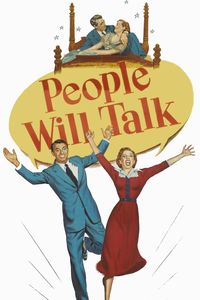
    (On Cable TV, May 2021) As much as I enjoy watching Cary Grant in every single film he’s made (well, maybe not Penny Serenade), I’m clearly done with the best and watching the rest in tackling People Will Talk. While the film is not a terrible one, I’m having a hard time deciding whether it’s a lower middle-tier or a higher lower-tier film. Here, Grant plays a doctor (a handsome one, naturally) who comes under scrutiny while working in a medical school. Mystery accompanies his earlier years, and the compassion he shows for others won’t stop an enemy from denouncing him to the authorities, lining up an inquiry with suspicious parallels to the McCarthy witch-hunts of the time. If the film has a hidden asset, it’s clearly writer-director Joseph L. Mankiewicz’s script. The acerbic dialogue is slightly toned down and the melodramatic plotting feels overdone, but the film nonetheless feels more ambitious than many of its contemporaries. A lot of heavy lifting is done by Grant’s natural charm in order to smooth over some of the film’s rougher edges, even if it doesn’t always work. Never mind the twenty-year age gap between him and his co-star Jeanne Crain—it’s the mixture of genres that doesn’t quite gel as comedy, romance, drama and mystery attempt to blend together. It’s not uninteresting to watch, but there’s a sense that something isn’t quite right with the results and that Mankiewicz could have used an editor to tell him where to focus. Grant is irreproachable but the film around him isn’t, and the result is something that doesn’t rank all that highly in his filmography despite intriguing elements.
  • Leave Her to Heaven (1945)

    Leave Her to Heaven (1945)

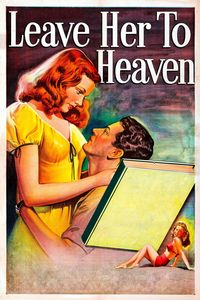
    (On TV, September 2020) The first half-hour of Leave Her to Heaven had me very, very confused—it’s a film noir, and yet I was served a Technicolor romantic drama about a man and his possessive new wife. While the images were spectacular (That lodge! Wow, that lodge!) and a foreboding prologue promised much, we were so deep in melodramatic territory that I found my attention slipping—Sure, Gene Tierney is always worth a look (although Jeanne Crain has her beat here), but would the film eventually get any better? And then it does, spectacularly. After a few arguments realistic enough to be uncomfortable, the film cranks it up midway through as a shocking death puts the female lead’s psychological cruelty to the forefront, and then it’s off to races as things get more and more convoluted for our likable protagonist. There are femmes fatales in film noir, and then there’s Gene Tierney’s character here, willing to plot revenge from beyond the grave in an effort to ensure that her husband will remain hers no matter what. By the end of Leave Her to Heaven, the film’s moniker as “the first Technicolor film noir” made complete sense—although I note with some amusement that it does provide a somewhat uplifting ending after so much misery. The blend of genres may be off-putting on a first viewing, but it does make the film stand out, even today, as something refreshingly different. Cornel Wilde is fine in the male lead role and Vincent Price does make a mark in a relatively short turn as a jilted then prosecuting attorney. But the film belongs to Gene Tierney, who was nominated for an Oscar for her performance. I’ll note that the film fits rather well in the “domestic thriller” subgenre of the era, albeit gender-flipped so that it’s the woman who is the threat rather than the husband. From an inauspicious beginning, Leave Her to Heaven does pack quite a punch in its later half. If you’re bored still after the first few minutes, keep watching—it gets much better.

  • Gentlemen Marry Brunettes (1955)

    Gentlemen Marry Brunettes (1955)

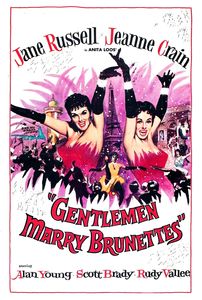
    (On Cable TV, April 2020) From the get-go, Gentlemen Marry Brunettes start with significant handicaps compared to its predecessor Gentlemen Prefer Blondes: Howard Hawks is not directing, Marilyn Monroe is not featured, and even the characters of the original film can’t return due to rights issues. At least Jane Russell is back, at least. What follows is a competent attempt at recreating the atmosphere and basic elements that ensured the success of the first film. It sort-of works, but we’re clearly more in a comfortable recreation than an attempt to build anything more ambitious. (Also: blackface.) The core conceit of having two girls gallivanting around Paris is there, as do musical numbers. Jane Russell does well here in a dual role as both the sister and niece of her own character in the first film, but it’s Jeanne Crain who impresses more in another dual role. The musical numbers are fun but rather forgettable, and the comedy is very light. Gentlemen Marry Brunettes is not terrible, but it’s clearly not up to the stratospheric level of the first film, and feels second-rate when measured against the kinds of musicals they were producing in the 1950s. And if you want to compare it to the first film, well — as a gentleman who usually prefers brunettes, in this case I vexingly have to give my vote to the blondes.