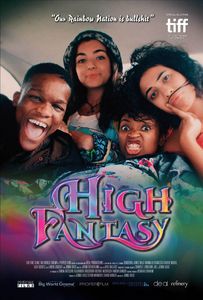
High Fantasy (2017)
(In French, On TV, February 2021) Messages should be part of popular entertainment. Art is self-expression, and artists who are not trying to tell others how they feel about the world are missing the point of art. But messages (especially political messages) are to be handled with a light touch: I’d rather play with ideas and viewpoint than being explicitly told who to vote for. So it is that writer-director Jenna Bass’s High Fantasy is often undone by its very reason to exist: a harsh, not especially optimistic look at race relations in late-2010s South Africa that often feels like an unfiltered, poorly-presented screed. I have to admire the high-concept at the heart of the movie: while on an outing in a rural area, four teenagers of different ethnicities somehow (it’s never explained) switch bodies, allowing them to explore being the other. By itself, it’s a lovely (if not entirely original) premise, and several writers would have been able to run for miles on this idea. The added wrinkle here is that our teenagers are from the influencer generation, meaning that the film is presented as found-footage of the trip, with the actors sharing writing and cinematography credits as they improvise and film themselves with their phones. The good news is that this means an intriguing, even provocative film on a threadbare budget. The not-so-good news is that High Fantasy often feels like a slapdash mixture of half-developed ideas, naturalistic cinematography (sometimes beautiful in taking in the natural landscape, but usually suffering from the usual indignities of amateur filmmaking), and bad dialogue. It gets even more irritating considering that for a group of friends heading out for a weekend of fun, nearly all of the shown dialogue is a political screed on racial issues and not the kind of stuff that friends would discuss among themselves. Yes, we understand the resentment between races in South Africa — yes, there are valid points to be made all around. But the unrelenting way those issues are always at the forefront quickly becomes annoying, especially since there seems to be no natural progression of ideas, simply the same topics raised in different ways. Here, I squarely suspect the improvised dialogue is to blame: there’s no building argument, logical synthesis or deliberate examination of facets here — it’s all thrown together, repeated and rehashed to the point where everyone and everything becomes irritating and juvenile. Even as a reality check on the illusions of Rainbow Nation, it’s better than nothing but still feels like a wasted opportunity. The lack of a clear climax is even more damageable — High Fantasy feels like a film without a point, which is too bad because it does have a lot to say.